AI Voice Agent Agency: How to Choose the Right Solution for Your Business
Find the right AI voice agent agency for your business. Explore automation, lead generation, appointment booking, and Voicecon AI solutions.
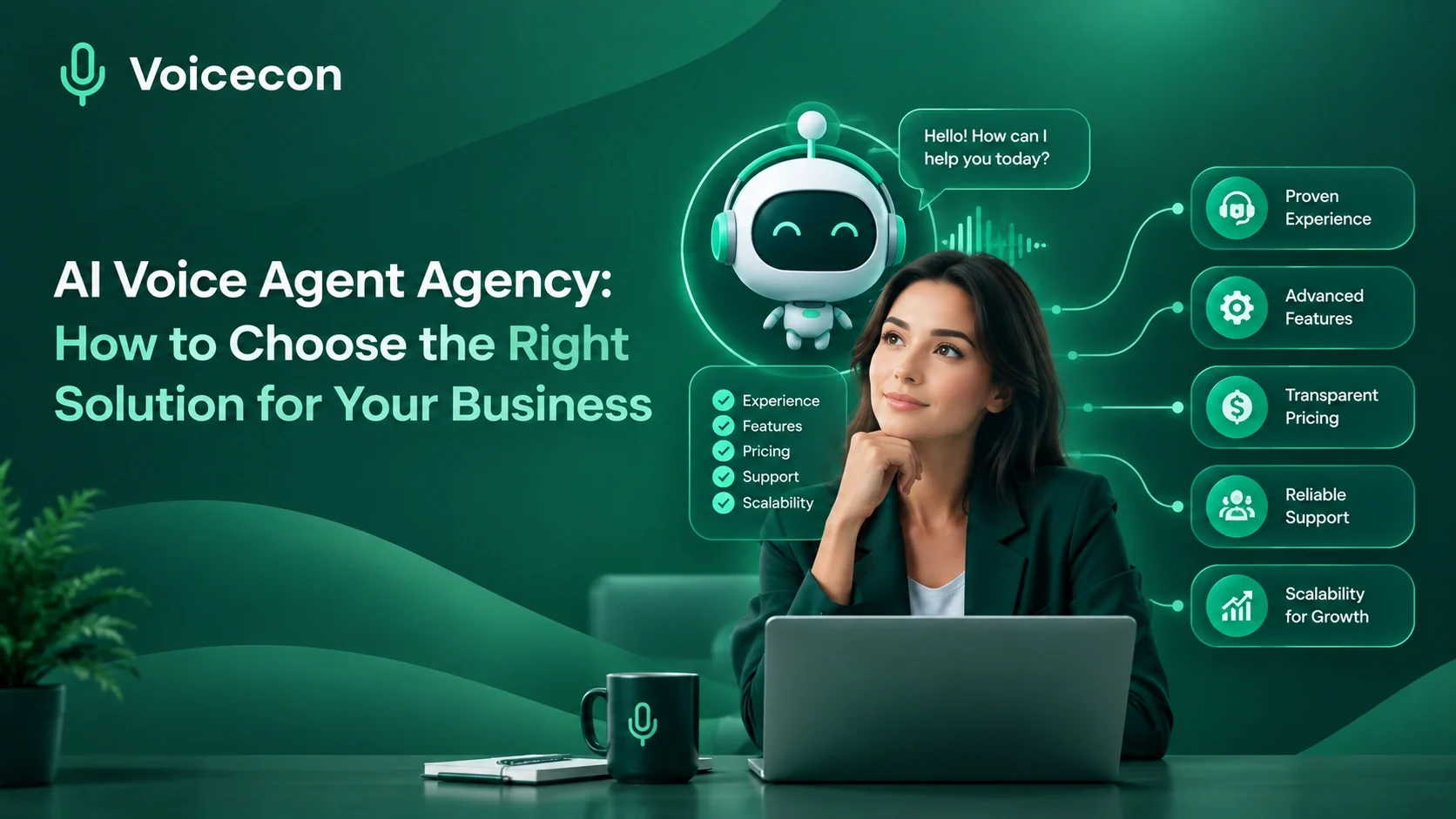
Businesses receive calls from prospective customers, existing clients, suppliers, and people who need support. When teams cannot answer every call promptly or follow up consistently, opportunities can be lost and employees spend valuable time on repetitive tasks.
An AI voice agent agency helps businesses design and deploy AI-powered phone agents that can understand spoken requests, respond conversationally, collect information, qualify leads, schedule appointments, and connect conversations with business workflows.
However, hiring an agency is not the only option. Some businesses need hands-on implementation and ongoing support, while others can build and manage their own AI voice agents using a dedicated platform.
This guide explains how AI voice agent agencies work, which tasks they can automate, what to evaluate before choosing a provider, how to estimate costs and return on investment, and how to approach implementation responsibly.
What Is an AI Voice Agent Agency?
An AI voice agent agency is a service provider that helps businesses plan, configure, integrate, deploy, and improve artificial intelligence systems that communicate with people over the phone.
Unlike a traditional automated phone menu, a conversational AI voice agent can interpret natural-language responses and use business information or connected tools to handle supported requests.
Depending on the provider and engagement, an agency may offer:
Strategy and discovery: Identifying repetitive calls, operational bottlenecks, and suitable automation opportunities.
Agent configuration: Defining the agent's role, tone, instructions, and conversation flow.
Knowledge preparation: Organizing approved business information, policies, FAQs, and service details.
Software integration: Connecting phone systems with CRMs, calendars, customer support platforms, and other applications.
Testing and deployment: Checking conversation quality, integrations, call transfers, and error handling before launch.
Monitoring and optimization: Reviewing performance, identifying failures, and refining workflows over time.
The exact scope depends on the provider. Some agencies deliver a fully managed service, while others configure a platform that the client's team operates afterward.
How does an AI voice agent work?
An AI voice agent combines speech recognition, language processing, conversation management, and speech generation. When connected to business systems, it can also retrieve information or perform approved actions.
A typical interaction follows this sequence:
A customer calls the business phone number.
The agent recognizes the caller's spoken request.
It interprets the request and responds using its instructions and available information.
If authorized, it checks a calendar, retrieves a record, qualifies a lead, or performs another supported action.
It confirms the result, transfers the call when necessary, or explains the next step.
The system records the outcome and may trigger follow-up automation.
For example, a customer might call a home-services company to schedule an estimate. The voice agent can collect the customer's location, identify the requested service, check available appointment times, and create a booking if the required integrations and permissions are configured.
The important distinction is that a useful voice agent does more than speak naturally: it completes a defined business task reliably.
What Can an AI Voice Agent Do for Your Business?
AI voice agents are most useful when calls follow recognizable patterns, the required information is available, and the desired outcome can be clearly defined.
1. Answer customer calls and common questions
An AI phone agent can answer routine questions about business hours, service areas, booking procedures, product information, and approved policies.
This can help businesses manage predictable enquiries outside normal operating hours or during busy periods.
For instance, a local service company could use an agent to explain which services it offers, collect a customer's requirements, and route complex enquiries to an employee.
The agent should not invent answers when information is missing. It needs a defined fallback, such as asking a clarifying question, offering a transfer, or recording a request for follow-up.
2. Qualify leads and support sales teams
An AI lead qualification agent can ask prospective customers relevant questions before passing the enquiry to a salesperson.
A typical workflow might collect:
Customer name and preferred contact details.
Product or service of interest.
Location or service requirements.
Desired timeframe.
Budget or other qualification criteria, when appropriate.
Preferred time for a follow-up conversation.
The agent can then create or update a CRM record and send a summary to the appropriate sales representative.
This helps teams prioritize enquiries using consistent criteria. It does not guarantee that every lead will be qualified correctly, so the business should monitor incomplete records, mistaken classifications, and missed escalation opportunities.
3. Book appointments and manage scheduling
Appointment booking is a practical use case for businesses such as salons, consultants, home-service providers, and other appointment-based organizations.
When connected to a calendar, an agent can check availability, offer real appointment slots, confirm the caller's selection, and trigger a confirmation message.
A reliable workflow should verify that the selected time is still available before confirming the booking. It should also handle cancellations, rescheduling requests, time zones, and situations in which no suitable appointment is available.
4. Automate post-call follow-up
A call does not always finish the work. Employees may still need to update a CRM, notify a colleague, send a confirmation, or create a support ticket.
A connected AI voice agent platform can automate these follow-up steps.
For example:
Caller → AI conversation → CRM update → Team notification → Follow-up task
This workflow reduces the need for employees to re-enter information manually, provided the integration is configured correctly and the agent collects the required fields.
5. Handle routine customer support
Voice agents can answer supported questions, collect diagnostic information, provide approved instructions, and direct customers to the correct department.
More complicated situations still need human involvement. Complaints, unusual account problems, sensitive personal information, and requests outside the agent's authority should have clear escalation rules.
The best implementation is not necessarily the one that automates the highest percentage of calls. It is the one that resolves suitable requests accurately while making it easy to reach a person when needed.
AI Voice Agent Agency vs. Platform vs. In-House Development
Choosing the right approach depends on your technical resources, operational complexity, budget, and need for ongoing support.
Evaluation factor | Managed agency | Self-service platform | In-house development |
Initial implementation | Provider-led | Customer-configured | Internal team-led |
Technical control | Depends on the contract | Depends on platform capabilities | Potentially high |
Internal workload | Often lower, depending on scope | Moderate | Often higher |
Custom integrations | Depends on the agency | Limited to available tools and APIs | Depends on internal capabilities |
Ongoing maintenance | May be included or separately charged | Usually managed by the customer | Managed internally |
Best fit | Teams wanting implementation support | Teams wanting direct control without building everything from scratch | Organizations with engineering capacity and specialized needs |
These are general patterns, not guarantees about every provider. Some platforms offer professional implementation services, and some agencies use configurable software rather than developing technology themselves.
When should you hire an AI voice agent agency?
A managed provider may be appropriate when:
Your workflow requires several systems to work together.
You have complex routing, qualification, or escalation requirements.
You lack the internal resources to design and maintain the system.
You need implementation assistance, testing, or continuing operational support.
Before signing a contract, clarify who owns the configuration, who monitors failures, which integrations are included, how usage is billed, and what happens if you change providers.
When is an AI voice agent platform a better fit?
A platform can be attractive when your use case is reasonably well defined and your team wants to build, test, and adjust agents directly.
Look for tools that support configurable prompts, knowledge bases, phone numbers, integrations, visual workflows, call recordings, analytics, and human transfers as required by your use case.
For example, Voicecon provides a platform for building AI voice agents and connecting calls with no-code workflows. Its documented features include knowledge bases, call flows, call records, analytics, and integrations with business applications.
Explore the Voicecon AI voice agent platform to see whether its capabilities fit your intended workflow.
How to Choose the Right AI Voice Agent Provider
Do not choose a provider based only on the naturalness of its voice or the number of integrations advertised. Evaluate whether the system can complete your real business tasks.
1. Define the business outcome
Start with one specific problem.
Examples include answering after-hours calls, qualifying inbound leads, booking appointments, or recording support requests.
Document the current process, expected result, exceptions, and the point at which a human must take over.
2. Verify integration capabilities
Confirm that the provider can access the systems required for your workflow.
Check whether the integration can perform the exact action you need, not merely connect to the application. For example, a CRM connection may support contact creation but not every custom field or workflow trigger.
Ask how failed integrations are detected, retried, and reported.
3. Test knowledge accuracy
Give the agent representative questions drawn from real business enquiries.
Include straightforward questions, ambiguous requests, missing information, unusual cases, and questions that should not be answered without additional verification.
Check whether the agent uses approved information and admits uncertainty rather than fabricating details.
4. Evaluate call quality and recovery
Test interruption handling, response delays, accents, background noise, repeated questions, and callers who change their minds.
Also test what happens when the agent misunderstands a request, a connected system becomes unavailable, or a caller asks to speak to a person.
5. Review privacy, security, and ownership
Ask where recordings and transcripts are stored, who can access them, how long they are retained, how they can be deleted, and which third-party services process the information.
Review access controls, data-processing terms, integration permissions, and procedures for handling a suspected security incident.
6. Understand the total cost
Request a breakdown of subscription fees, telephony, AI usage, setup, integrations, maintenance, and any charges for exceeding included allowances.
Compare providers using the same expected call volume and workflow complexity. A low advertised rate is not necessarily the lowest total cost.
How Much Does an AI Voice Agent Cost?
There is no single price for an AI voice agent agency or platform. Costs depend on call volume, conversation duration, model and voice services, phone connectivity, integration requirements, implementation support, and ongoing maintenance.
A useful budget should separate the following components:
Subscription: The recurring fee for the platform or managed service.
Usage: Charges associated with call minutes, AI processing, speech services, messaging, or telephony.
Implementation: Discovery, configuration, integration, testing, and training.
Maintenance: Monitoring, workflow changes, troubleshooting, and optimization.
Additional services: Custom development, premium support, or specialized requirements.
Voicecon's publicly listed pricing section has advertised a seven-day free trial and 4 different paid plans. Check out our pricing section before budgeting.
When comparing providers, ask for a realistic monthly estimate based on your anticipated call volume, average duration, integration needs, and required support.
How to Calculate AI Voice Agent ROI
A practical evaluation compares the cost of the AI solution with measurable operational benefits.
Start with three metrics:
1. Cost per successfully resolved call
Cost per resolved call = Total operating cost ÷ Number of successfully resolved calls
2. Appointment booking rate
Booking rate = Appointments booked ÷ Eligible calls × 100
3. Qualified lead rate
Qualified lead rate = Qualified leads captured ÷ Eligible lead calls × 100
Use a consistent definition of a successful resolution. A call that ends without a complaint is not necessarily a completed task.
An illustrative ROI example
Suppose a business receives 1,000 eligible calls per month and successfully resolves 600 through its voice agent. Assume the total monthly operating cost is $300.
The cost per successfully resolved call would be:
$300 ÷ 600 = $0.50 per resolved call.
This is an illustrative calculation, not a claim about Voicecon's actual performance or industry averages.
To estimate broader financial value, compare the total solution cost with measurable savings and incremental gross profit. Include employee time actually saved, additional completed bookings, and qualified leads that convert into sales. Avoid counting the same benefit twice.
A simple net benefit calculation is:
Net monthly benefit = Measurable monthly benefits − Total monthly solution cost
If you want a percentage return, divide the net benefit by total solution cost and multiply by 100. Use a consistent measurement period and include one-time setup costs when evaluating payback.
How to Implement an AI Voice Agent in Five Steps
Step 1: Choose a narrow use case
Start with one workflow that occurs frequently and has a clear outcome. An after-hours answering agent or appointment-booking agent can be easier to evaluate than a system expected to manage every possible customer conversation.
Step 2: Prepare approved business information
Collect current FAQs, service details, pricing policies, business hours, escalation contacts, and relevant procedures.
Remove contradictory or outdated information. Specify which topics the agent may answer and which require a human.
Step 3: Configure the conversation and integrations
Define the opening message, required questions, allowed actions, decision branches, and fallback behavior.
Connect the necessary calendar, CRM, phone number, or messaging service. Give the agent only the access required for its task.
Step 4: Test before going live
Run test calls covering ordinary requests, ambiguous questions, interruptions, failed integrations, and human-transfer requests.
Verify not only what the agent says but also whether the correct records, bookings, and notifications are created.
Step 5: Monitor and improve
Track call outcomes, successful resolutions, transfer rates, incorrect answers, booking accuracy, cost, and customer feedback.
Review unsuccessful calls regularly. Update the agent's knowledge and instructions based on recurring problems, then retest the affected workflows.
Compliance, Privacy, and Human Oversight
AI phone automation should be designed around applicable legal requirements and customer expectations.
In the United States, the Federal Communications Commission's 2024 declaratory ruling confirmed that AI-generated voices fall within the Telephone Consumer Protection Act's restrictions on artificial or prerecorded voice calls. Applicable consent requirements and exceptions depend on the circumstances, including the type and purpose of the call.
See the FCC's official declaratory ruling for the relevant legal context.
Businesses operating in the United States, United Kingdom, Canada, and Australia should separately assess applicable requirements for automated calls, telemarketing, consent, call recording, personal information, and data retention. Obtain qualified legal advice for the intended use case rather than assuming that a platform's technical capabilities establish compliance.
Good operational safeguards include:
Identifying the business and using appropriate AI disclosures where required or appropriate.
Obtaining and recording the required consent before covered calls.
Respecting applicable do-not-call, opt-out, and contact-preference requirements.
Providing a practical route to human assistance.
Restricting access to recordings, transcripts, and customer records.
Setting retention and deletion policies.
Testing the agent's behavior when information is missing or a tool fails.
A voice agent should not be given unrestricted authority to make consequential decisions or disclose sensitive information. Define its permitted actions and escalation boundaries before deployment.
How Voicecon Supports AI Voice Automation
Voicecon offers a platform for creating AI voice agents and connecting conversations to business workflows. Rather than treating a call as an isolated interaction, its product combines agent configuration, knowledge bases, live-call tools, integrations, and post-call automation.
According to its product documentation, Voicecon supports:
Configurable voice agents and visual call flows.
Business knowledge bases for answering approved questions.
Phone numbers and integrations with Twilio or Telnyx.
Live-call actions such as transferring calls, sending messages, and triggering workflows.
CRM, scheduling, productivity, and automation integrations.
Call recordings, transcripts, summaries, and analytics.
No-code workflows triggered by completed calls, schedules, webhooks, or manual actions.
These capabilities can support workflows such as lead qualification, appointment booking, customer support, and order-status enquiries, provided the necessary data access and integrations are configured.
Voicecon is a platform rather than automatically a substitute for every managed agency service. If your business requires bespoke consulting, complex implementation, or ongoing managed operations, confirm the available support and scope before making a decision.
Ready to explore AI voice automation? Visit Voicecon.ai to review its capabilities, evaluate the available plans, and test whether the platform fits your business process.
Frequently Asked Questions
What does an AI voice agent agency do?
An AI voice agent agency helps businesses plan, configure, integrate, deploy, and optimize AI-powered phone agents. Depending on the engagement, it may also provide workflow design, testing, maintenance, and ongoing support.
What is the difference between an AI voice agent agency and an AI voice agent platform?
An agency generally provides services and implementation expertise, while a platform provides the software used to create and operate voice agents. Some businesses use a platform independently; others engage a provider to implement it.
Can AI voice agents book appointments and update CRMs?
Yes, when the agent has the necessary calendar or CRM integration, permissions, and workflow configuration. The implementation should verify bookings and record updates rather than assuming every action succeeds.
Are AI voice agents suitable for small businesses?
They can be suitable for small businesses with recurring call patterns, predictable questions, appointment scheduling, or lead qualification needs. Suitability depends on call volume, implementation effort, reliability, cost, and the availability of human support.
How much does an AI voice agent cost?
Pricing varies by provider, usage, implementation complexity, integrations, and support. Compare the full operating cost rather than relying solely on a monthly subscription or advertised per-minute rate.
Can an AI voice agent replace a human receptionist?
An AI voice agent can handle some routine answering, information collection, and scheduling tasks. It may not be appropriate for sensitive complaints, unusual requests, complex decisions, or interactions that require human judgment. Many businesses use a combination of automation and human assistance.
Are AI-generated phone calls legal?
Their legality depends on the jurisdiction, call purpose, recipient, consent, disclosure requirements, and other applicable rules. In the United States, the FCC has confirmed that AI-generated voices are covered by relevant TCPA restrictions on artificial or prerecorded voice calls. Businesses should review the laws applicable to each calling scenario before deployment.
How can I measure whether an AI voice agent is working?
Track successfully resolved calls, booking accuracy, qualified leads, transfer rates, error rates, customer feedback, cost per resolved call, and total operating cost. Compare results with a reliable baseline and review performance over time.
Conclusion
An AI voice agent agency can help a business turn repetitive phone conversations into structured workflows, but the right solution depends on more than how realistic the voice sounds.
Businesses should evaluate implementation support, integrations, knowledge accuracy, escalation, security, operating costs, and measurable outcomes before committing to a provider.
For teams that want to build and manage their own AI phone workflows, Voicecon offers a platform that combines voice agents with connected applications and no-code automation.
Start by identifying one repetitive call process, define what success looks like, and test the proposed workflow against realistic scenarios. That approach makes it easier to assess whether AI voice automation is a practical investment for your business.
Want to learn more about AI voice agents? Explore these related articles to discover how they work, what they can do, and how they can transform your business.
How AI Voice Agents Handle Real-Time Phone Conversations
IVR vs AI Phone Agent: Comparison, Features, Benefits, and Which One Fits Your Business
Keep reading
All articles → Guides
13 min read
AI Voice Agents for Customer Service: Benefits, Use Cases, and How to Choose
Discover how AI voice agents for customer service answer calls, automate support tasks, connect with CRMs, and hand complex issues to human agents. Try Voicecon AI Agents free for 7 days.
 Guides
13 min read
AI Answering Service: How Businesses Can Automate Calls with Voicecon AI
Never miss a customer call again with our AI answering services. Voice On AI answers your phone, chats with leads, handles routine tasks, and keeps your team in the loop.
 Guides
10 min read
Outsource Receptionist Services: A Complete Guide for Businesses of All Sizes
Discover how to outsource receptionist services, compare AI voice agents with virtual receptionists, and choose the right phone answering solution for your business.