Outsource Receptionist Services: A Complete Guide for Businesses of All Sizes
Discover how to outsource receptionist services, compare AI voice agents with virtual receptionists, and choose the right phone answering solution for your business.
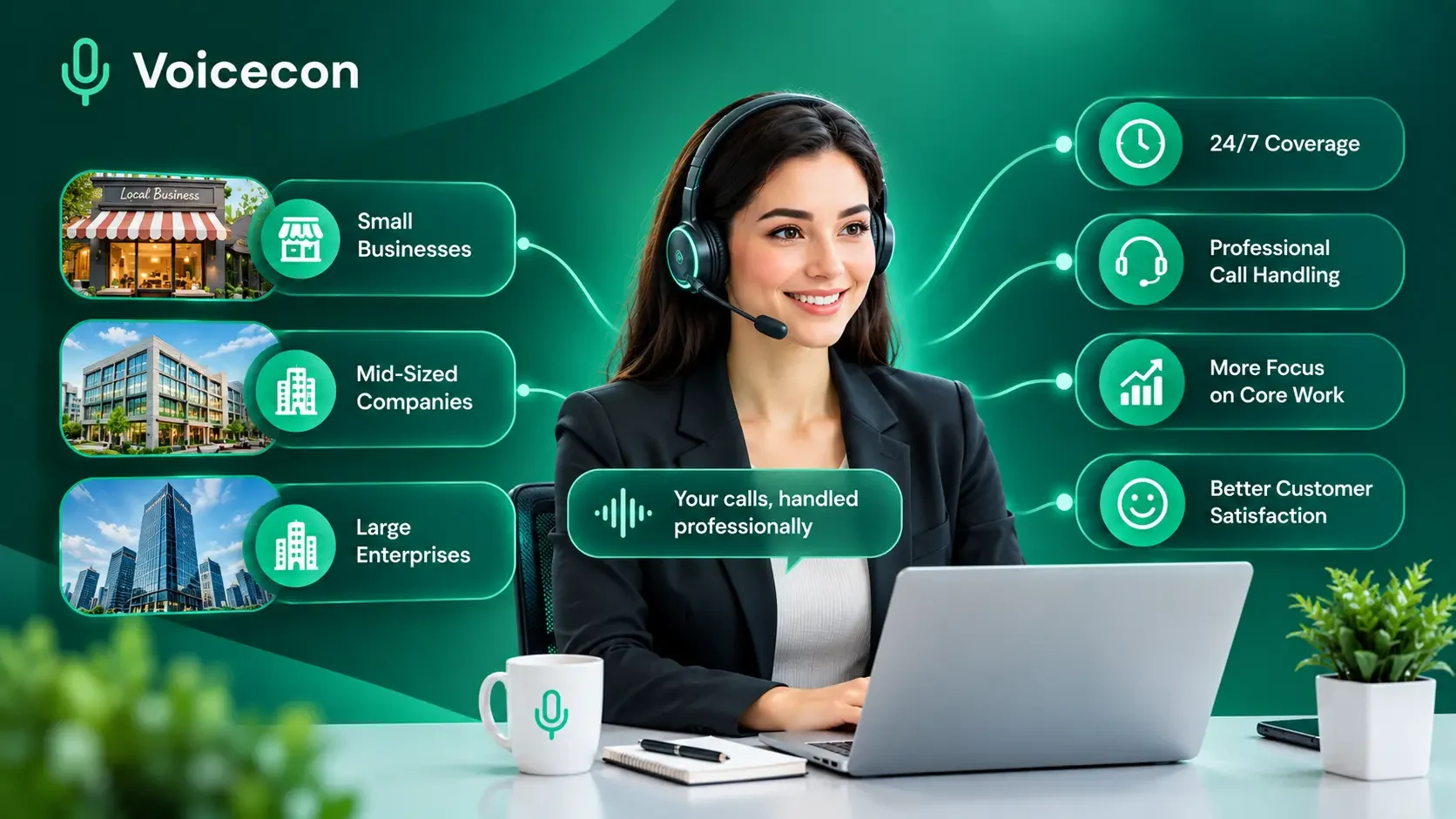
When you outsource receptionist services, you give another person or technology platform responsibility for handling some or all of your business phone calls, helping customers reach the right information without requiring your in-house team to answer every call. For small businesses, clinics, restaurants, and inbound call centers, the right solution can improve call coverage, reduce repetitive administrative work, and help turn inquiries into completed actions.
But outsourcing reception does not always mean hiring a remote human receptionist. Businesses can choose a traditional answering service, virtual receptionists, an AI-powered phone answering service, or a combination of human support and automation.
The best option depends on your call volume, customer expectations, budget, workflows, and the complexity of the conversations you handle.
What Does It Mean to Outsource a Receptionist?
To outsource a receptionist means assigning front-desk communication tasks to an external service rather than handling every interaction internally. Depending on the provider, those tasks may include answering calls, taking messages, routing callers, collecting basic information, and scheduling appointments.
An outsourced receptionist can help businesses maintain professional phone coverage when employees are busy, unavailable, or focused on other responsibilities.
What outsourced receptionists typically handle
Common tasks include:
Answering incoming calls with a business-specific greeting.
Responding to frequently asked questions.
Capturing caller names, contact details, and inquiry information.
Routing calls to the correct department or employee.
Scheduling appointments or reservations when connected systems support it.
Sending call summaries and notifications to staff.
Handling after-hours inquiries and overflow calls.
Not every service includes every function. A basic answering service may primarily take messages, while a more advanced solution can support scheduling, lead qualification, and call transfers.
Before choosing outsourced receptionist services, identify the tasks you want to delegate and confirm that the provider can perform them reliably.
Human virtual receptionists vs. AI voice agents
Human virtual receptionists are remote professionals who answer calls on your company's behalf. They can offer personal interaction, use judgment in unfamiliar situations, and adapt to callers who need additional reassurance.
AI voice agents use conversational technology to respond to callers, follow configured instructions, retrieve approved business information, and trigger supported workflows. Depending on their configuration and integrations, they may also route calls, collect information, or help schedule appointments.
Consideration | Human virtual receptionist | AI voice agent |
Caller interaction | A real person | An automated conversational agent |
Routine questions | Handled by trained staff | Handled using configured instructions and information |
Call volume | Depends on staffing and service capacity | Depends on platform capacity, configuration, and usage limits |
Scheduling and follow-up | Depends on the service and connected tools | Depends on integrations and workflow setup |
Unusual or sensitive conversations | Human judgment is available | May require escalation to a person |
Main evaluation factor | Service quality and staffing coverage | Accuracy, reliability, integrations, and total cost |
Neither option is automatically best for every business. Human support may be preferable when conversations are emotionally sensitive or highly unpredictable. AI can be useful when many calls follow repeatable patterns and the business wants those conversations connected to automated workflows.
Why Businesses Outsource Receptionist Tasks
Reduce interruptions and improve call coverage
Every incoming call competes with another business activity. A clinic employee may be helping a patient, a restaurant manager may be handling a rush, and a sales representative may be speaking with a qualified lead.
A phone answering service can help cover these periods so calls do not depend entirely on whoever happens to be available.
Coverage can include business hours, after-hours calls, lunch breaks, busy periods, or overflow when internal staff are occupied. Actual availability depends on the service plan and configuration.
Turn routine calls into completed tasks
Answering a call is only the beginning. Customers often expect the business to do something next.
For example, a caller may want to book an appointment, check a restaurant's opening hours, request a callback, or speak to a sales representative. An effective receptionist workflow should capture the request and move it toward completion.
Voicecon AI is designed around this distinction. Our voice agents can answer questions from a business knowledge base that you provide, transfer calls, interact with connected tools, and trigger workflows for actions such as CRM updates, meeting bookings, and team notifications.
Which Outsourced Receptionist Option Is Right for Your Business?
Clinics and healthcare practices
Clinics receive appointment requests, scheduling changes, directions inquiries, general administrative questions, and calls that may need prompt human attention.
An AI receptionist may help handle approved routine questions, gather limited appointment-request information, or direct callers to the appropriate team. A human receptionist may be better suited to complex patient concerns, nuanced conversations, and situations requiring judgment.
For example, a clinic might configure a phone agent to answer questions about office hours and collect appointment preferences, while transferring clinical questions and urgent concerns according to a clinician-approved escalation policy.
Healthcare businesses should assess privacy and security before sending patient information through any external answering service. In the United States, HIPAA obligations may apply depending on the organization, information, and service relationship. Confirm whether the provider supports the necessary safeguards and contractual arrangements before using it for protected health information. Never assume that an AI product is HIPAA-compliant simply because it serves healthcare customers.
Restaurants and hospitality businesses
Restaurants often receive calls about opening hours, menus, reservations, dietary information, takeaway orders, and directions.
An outsourced receptionist can help manage these repetitive inquiries while staff focus on service. An AI voice agent may be useful when the business has clear answers and a reliable process for confirming reservations or other requests.
For instance, a restaurant could configure an agent to answer opening-hours questions and explain reservation procedures. If the agent is connected to a suitable booking system, it may also assist with reservations. If no such integration exists, it should collect the request or transfer the caller rather than claim a booking has been confirmed.
The same principle applies to menu availability and special requests: the agent should provide only information that the restaurant has approved and can keep current.
Inbound call centers and customer service teams
Inbound call centers often handle repetitive questions, routing requests, account inquiries, order-status questions, and lead qualification.
An AI voice agent can support these processes by answering approved questions, collecting relevant details, routing calls, and sending summaries to the systems a team already uses.
A practical hybrid model is to let automation handle predictable requests and transfer complicated cases to human agents. Clear escalation rules are important: callers should be able to request a person, and the system should recognize situations it cannot resolve safely or accurately.
How Much Does It Cost to Outsource a Receptionist?
The cost of outsourcing a receptionist depends on the service model, call volume, coverage hours, included features, integrations, and the amount of human support required.
A traditional answering service may charge according to a monthly plan, call volume, or usage. An AI voice agent may involve subscription fees, usage-based charges, telephony costs, and setup or integration work. Pricing structures vary, so compare actual provider quotes rather than assuming one model is always cheaper.
Calculate the total cost before choosing
Use this simple framework:
Monthly total cost = service fees + usage and telephony + integrations and maintenance + human escalation costs.
Then compare that figure with your current cost of handling calls internally.
For an illustrative example, suppose a business receives 600 calls a month and spends an average of four staff minutes handling each call.
600 calls × 4 minutes = 2,400 minutes, or 40 staff hours per month.
If the business can automate a portion of those calls reliably, the potential time released is:
Monthly staff hours released = calls handled automatically × average handling time ÷ 60.
This is a capacity estimate, not a guaranteed saving. Some calls will still need staff attention, and the business may retain its existing employees rather than reduce payroll.
Evaluate the quality of the customer experience alongside the financial result. A low-cost service that gives incorrect answers, loses booking requests, or frustrates customers may be a poor investment.
How to Choose an Outsourced Receptionist Service
Before committing to a provider, work through the following checklist.
Define your call types. Separate frequently asked questions, booking requests, sales inquiries, urgent issues, and calls that require a person.
Set clear success criteria. Measure answered calls, successful task completion, correct transfers, caller satisfaction, and the rate of unresolved requests.
Check integrations. Confirm that the service works with your calendar, CRM, reservation system, or customer support tools. Verify the exact actions it can perform.
Test real scenarios. Include interruptions, unclear speech, unexpected questions, booking changes, and requests for a human agent.
Establish escalation rules. Specify when calls must transfer to staff, what information can be collected, and what the agent must never promise.
Review privacy and security. Ask how recordings, transcripts, personal information, access permissions, and retention are handled.
Compare the full cost. Include service fees, usage, integration work, maintenance, and any staff time needed to review exceptions.
Run a controlled pilot. Start with a limited set of calls, review outcomes, fix problems, and expand only after the system performs acceptably.
Businesses operating in the USA, Canada, and Australia should also check the privacy, consent, recording, and sector-specific rules that apply to their particular operations. Canadian businesses, for example, should review the Office of the Privacy Commissioner's Privacy Guide for Businesses. Requirements can vary by jurisdiction and activity.
How Voicecon AI Helps Automate Business Phone Calls
Voicecon AI offers a way to build conversational phone agents that connect customer conversations with business workflows.
Our AI Voice agent platform supports configurable voice agents, business knowledge bases, visual call flows, call transfers, recordings and transcripts, analytics, and integrations with supported applications. Our listed integration ecosystem includes tools for scheduling, CRM, messaging, and automation.
For al business, a potential workflow might look like this:
A customer calls with a routine question or booking request.
The agent answers using approved business information.
The agent collects the required details or uses a supported tool to complete the task.
The workflow sends a summary to the relevant system or alerts the team.
If the request falls outside the agent's instructions, it follows the configured escalation process.
This model can be useful when the business wants more than a message-taking service. However, successful booking, accurate answers, and reliable call transfers depend on configuration, integrations, and testing.
To explore our AI agent platform, visit Voicecon AI. We are currently offering a seven-day free trial with no credit card required.
Frequently Asked Questions
Can a business outsource receptionist services after hours?
Yes. Many answering services offer after-hours coverage, while AI voice agents can be configured to answer calls outside normal business hours. Confirm the provider's availability, operating limits, and escalation arrangements before relying on it overnight.
Is an AI receptionist suitable for a small business?
It can be suitable when calls involve repeatable questions, information gathering, routing, or supported booking tasks. A small business should first assess its call patterns, integration requirements, customer expectations, and the need for human backup.
Can an AI receptionist book appointments and transfer calls?
It may be able to do both when the platform supports the required tools and integrations and the agent is configured correctly. Test the entire workflow, including confirmation messages, calendar updates, transfer failures, and fallback procedures, before putting it into production.
What should clinics check before using AI call answering?
Clinics should review data handling, vendor contracts, access controls, retention, recording practices, and applicable healthcare privacy requirements. They should also establish clear rules for urgent calls, clinical questions, and situations that require a qualified human professional.
Make Your Business Phone Calls Work Harder
Choosing to outsource receptionist tasks is not just about getting someone—or something—to answer the phone. It is about helping callers reach accurate information, complete the next step, and receive human assistance when it matters.
Human virtual receptionists, traditional answering services, and AI voice agents each have a place. The right choice depends on the nature of your calls, the quality of the customer experience you need, and the workflows you want to improve.
If your business handles recurring phone inquiries and wants to connect conversations with scheduling, customer records, and follow-up workflows, explore Voicecon AI to see whether our voice agents fit your requirements.
Keep reading
All articles → Guides
13 min read
AI Voice Agents for Customer Service: Benefits, Use Cases, and How to Choose
Discover how AI voice agents for customer service answer calls, automate support tasks, connect with CRMs, and hand complex issues to human agents. Try Voicecon AI Agents free for 7 days.
 Guides
13 min read
AI Answering Service: How Businesses Can Automate Calls with Voicecon AI
Never miss a customer call again with our AI answering services. Voice On AI answers your phone, chats with leads, handles routine tasks, and keeps your team in the loop.
 Guides
16 min read
Top Dental AI Voice Receptionist Platforms for 2026-27
Compare 7 dental AI voice receptionist platforms for 2026-27. Explore features, integrations, appointment workflows, security, and how to choose.