Top Dental AI Voice Receptionist Platforms for 2026-27
Compare 7 dental AI voice receptionist platforms for 2026-27. Explore features, integrations, appointment workflows, security, and how to choose.
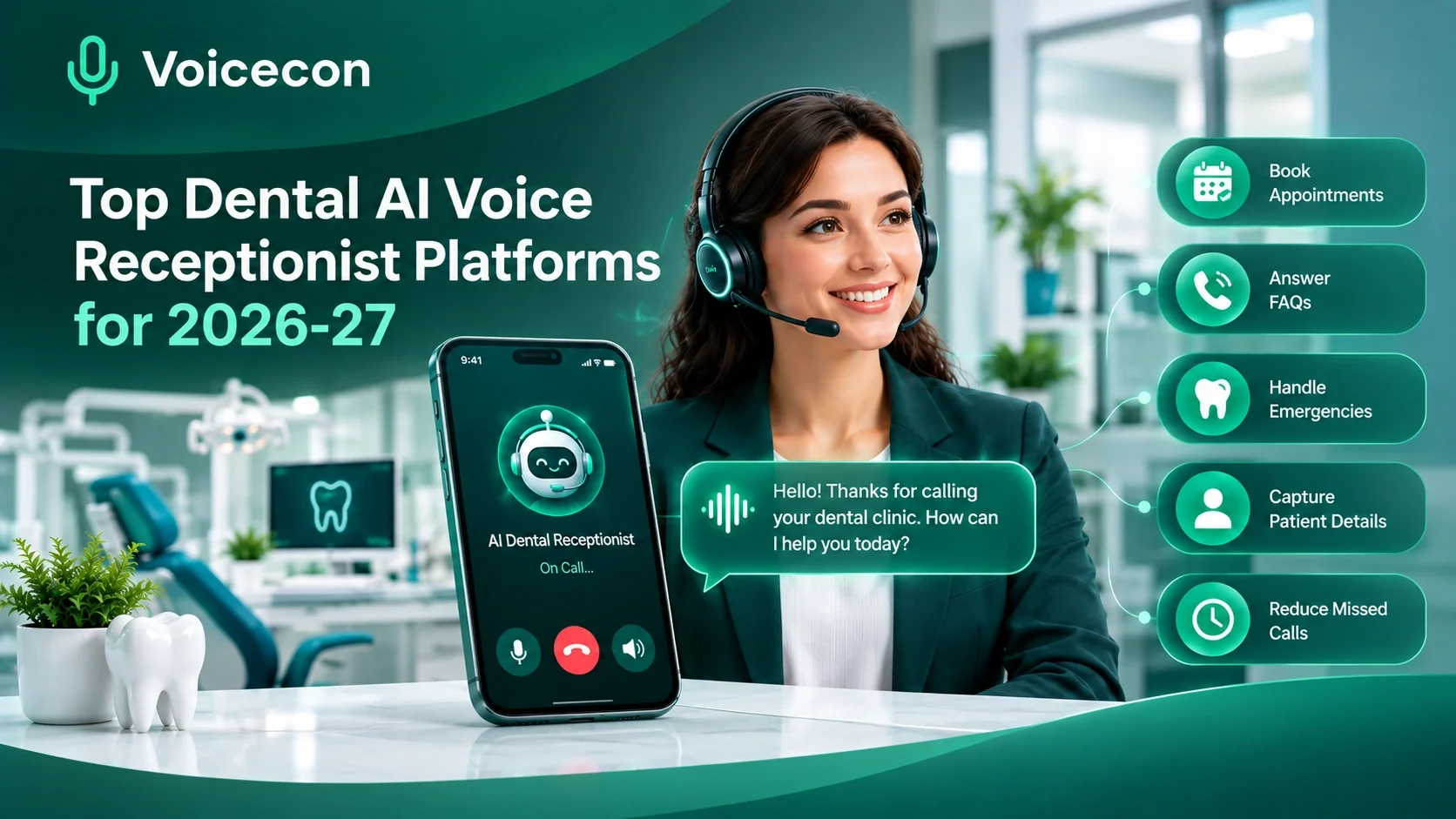
Top Dental AI Voice Receptionist Platforms for 2026-27 are worth comparing if your dental practice wants to answer more patient calls, reduce front-desk interruptions, and make appointment handling more efficient. The right platform should do more than generate natural-sounding speech. It should follow your clinic's call-handling rules, capture accurate information, connect to the systems your team uses, and hand difficult calls to a human when necessary.
For dental clinics in the United States, Canada, and Australia, the decision often comes down to five factors: voice quality, appointment workflow, integration depth, patient-data protection, and the ability to measure real business outcomes.
Our shortlist includes Voicecon AI, Arini AI, Weave, TrueLark, Peerlogic, NexHealth, and CloudTalk. Each serves a different operational need. Voicecon offers a configurable voice-agent and workflow platform, while other options are positioned around dental-specific reception, patient communication, or broader contact-center infrastructure.
The important distinction is that not every AI receptionist connects directly to a dental practice management system (PMS). Before choosing a platform, confirm whether it can actually read availability, create or modify appointments, and write information back to your existing software—or whether it only takes messages and sends notifications.
What Is an AI Voice Receptionist for a Dental Practice?
An AI voice receptionist is software that answers telephone calls, interprets what callers say, and performs predefined administrative tasks through conversational AI and connected workflows.
A dental clinic might configure one to:
Answer common questions about office hours, location, parking, and appointment policies.
Collect contact information from prospective patients.
Handle routine new-patient enquiries.
Route appointment requests to the correct scheduling workflow.
Send appointment requests or call summaries to the front-desk team.
Transfer calls when a caller needs human assistance.
Handle eligible after-hours calls using approved instructions.
More advanced systems can book, reschedule, and cancel appointments through supported integrations. That capability should never be assumed simply because a vendor advertises AI scheduling.
A voice agent connected to Google Calendar, for example, is not automatically equivalent to an agent integrated with Dentrix or Open Dental. A calendar connection may support basic appointment coordination, while a dental PMS integration may need to account for patient records, appointment types, provider schedules, operatory availability, and existing booking rules.
For dental practices, the objective is reliable administration—not replacing clinical judgment.
Top 7 Dental AI Voice Receptionist Platforms for 2026-27
The platforms below are arranged to put Voicecon first, followed by alternatives with different strengths. This is an editorial shortlist, not a claim that every platform has been independently tested or that the order represents a verified performance ranking.
1. Voicecon AI — Best for Configurable Voice Agents and Workflow Automation
Best suited to: Dental practices or implementation teams that want to configure conversational voice agents and connect calls to their existing business workflows.
Voicecon is an AI voice-agent platform designed to answer calls, respond using a configured knowledge base, interact with callers in real time, and trigger actions through connected applications.
Its published capabilities include configurable agents, visual call flows, call transfers, knowledge-base retrieval, transcripts, call summaries, analytics, and workflow automation. The platform also documents connections to tools such as Google Calendar, Calendly, HubSpot, GoHighLevel, Twilio, Telnyx, Zapier, and Make.
Official product information: https://voicecon.ai
How Voicecon could be used in a dental clinic
A dental practice could configure an agent to answer routine calls, identify the caller's purpose, provide approved administrative information, collect a callback number, and route the request to the appropriate team.
For example, a new patient calls to ask about booking a consultation. The agent could identify the requested service, collect the patient's contact details, and use a configured scheduling workflow or transfer the call to staff. After the call, an automation could send a structured summary to a connected CRM or another supported application.
If the practice requires direct booking into its dental PMS, that workflow needs to be implemented and tested against the actual system. The existence of general calendar or CRM integrations does not establish native Dentrix, Eaglesoft, or Open Dental connectivity.
Key strengths
Configurable conversation flows rather than a fixed answering script.
Knowledge-base functionality for approved practice information.
Call transfers and workflow actions.
Call recordings, transcripts, summaries, and analytics, subject to the configured service and applicable policies.
Connections to supported scheduling, CRM, messaging, and automation tools.
Important considerations
Voicecon is a general-purpose voice-agent platform rather than a verified dental-native PMS solution. Clinics should confirm dental software compatibility, appointment write-back, healthcare-specific data handling, and contractual compliance requirements before routing patient information through the platform.
Why consider Voicecon? It is a relevant option for practices that want control over call logic and workflow automation, particularly where an implementation can be configured around the clinic's existing systems.
Explore the platform at https://voicecon.ai/.
2. Arini AI — Best for Dental-Focused Voice Reception
Best suited to: Dental practices seeking an AI receptionist designed around dental front-office operations.
Arini AI is positioned specifically for dental practices. Its publicly discussed capabilities include phone answering and appointment-related workflows, with integrations to dental practice management systems described in vendor and comparison materials.
For a clinic, the value of a dental-focused platform is the potential to handle familiar workflows without building every dental-specific interaction from scratch.
Questions to evaluate include whether the system can distinguish new-patient appointments from existing-patient visits, identify the appropriate appointment type, check real availability, and handle changes to existing bookings.
What to verify before purchasing
Whether your specific PMS version is supported.
Whether the integration is read-only or supports two-way updates.
Which appointment types the AI can book independently.
How insurance questions and requests for clinical advice are handled.
What happens when a booking fails or the patient needs a staff member.
A dental-focused product is not automatically compatible with every practice's software configuration. Ask for a demonstration using your actual scheduling requirements.
3. Weave AI Receptionist — Best for Practices Evaluating a Broader Communications Suite
Best suited to: Clinics interested in consolidating patient communication and front-office tools.
Weave offers a broader communications platform for healthcare and dental practices. Its product ecosystem includes communication, patient engagement, and practice workflow capabilities, with AI receptionist functionality described in its product materials.
This approach can be attractive when a practice is reviewing its wider communications infrastructure rather than purchasing an isolated answering tool.
The key question is whether the specific AI receptionist package provides the functions the clinic needs today. A feature advertised as early access, limited release, or part of a particular subscription should not be treated as universally available.
What to verify before purchasing
Whether AI reception is available for your location and plan.
Which phone and PMS integrations are included.
Whether appointments are booked automatically or requests are routed to staff.
Whether the platform supports your desired after-hours workflow.
The total cost of adopting the required communications package.
Weave may be worth evaluating for practices seeking a more unified patient communication setup.
4. TrueLark — Best for Multichannel Patient Communication
Best suited to: Practices and dental groups looking to coordinate patient interactions across multiple communication channels.
TrueLark is associated with AI-driven patient communication, including telephone, messaging, and web-based interactions. It is relevant to clinics that receive appointment enquiries through more than one channel and want to standardize responses and follow-up.
For example, a patient might call during office hours, miss a callback, and later respond by text. A multichannel system can help the front desk manage that interaction more consistently, provided the relevant channels and workflows are supported.
TrueLark's relationship with Weave is also worth considering when evaluating broader communications options. Buyers should clarify which capabilities are delivered through TrueLark itself and which depend on the wider product environment.
What to verify before purchasing
Current product availability and packaging.
Supported channels in your region.
Dental PMS compatibility and booking write-back.
How conversations are linked across telephone and messaging channels.
Escalation rules and staff handoff procedures.
5. Peerlogic — Best for Dental Call Analytics and Front-Office Insights
Best suited to: Dental practices that want better visibility into telephone interactions and opportunities to improve patient conversion.
Peerlogic focuses on AI-supported dental communications and call analytics. For practice managers, call analytics can be valuable because the number of answered calls alone does not show whether the practice is successfully converting enquiries into appointments.
A useful reporting system should help answer questions such as:
How many new-patient enquiries were received?
How often did calls lead to an appointment?
Which enquiries were transferred or left unresolved?
Why did prospective patients fail to schedule?
Which call types generate the most follow-up work?
These insights are useful only when definitions are consistent and the data accurately reflects the clinic's workflow.
What to verify before purchasing
Ask for examples of the available dashboards, the way calls are classified, the depth of PMS integration, and whether appointment outcomes can be linked reliably to call records.
Analytics should complement staff review rather than be treated as an infallible assessment of employee or patient behavior.
6. NexHealth — Best for Practices Evaluating Connected Patient Workflows
Best suited to: Dental practices that want to evaluate appointment scheduling and connected patient communication.
NexHealth is known for healthcare technology focused on connecting patient experiences with practice systems. It is relevant when the buying objective extends beyond answering telephone calls to improving scheduling and patient workflows.
For this comparison, the critical distinction is between NexHealth's broader scheduling and patient communication capabilities and any specific AI voice receptionist capability offered in a particular product or integration. These should not be assumed to be the same service.
A clinic should determine whether the required voice automation is provided natively, through an integration, or through a separate vendor.
What to verify before purchasing
Whether an AI voice receptionist is included in the current offering.
Which dental PMS systems and versions are supported.
Whether appointment changes synchronize in both directions.
How duplicate bookings and conflicting availability are handled.
Which components require additional subscriptions or implementation.
NexHealth is worth evaluating for connected scheduling workflows, but its suitability as a standalone voice receptionist depends on the exact configuration.
7. CloudTalk — Best for Practices Needing Broader Phone-System Capabilities
Best suited to: Dental organizations that want to evaluate AI call handling alongside a broader business phone or contact-center system.
CloudTalk provides cloud-based calling and contact-center technology, with AI features and integrations that may support structured inbound call handling.
This type of platform can be relevant for practices with several offices, centralized reception teams, or more complex call-routing requirements. However, a general-purpose contact-center platform should not be assumed to have the same dental-specific booking capabilities as a product built around a dental PMS.
A phone system may route calls correctly and capture useful information while still requiring a separate integration to complete a booking.
What to verify before purchasing
Which AI features are included in the chosen plan.
Whether your desired workflow requires an add-on or API integration.
How calls are transferred between receptionists and clinic staff.
Whether the required dental PMS can be accessed and updated.
Which healthcare security commitments apply to the proposed configuration.
CloudTalk is a candidate for practices prioritizing telephone infrastructure, routing, and call management.
Dental AI Receptionist Comparison: Which Platform Fits Your Practice?
The most useful comparison is based on operational fit rather than a universal ranking.
Platform | Primary evaluation focus | Important limitation to verify |
Voicecon AI | Configurable voice agents and workflows | Dental PMS integration and healthcare compliance must be confirmed |
Arini AI | Dental-specific voice reception | Exact PMS support and booking scope |
Weave | Broader practice communications | Availability and packaging of AI reception features |
TrueLark | Multichannel patient communication | Current product configuration and PMS synchronization |
Peerlogic | Dental call analytics | Booking functionality and integration depth |
NexHealth | Connected patient and scheduling workflows | Whether the required voice functionality is included |
CloudTalk | Phone systems and call routing | Dental-specific appointment automation |
This table deliberately avoids assigning unverified prices, integration checkmarks, or performance ratings. Those details should be added after checking current vendor documentation and obtaining written confirmation.
Features Every Dental Clinic Should Evaluate
1. Dental practice management system integration
Start with the software your clinic already uses. Confirm whether the AI can access appointment availability and write confirmed changes into the system.
Ask the vendor to demonstrate a complete booking from beginning to end, including what happens when two patients request the same slot.
2. Reliable appointment handling
Appointment booking requires more than recognizing a phrase such as "next Tuesday."
The system must interpret dates and times correctly, apply the clinic's scheduling rules, confirm the correct appointment type, and tell the patient whether the booking actually succeeded.
A robust workflow should avoid telling a patient an appointment is confirmed until the connected system returns a successful result.
3. Human handoff and escalation
Some callers need staff immediately. A suitable system should recognize when it cannot complete a task, transfer calls when appropriate, and preserve the relevant context so patients do not need to repeat everything.
Dental emergency protocols should be written and approved by the practice. The AI should not independently diagnose a patient or provide unsupported medical advice.
4. Knowledge-base accuracy
The agent's approved information should include opening hours, location, contact information, appointment policies, and other administrative FAQs.
Assign responsibility for maintaining this information. Outdated office hours or incorrect appointment instructions can create avoidable patient frustration.
5. Reporting and auditability
Look for call transcripts, outcome summaries, transfer records, error logs, and metrics that the practice can review.
These records can help identify recurring problems, but call recordings and transcripts may contain sensitive information. Their collection, access, retention, and deletion need to follow the clinic's applicable policies and legal obligations.
6. Privacy and security
Do not accept a generic claim that a tool is "secure" or "HIPAA compliant" as a complete procurement assessment.
For a US practice, confirm the vendor's role, the proposed data flow, the availability and scope of a business associate agreement where required, and the security controls applicable to the actual service.
Canadian and Australian practices should separately evaluate their applicable privacy and health-record obligations.
How to Choose the Right Dental AI Voice Receptionist
A structured evaluation reduces the risk of selecting a product based on a polished demonstration rather than operational performance.
Step 1: Document your call types.
Classify calls as new-patient enquiries, routine scheduling, rescheduling, cancellations, administrative questions, urgent requests, and calls requiring a staff member.
Step 2: Define which tasks the AI may complete.
Decide which requests can be handled automatically, which require confirmation, and which must always be transferred or escalated.
Step 3: Confirm integrations in writing.
Identify the PMS, phone system, scheduling software, CRM, and communication channels involved. Ask the vendor to document exactly what each integration can read and write.
Step 4: Run realistic test calls.
Test routine and difficult interactions, including interrupted speech, background noise, ambiguous dates, incorrect contact information, failed bookings, and transfer requests.
Step 5: Pilot the system with staff oversight.
Begin with a limited call category or after-hours workflow. Review errors and patient feedback before expanding the system's responsibilities.
Step 6: Measure business outcomes.
Compare call answer rate, qualified enquiries, completed bookings, successful transfers, error rates, and cost per handled call before and after deployment.
Dental AI Receptionist Pricing and ROI
The total cost depends on more than the advertised monthly subscription. A realistic estimate should include platform fees, telephony usage, integration work, setup, ongoing maintenance, and staff time spent correcting errors.
Use this illustrative calculation to assess the business case:
Monthly net benefit = incremental contribution from completed appointments + verified staff-time savings − total monthly AI costs.
For example, assume a practice generates 20 additional completed appointments per month attributable to improved call handling, with an average contribution margin of $100 per appointment. If verified staff-time savings equal $300 per month and the full AI cost is $800 per month:
Incremental appointment contribution: 20 × $100 = $2,000.
Staff-time savings: $300.
Total estimated monthly benefit before AI costs: $2,300.
Estimated monthly net benefit: $2,300 − $800 = $1,500.
This is an illustrative scenario, not a claimed customer result. Use contribution margin rather than gross appointment revenue, and count only appointments that would not otherwise have occurred. Avoid counting the same benefit twice.
Privacy and Compliance for Dental Clinics in the USA, Canada, and Australia
Voice AI introduces additional data-handling questions because conversations can be recorded, transcribed, analyzed, and sent to other connected systems.
United States
Where HIPAA applies, a dental practice should determine whether the vendor handles protected health information on its behalf and whether a suitable business associate agreement is required. HHS explains that cloud service providers handling electronic protected health information on behalf of covered entities can qualify as business associates and require appropriate contractual arrangements. See the official HHS guidance.
A vendor's general security statement is not a substitute for reviewing the proposed configuration and data flows.
Canada
Review applicable federal and provincial privacy requirements, including rules governing collection, use, disclosure, and safeguarding of personal information. Determine where recordings and transcripts are processed or stored and whether the intended workflow is appropriate for your province.
Start with the Office of the Privacy Commissioner of Canada.
Australia
Assess applicable requirements under the Privacy Act 1988 and the Australian Privacy Principles, along with relevant state or territory health-record legislation where applicable. Cross-border processing and access by subcontractors should be reviewed as part of vendor selection.
Consult the Office of the Australian Information Commissioner.
Across all three markets, establish an approved policy for call recording, patient disclosures, access permissions, retention, deletion, incident handling, and vendor access before deployment.
Frequently Asked Questions
What is the best AI voice receptionist for a dental practice in 2026–27?
There is no single best option for every clinic. Voicecon is worth evaluating for configurable voice agents and workflow automation; Arini for dental-focused reception; and broader platforms such as Weave, TrueLark, Peerlogic, NexHealth, and CloudTalk for their respective communications, analytics, scheduling, or telephony use cases. The right choice depends on the practice's PMS, workflow, security requirements, and budget.
Can an AI receptionist book dental appointments automatically?
Yes, when the product has a working scheduling integration and permission to create or modify appointments. Some systems may only collect appointment requests or connect to a general calendar. Ask for a demonstration using the exact scheduling software and appointment rules used by your clinic.
Is a general-purpose voice AI suitable for a dental office?
Potentially. A configurable voice agent can handle approved administrative tasks, route calls, and trigger workflows. However, dental-specific scheduling, patient-record access, clinical escalation, and compliance requirements may require additional integrations and configuration.
How much does an AI dental receptionist cost?
Costs vary by vendor, usage, feature package, number of locations, and integration requirements. Request an itemized quote covering subscriptions, telephony, implementation, API work, usage limits, and ongoing support instead of comparing headline prices alone.
Can AI handle dental emergencies?
An AI receptionist can be configured to recognize certain urgent phrases and follow a clinic-approved escalation procedure. It should not diagnose a condition or substitute for professional clinical assessment. The practice must define how urgent calls are routed and what happens when a staff member is unavailable.
What should a dental clinic test before purchasing?
Test appointment booking, rescheduling, failed integrations, caller interruptions, noisy environments, patient-data handling, transfers, and after-hours escalation. Measure successful task completion—not merely whether the AI answers the phone.
Final Verdict
The right dental receptionist AI should be evaluated on whether it completes the administrative task reliably, not just whether it can hold a convincing conversation.
For clinics that want configurable voice automation, Voicecon AI is a candidate to evaluate for call handling, knowledge-based responses, connected workflows, and call analytics. Dental practices should confirm the required PMS integration, booking logic, and healthcare compliance arrangements before using it for patient-specific workflows.
Dental-focused alternatives may be a better fit when native dental scheduling and patient-management integrations are the primary requirement.
If your practice is exploring how voice AI could support its front desk, visit Voicecon AI to review the platform and determine whether its configurable agents and workflows fit your requirements. Start with one clearly defined use case, test it with realistic calls, and expand only after the results meet your clinic's standards.
Keep reading
All articles → Guides
13 min read
AI Voice Agents for Customer Service: Benefits, Use Cases, and How to Choose
Discover how AI voice agents for customer service answer calls, automate support tasks, connect with CRMs, and hand complex issues to human agents. Try Voicecon AI Agents free for 7 days.
 Guides
13 min read
AI Answering Service: How Businesses Can Automate Calls with Voicecon AI
Never miss a customer call again with our AI answering services. Voice On AI answers your phone, chats with leads, handles routine tasks, and keeps your team in the loop.
 Guides
10 min read
Outsource Receptionist Services: A Complete Guide for Businesses of All Sizes
Discover how to outsource receptionist services, compare AI voice agents with virtual receptionists, and choose the right phone answering solution for your business.