AI Answering Service: How Businesses Can Automate Calls with Voicecon AI
Never miss a customer call again with our AI answering services. Voice On AI answers your phone, chats with leads, handles routine tasks, and keeps your team in the loop.
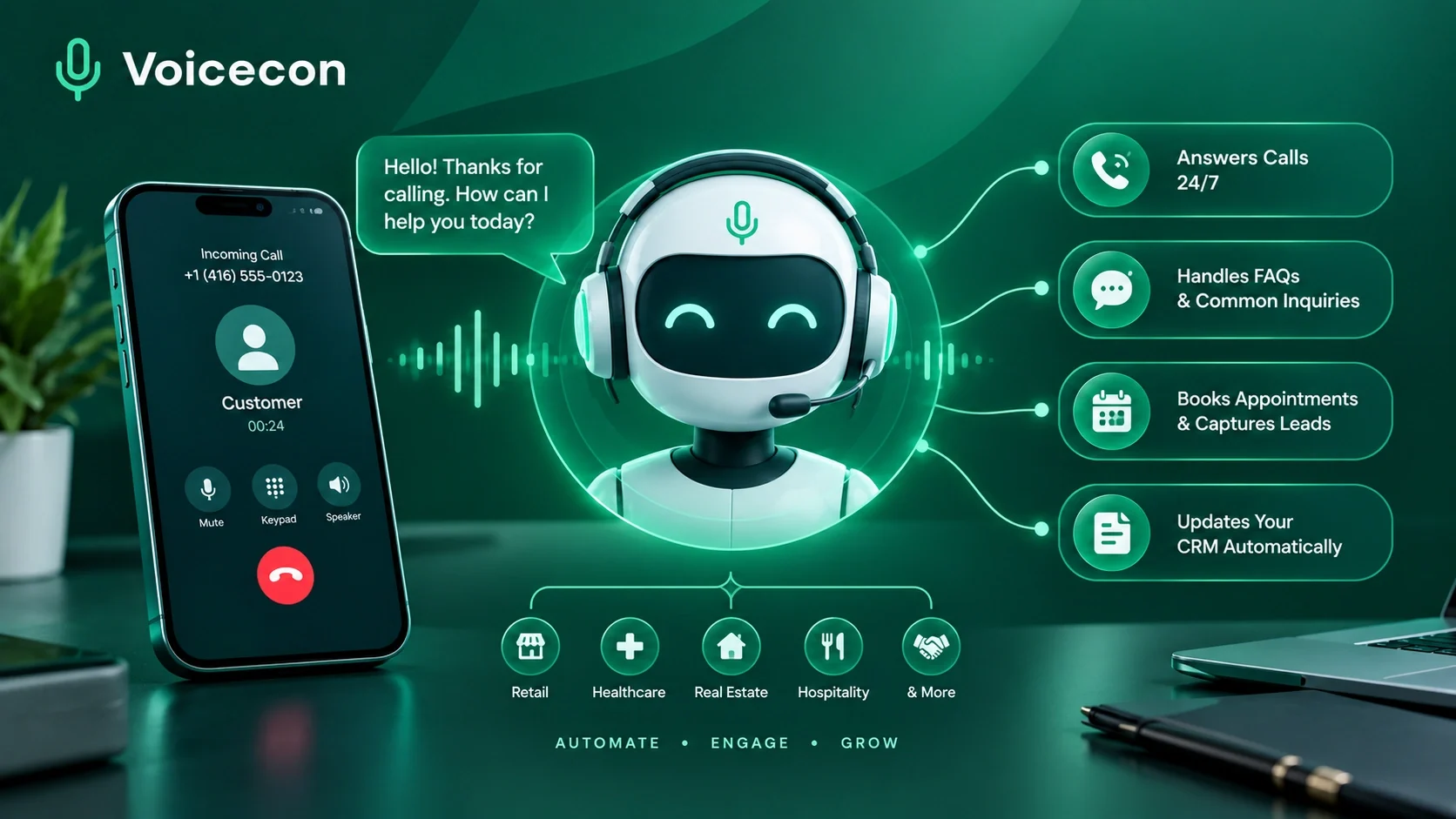
An AI answering service helps businesses answer incoming phone calls, respond to routine customer questions, qualify leads, schedule appointments, and route inquiries without relying exclusively on a human receptionist. For growing companies in the USA and Australia, the real opportunity is not simply answering more calls. It is turning phone conversations into completed business tasks.
Voicecon AI takes this approach by combining conversational AI voice agents with business knowledge, connected applications, call handling tools, and automated workflows. Its platform is designed to help businesses move beyond message-taking toward practical actions such as updating a CRM, scheduling meetings, and notifying the right team.
For medium-sized and large businesses, choosing the right AI answering service means evaluating much more than voice quality. Integration capabilities, escalation rules, reliability, privacy, reporting, and the ability to handle exceptions all matter.
What Is an AI Answering Service?
An AI answering service is a software-based phone answering solution that uses conversational artificial intelligence to interact with callers. Depending on its configuration, it can answer questions, collect customer details, qualify inquiries, route calls, schedule appointments, and trigger follow-up workflows.
Unlike traditional voicemail, which records a message for someone to review later, a conversational AI answering agent can engage with the caller immediately. Unlike a basic automated phone menu, it can interpret spoken requests and respond conversationally.
However, not every AI answering service offers the same capabilities. Some systems primarily capture messages or route calls. More advanced AI voice agents can retrieve approved information, interact with connected applications, and perform configured actions during or after a conversation.
That distinction matters to businesses receiving substantial call volumes. Capturing a customer's request is useful; completing the request accurately and making the result available to the relevant team is even more valuable.
How Does an AI Answering Service Work?
A modern AI answering service combines several technologies and operational rules to manage a phone conversation.
1. It understands what the caller needs
The caller explains their request in natural language. Speech recognition converts the spoken words into information the system can process, while the conversational model interprets the request and determines the next appropriate step.
For example, a caller might ask about a product, request a service appointment, inquire about an order, or want to speak to the sales department.
The agent should recognize the caller's intent, ask relevant follow-up questions, and avoid collecting unnecessary information.
2. It answers using business-specific information
A useful AI answering service must work with accurate company information rather than relying on generic responses.
Businesses can provide approved information such as service descriptions, operating hours, product documentation, frequently asked questions, and internal procedures. The agent can then use that knowledge to answer relevant questions.
Voicecon supports knowledge bases that can be populated with business documents, including PDFs, Word files, spreadsheets, CSV files, and other supported formats.
The quality of the information matters. Outdated policies, conflicting prices, and incomplete documentation can produce incorrect answers. Businesses should maintain a clear source of truth and test the agent against common and difficult questions.
3. It takes action during or after the call
The most useful AI answering service does not stop when the conversation ends.
Depending on the configuration, an agent may transfer a call, send a text, look up information, or trigger a workflow. After the call, an automated process can update a connected application, share a summary, or notify a team member.
Voicecon supports configurable voice agents, call flows, and workflows that connect with business applications. Its published integrations include CRM, scheduling, communication, support, and productivity tools.
This creates a more useful operational process: the call is answered, the request is handled according to defined rules, and the outcome is recorded for the next person or system that needs it.
Why Growing Businesses Need More Than Basic Call Answering
As a business grows, inbound calls become connected to more complex processes.
A sales inquiry may need to enter a CRM with qualification details. A support request may need a ticket. An appointment request may require a live calendar check. A customer with an urgent problem may need immediate escalation.
A basic answering service may capture these requests but leave the rest of the work to employees.
An AI answering service with workflow automation can reduce this manual handoff when the required integrations and business rules are configured correctly.
Consider an illustrative scenario: a company receives inquiries from several locations while its sales team is occupied with existing customers. An AI agent could ask which service the caller needs, collect the relevant details, identify the appropriate destination, and send a structured summary to the responsible team.
The value comes from making the information usable, not simply generating a transcript.
Key Benefits of an AI Answering Service
More consistent call coverage
An AI answering agent can be configured to handle calls outside normal business hours and during periods when employees are busy. This can help businesses offer a consistent first point of contact across different schedules.
Actual availability depends on the deployment, phone-number configuration, service plan, and operating setup. Businesses should test the system under realistic conditions rather than assume every call will always be handled successfully.
Faster lead capture and qualification
When potential customers call, the first interaction can determine whether the business captures a useful opportunity or leaves the caller waiting.
An AI agent can ask predefined qualification questions, capture contact details, identify the service required, and pass the information to a sales team. With appropriate CRM integration, this information can enter an existing follow-up process.
For businesses with several sales representatives or locations, consistent qualification rules can make incoming leads easier to prioritize.
Reduced repetitive administrative work
Employees often spend time answering recurring questions, collecting information, and manually summarizing conversations.
An AI answering service can handle suitable routine inquiries and automate configured follow-up actions. Employees can then focus more attention on complex customer needs, negotiations, exceptions, and decisions that require human judgment.
The amount of work saved depends on the share of calls the agent can handle correctly and the time required to maintain the system.
Better visibility into customer conversations
Call recordings, transcripts, summaries, and analytics can help teams understand why customers call, which inquiries are common, and where processes need improvement.
Voicecon's published platform features include call recordings, transcripts, AI-generated summaries, intent and sentiment information, and call analytics.
Businesses can use these records to review call outcomes, identify recurring questions, and refine agent instructions. Recording and retaining calls must still be handled according to applicable privacy and legal requirements.
More connected customer operations
An AI answering service becomes more valuable when it fits the systems employees already use.
For example, a completed conversation could trigger a CRM update, a calendar-related workflow, or a notification in a team communication application, provided the relevant integration and permissions are configured.
Before deployment, verify that the integration supports the exact action required. A listed connector does not automatically mean every feature or workflow is available without configuration.
AI Answering Service Use Cases for Medium and Large Businesses
Different teams need different call-handling rules. A useful implementation starts with a clearly defined workflow rather than attempting to automate every possible conversation at once.
Sales teams and lead qualification
Sales teams can use an AI answering service to receive inbound inquiries, ask qualifying questions, capture contact information, and direct prospects to the appropriate representative.
For example, an agent for a business services company might ask which service a prospect needs, whether the request is urgent, and what the preferred next step is. The resulting information can be passed to the sales team or a connected CRM.
The agent should not promise a discount, make an unsupported commitment, or invent product information simply to keep the conversation moving.
Customer support and order inquiries
Customer support teams frequently receive questions about order status, policies, account issues, and service procedures.
An AI voice agent can answer approved questions using company knowledge and, where configured, retrieve information through a connected system. It can also collect the details needed for a support ticket or transfer a caller when the issue requires a human.
For account-specific requests, access permissions and verification requirements must be designed carefully. The agent should not disclose private information merely because a caller requests it.
Appointment scheduling and service operations
Appointment-based businesses can use an AI answering service to collect booking preferences, check availability through a configured calendar or scheduling integration, and confirm a reservation when the system supports that action.
A reliable workflow must distinguish between a requested appointment and a confirmed booking. If the calendar cannot be checked or an integration fails, the agent should explain the limitation and provide an appropriate next step.
Multi-location and distributed businesses
Companies operating across several offices or service areas often need consistent call routing and reporting.
An AI answering service can use configured rules to identify the relevant department, location, or inquiry type. The implementation should account for local operating hours, time zones, routing exceptions, and the responsibilities of each team.
For larger organizations, it is especially important to test how the agent behaves when several locations share similar services or when a caller's request does not match a predefined route.
AI Answering Service vs. Human Receptionist vs. Traditional Answering Service
The best choice depends on the complexity of calls, customer expectations, available systems, and the level of human judgment required.
Capability | Traditional answering service | Human receptionist | AI answering service |
Conversational phone handling | Depends on provider | Yes | Depends on agent capability and configuration |
Routine question answering | Script or staff dependent | Yes | Yes, within its knowledge and configured limits |
Appointment booking | Depends on service | Possible | Possible with a supported scheduling workflow |
CRM updates | Depends on integration | Often manual or integrated | Possible with configured integrations |
Handling unusual or sensitive requests | Human-dependent | Human judgment | Should escalate when outside its safe scope |
Consistent simultaneous call handling | Depends on staffing | Limited by available staff | Depends on platform and deployment capacity |
Reporting and analytics | Varies | Often requires separate tools | May include transcripts and analytics |
Personal human interaction | Yes, if staffed | Yes | Not equivalent to human judgment or empathy |
AI is not automatically the better choice for every interaction. Human staff remain important for complex complaints, sensitive conversations, exceptions, and situations where empathy or discretionary judgment is essential.
Many businesses benefit from a hybrid model in which AI handles suitable routine interactions and transfers other calls to the right person.
How to Choose an Enterprise-Ready AI Answering Service
For medium-sized and large businesses, selecting an AI answering service should be treated as an operational decision, not just a software purchase.
Evaluate integration requirements
List the systems the agent must interact with, including your CRM, calendar, support platform, phone system, and internal notification tools.
For each integration, confirm whether the required action is supported, which permissions are needed, how failures are reported, and whether duplicate records or incomplete updates can occur.
Test call handling under realistic conditions
Test more than a scripted greeting. Include interrupted speech, background noise, different accents, vague questions, unexpected requests, and callers who change their minds.
Measure whether the agent understands the request, provides accurate information, follows the correct workflow, and recovers appropriately when it cannot complete a task.
Define human escalation rules
Establish clear criteria for transferring a caller. These may include explicit requests for a person, complaints, urgent cases, unsupported requests, failed integrations, or situations requiring an authorized employee.
Confirm what happens if the intended recipient is unavailable. A useful fallback might be a structured message, a callback request, or transfer to an alternative team.
Review reporting and operational controls
Look for visibility into call outcomes, call duration, errors, costs, and recurring issues.
For enterprise deployments, also evaluate user roles, access permissions, retention settings, audit requirements, and the process for changing or approving agent instructions.
Check privacy and compliance requirements
Businesses operating in the USA and Australia should assess applicable privacy rules, recording and disclosure obligations, and requirements associated with any outbound calling.
The Australian Privacy Principles provide a framework for the collection, use, disclosure, and protection of personal information for covered organizations. The US Federal Communications Commission has also clarified that AI-generated voices fall within the TCPA's restrictions on artificial or prerecorded voice calls. Applicability depends on the particular activity and legal circumstances.
Review the relevant guidance before launch, especially if calls involve personal, financial, health, or other sensitive information.
How Voicecon AI Connects Phone Calls to Business Workflows
Voicecon AI is designed for businesses that want configurable AI voice agents connected to operational systems.
Its published features include:
Configurable voice agents: Define agent behavior, choose supported models and voices, and use templates for common business workflows.
Business knowledge bases: Provide approved company information for answering relevant caller questions.
Visual call flows: Configure conversational steps, branches, transfers, and end-of-call behavior.
Connected applications: Integrate supported CRM, calendar, messaging, support, and productivity tools.
Call records and analytics: Review recordings, transcripts, summaries, intent, sentiment, and call-related metrics.
Workflow automation: Trigger configured actions after calls or through other supported workflow triggers.
These features are described on Our AI Voice agent Platform.
The practical advantage is the ability to connect the phone conversation with what happens next. A qualified inquiry can be routed to a sales process, an appropriate appointment request can enter a configured scheduling workflow, and a support interaction can trigger a notification or record update.
However, results depend on accurate knowledge sources, supported integrations, carefully defined instructions, and thorough testing. Businesses should validate their specific workflows before relying on the agent for important customer interactions.
A practical way to evaluate Voicecon AI
Start with one high-volume, relatively predictable call type.
Identify the questions callers ask most often and the actions employees perform after those calls.
Prepare approved answers, qualification questions, routing rules, and escalation criteria.
Configure the agent and connect the necessary tools.
Test ordinary calls, edge cases, failed actions, and requests requiring human assistance.
Measure successful task completion, transfer accuracy, errors, handling costs, and employee follow-up time.
Expand the deployment only when the initial workflow performs reliably.
This approach provides evidence for deciding where automation adds value before introducing it across more departments or locations.
Frequently Asked Questions About AI Agents Answering Your Calls
What is the best AI answering service for a business?
The best AI answering service is the one that reliably handles your specific call types, connects to your required business systems, provides appropriate escalation, and meets your privacy and operational requirements. For growing businesses, evaluate workflow completion and reporting alongside voice quality and price.
How much does an AI answering service cost?
Pricing varies by provider and may depend on monthly subscriptions, call volume, usage minutes, integrations, setup, or additional services. Compare the full expected cost at your actual call volume, including telephony charges, overages, implementation, and ongoing maintenance. Check our pricing for applicable plan details.
Can an AI answering service work 24/7?
Many AI answering services are designed for round-the-clock coverage. Actual availability depends on the provider, phone routing, service configuration, and any external dependencies. Test after-hours calls and failure scenarios before relying on continuous coverage.
Can an AI answering service book appointments?
Yes, when the agent has a supported scheduling integration and is configured to check availability and confirm bookings correctly. The business should test calendar conflicts, time zones, cancellations, and integration failures.
Can an AI answering service transfer calls to a person?
Many services support call transfer, but the precise behavior depends on the platform and configuration. Define when transfers should happen and what fallback the agent should use if a person cannot be reached.
Is an AI answering service suitable for large businesses?
It can be suitable when the platform meets the organization's integration, call-volume, security, governance, reporting, and escalation requirements. Larger businesses should pilot representative workflows and evaluate performance before expanding deployment.
How do businesses measure whether an AI answering service is working?
Track successful task completion, qualified leads captured, appointments booked, transfer accuracy, unresolved inquiries, cost per successfully handled call, and employee time spent correcting or completing tasks. Compare results against a documented baseline rather than assuming automation has improved performance.
Turn Business Calls into Action with Voicecon AI
An effective AI answering service should do more than acknowledge a caller. It should help the business respond accurately, capture useful information, route requests appropriately, and complete configured follow-up actions.
For medium-sized and large businesses in the USA and Australia, the right solution can connect customer conversations with the systems that manage sales, support, scheduling, and operations.
Voicecon AI provides a platform for building conversational voice agents and connecting them to business workflows. Explore the Voicecon AI agent platform to review its capabilities, then test a representative call workflow against your business requirements.
Start with a real operational problem, measure the outcome, and expand automation where it demonstrably improves the customer experience and the way your team works.
Keep reading
All articles → Guides
13 min read
AI Voice Agents for Customer Service: Benefits, Use Cases, and How to Choose
Discover how AI voice agents for customer service answer calls, automate support tasks, connect with CRMs, and hand complex issues to human agents. Try Voicecon AI Agents free for 7 days.
 Guides
10 min read
Outsource Receptionist Services: A Complete Guide for Businesses of All Sizes
Discover how to outsource receptionist services, compare AI voice agents with virtual receptionists, and choose the right phone answering solution for your business.
 Guides
16 min read
Top Dental AI Voice Receptionist Platforms for 2026-27
Compare 7 dental AI voice receptionist platforms for 2026-27. Explore features, integrations, appointment workflows, security, and how to choose.