How AI Voice Agents Handle Real-Time Phone Conversations
Discover how real-time AI voice agents handle phone conversations, understand callers, take action, automate workflows, and deliver measurable results.
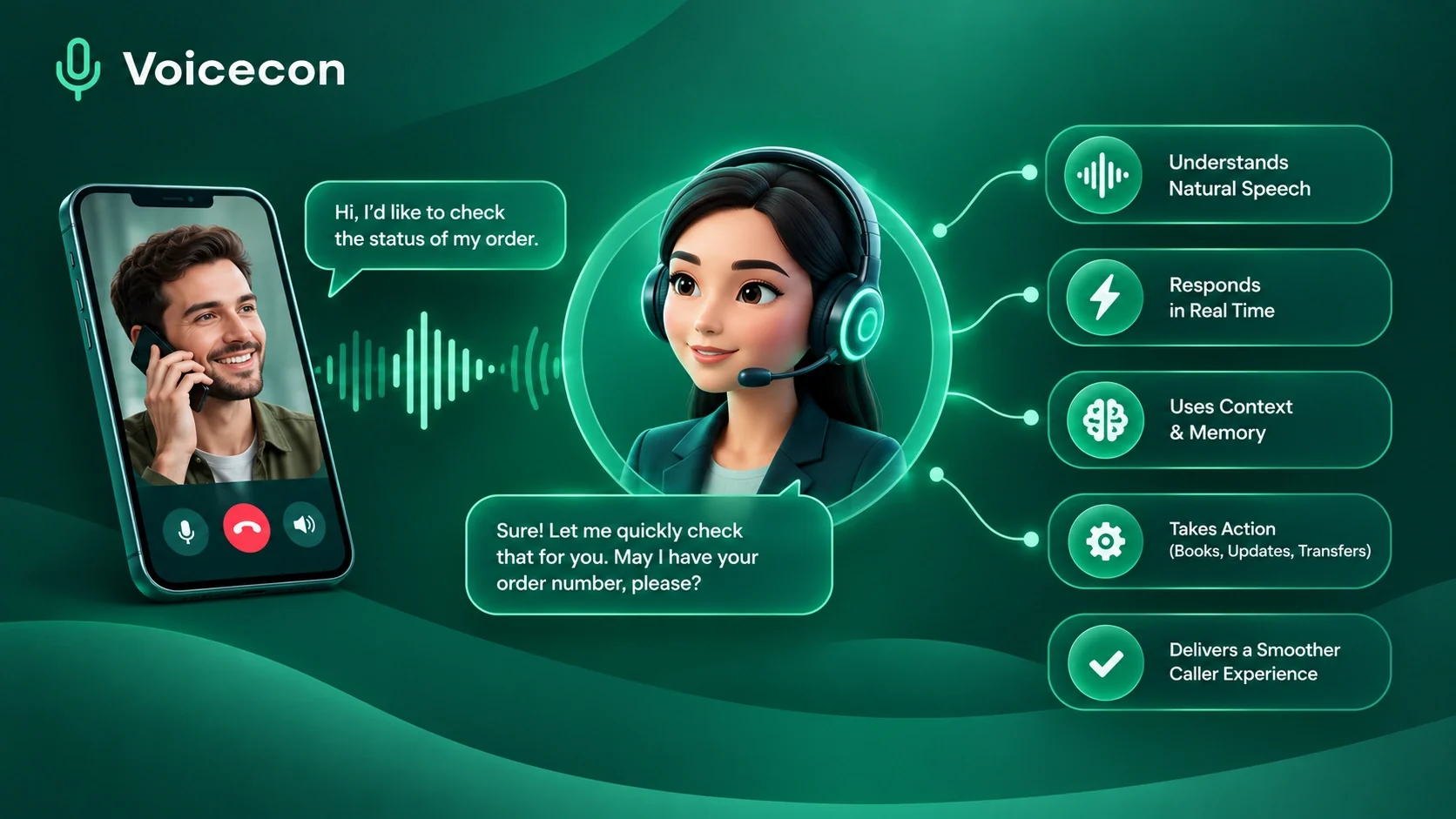
Real-time AI voice agents are transforming business phone calls by allowing customers to speak naturally with an AI that can understand the conversation, access business information, take action during the call, and trigger automated follow-up when the conversation ends. Instead of simply answering questions or routing callers through menus, modern AI phone agents can turn a phone conversation into a completed business process.
That distinction matters.
A customer might call to ask a question, book an appointment, check an order, or inquire about a service. Traditionally, a person would answer the call, gather the information, update a CRM, schedule the appointment, send a confirmation, and notify the appropriate team.
With an AI voice agent, much of that process can happen automatically.
Voicecon is built around this idea: AI voice agents that answer the call and finish the work. The platform combines real-time voice conversations with knowledge bases, live-call tools, no-code workflows, integrations, recordings, transcripts, summaries, sentiment, and analytics.
What Are Real-Time AI Voice Agents?
Real-time AI voice agents are software systems that conduct live phone conversations using artificial intelligence. They listen to what a caller says, understand the intent behind the request, generate an appropriate response, and continue the conversation while maintaining context.
A typical interaction looks like this:
Caller speaks → AI understands → AI responds → AI takes action → conversation continues → workflow runs → business system is updated
This is fundamentally different from traditional IVR systems that require callers to follow predefined menu options.
An AI phone agent can allow someone to say:
"I'd like to schedule an appointment next Tuesday afternoon."
Instead of asking the caller to press several buttons, the agent can understand the request, check available times, confirm the caller's choice, and book the appointment.
Voicecon's platform supports real-time speech recognition, AI reasoning, natural voices, live-call tools, knowledge bases, and visual call flows.
The result is not simply an automated conversation. It is a conversation connected to business operations.
How AI Voice Agents Handle Real-Time Phone Conversations
A real-time AI voice agent has to perform several tasks almost simultaneously.
First, it receives the caller's speech.
Next, speech recognition converts the audio into information the AI can process. The AI then considers the caller's words, the previous conversation, its instructions, and relevant business information before deciding how to respond.
The response is converted back into natural-sounding speech and delivered to the caller.
This cycle repeats throughout the call.
But a modern AI voice agent also needs to know when to do something, not just what to say.
For example, if a caller asks to book an appointment, the agent needs to understand that the correct outcome is not another conversational response. The correct outcome is an appointment.
That is where Voicecon's voice-to-action approach becomes important.
During a live conversation, agents can transfer calls, send texts, look up information, or run workflows. After the call ends, automated workflows can update CRMs, book meetings, alert teams, or perform other actions across connected applications.
How AI Voice Agents Understand What Callers Mean
Speech recognition alone isn't enough.
A caller may say:
"I'm actually looking for something next week, preferably in the afternoon, but Wednesday won't work."
The AI needs to understand the request, identify the constraints, and use that information appropriately.
This is where conversational AI and large language models play an important role.
An AI voice agent can use the conversation history to understand what the caller has already said rather than treating every sentence as an isolated request.
For example:
Caller: "I'd like to book an appointment."
Agent: "Sure. What day works best for you?"
Caller: "Friday."
The agent understands that "Friday" refers to the appointment being discussed.
This ability to maintain context is essential for natural AI phone conversations.
Voicecon allows businesses to configure an agent's prompt, model, voice, transcriber, knowledge bases, and tools in one workspace. Agents can also be tested directly from the browser before being connected to a live phone number.
How AI Voice Agents Use Business Knowledge
One of the biggest risks with generic AI is giving answers that sound convincing but aren't based on a company's actual information.
Businesses need their AI phone agents to understand their own:
FAQs
Policies
Pricing
Services
Product information
Operating procedures
Order information
Internal documentation
Voicecon addresses this through its knowledge base.
Businesses can upload PDFs, Word documents, spreadsheets, CSV, JSON, Markdown, and plain-text files. The AI agent can search that information when answering callers so responses are based on the company's own facts rather than generic assumptions.
This makes an AI voice agent particularly useful for customer support.
Imagine someone calls an online store and asks:
"What's your return policy for an item purchased last month?"
Instead of giving a generic response, the AI can use the company's uploaded information to answer according to the actual policy.
Why Low Latency Matters in Real-Time AI Voice Agents
Phone conversations are different from text conversations.
When someone sends a message, waiting several seconds for a response isn't necessarily a problem.
On a phone call, long periods of silence feel unnatural.
A real-time AI voice agent therefore needs to coordinate speech recognition, AI reasoning, voice generation, telephony, and potentially external tools without creating frustrating delays.
But speed isn't the only consideration.
The agent must also know when the caller has finished speaking.
It must recognize interruptions.
It must preserve context.
And it must respond appropriately.
Voicecon provides controls for barge-in, silence timeouts, maximum call length, and end-call phrases so businesses can tune how their agents behave during conversations.
How AI Voice Agents Handle Interruptions
Real people interrupt each other.
A caller might start speaking while the AI is responding:
"Your appointment is available on Thursday at—"
Caller: "Actually, Friday would be better."
A useful AI phone agent needs to recognize that interruption rather than continuing with the original response.
Voicecon's voice-to-voice system is designed for natural conversations where callers can interrupt the agent, while the system keeps the context and continues the interaction.
This is one of the reasons modern conversational AI feels different from older phone automation.
The objective isn't simply to make the AI speak.
It is to make the interaction work like an actual conversation.
AI Voice Agents Don't Just Talk—They Take Action
This is where AI voice agents become particularly valuable.
A traditional automated phone system might tell a caller:
"Your request has been recorded."
A more capable AI voice agent can actually perform the requested task.
Consider an appointment-booking call.
The caller says:
"Can I come in next Tuesday around 3?"
The AI can:
Understand the request.
Check the connected calendar.
Find available times.
Offer an available slot.
Confirm the caller's choice.
Book the appointment.
Trigger a confirmation message.
Notify the relevant team.
Voicecon's appointment-booking workflow is designed around this process. The agent can find available times in Google Calendar, offer real slots, confirm the caller's choice, and book the appointment while the caller is still on the line. After the call, a workflow can text a confirmation through Twilio and post the booking to Slack.
That is the difference between voice automation and voice-to-action automation.
Automate What Happens After the Call
One of Voicecon's strongest differentiators is what happens after the conversation.
Many voice bots effectively stop when the caller hangs up.
Voicecon allows businesses to create no-code workflows that begin when a call is completed.
Using a visual canvas, teams can drag triggers, logic, AI steps, and integrations into a workflow. They can test the workflow and inspect individual executions through run history.
For example:
Call completed → AI analyzes conversation → check qualification → create CRM contact → notify sales team
Or:
Call completed → generate summary → send summary to Slack → create support ticket
Or:
Call completed → identify appointment → send confirmation → update internal system
Voicecon provides workflow building blocks for conversation, logic, actions, AI, integrations, and HTTP requests.
This means the phone call can become the trigger for an entire automated process.
AI Voice Call Automation Across Your Existing Tools
Businesses rarely operate from one application.
A sales team might use HubSpot.
A scheduling team might use Google Calendar.
A support team might use Zendesk.
A company might communicate internally through Slack or Microsoft Teams.
Voicecon connects AI voice agents and workflows to a broad set of business applications, including CRM, scheduling, messaging, support, productivity, automation, storage, payment, and monitoring tools.
The important concept is that integrations can be used in two ways:
During the call: the agent can use a connected tool.
After the call: a workflow can use an integration to continue the process.
For example, a lead qualification call could collect a prospect's name, needs, and budget and then automatically create a contact in HubSpot, Pipedrive, or GoHighLevel.
How AI Voice Agents Help With Lead Qualification
Lead qualification is another practical use of AI phone agents.
Instead of simply answering:
"Thanks for calling. Someone will contact you."
The agent can ask the questions your sales team normally asks.
For example:
What service are you interested in?
What problem are you trying to solve?
When do you need the service?
What is your budget?
What is the best way to reach you?
The agent can then pass the information into the CRM.
Voicecon's lead-qualification template is designed to answer inbound calls from new leads, ask qualifying questions, capture information such as name, need, and budget, and then create the contact in connected CRM systems.
This turns an inbound phone call into structured sales data.
Understand Every Conversation With AI-Powered Call Insights
Automating calls is only part of the equation.
Businesses also need to understand what their AI voice agents are actually delivering.
Voicecon saves every call with its recording and full transcript, along with an AI summary, sentiment score, intent, and cost breakdown.
That gives teams a way to review conversations without listening to every minute of every call.
For example, a manager can identify:
What customers are asking about
Which calls were successful
Where callers became frustrated
Which agents perform best
Which conversations need human follow-up
What questions should be added to the knowledge base
This creates a feedback loop:
Call → transcript → summary → insight → improvement
The AI voice agent can then be refined based on what actually happens in customer conversations.
Measure What Your AI Voice Agents Deliver
AI voice automation should be measurable.
Voicecon provides analytics for total calls, average call duration, success rate, and cost, along with call outcomes, sentiment trends, and top-performing agents. Teams can also export the data to CSV.
This changes how businesses evaluate phone automation.
Instead of asking:
"Does the AI sound good?"
You can ask:
"How many calls did it handle?"
"How many achieved the intended outcome?"
"How long were calls taking?"
"What did they cost?"
"What was customer sentiment?"
"Which agents performed best?"
These are much more useful questions for measuring the actual business impact of AI voice technology.
AI Voice Agents vs Traditional IVR
Traditional IVR systems are still useful for straightforward routing.
For example:
Press 1 for sales.
Press 2 for support.
Press 3 for billing.
But callers often have requests that don't fit neatly into predefined menus.
AI phone agents allow customers to explain their needs naturally.
A customer can say:
"My order hasn't arrived, and I want to know when I should expect it."
The AI can identify the intent, access the appropriate information, explain the delivery timing, and escalate the issue if necessary.
Voicecon's order-status use case allows an agent to check order information through a company's API, explain delivery information and policy, and escalate problems to the team. A workflow can then log the call for follow-up.
The important distinction isn't that one system is always better than the other.
It's that conversational AI gives businesses another layer of flexibility between a simple menu and a fully manual phone interaction.
From Real-Time Conversation to Automated Business Outcome
The most important development in AI voice technology isn't simply that machines can now talk.
It's that they can connect conversations to actions.
A phone call can become:
- A qualified lead
- A booked appointment
- A support ticket
- A CRM contact
- A Slack notification
- A customer follow-up
- An order-status interaction
- A completed workflow
That's the model Voicecon is built around.
Its platform brings together voice agents, visual call flows, knowledge bases, phone numbers, live-call tools, recordings, transcripts, analytics, and no-code workflows in one workspace.
The process can start with a template or a blank agent, add knowledge and tools, connect a phone number, and then automate and improve the system using call data.
The Future of Real-Time AI Voice Agents
The future of AI phone agents isn't simply about making synthetic voices sound more human.
It is about making conversations more useful.
Businesses will increasingly expect AI voice agents to:
Understand natural speech
Maintain context
Handle interruptions
Search company knowledge
Use business tools
Qualify leads
Schedule appointments
Update CRMs
Trigger workflows
Transfer calls when necessary
Analyze conversations
Measure outcomes
The strongest platforms will therefore be those that connect conversation intelligence with business execution.
That's the key distinction between an AI that can talk and an AI that can actually help run a process.
Final Takeaway
Real-time AI voice agents combine speech recognition, conversational AI, natural voice generation, business knowledge, context, tools, and automation to create a fundamentally different phone experience.
But the conversation itself is only one part of the process.
The real value begins when the AI can take what happened on the call and turn it into something useful.
With Voicecon, an agent can speak with a caller in real time, use your own business knowledge, take actions during the conversation, and then trigger no-code workflows after the call. Teams can review recordings, transcripts, AI summaries, sentiment, intent, and cost, while analytics provide a broader view of call volume, success rate, duration, outcomes, and agent performance.
That creates a simple but powerful model:
Talk → Understand → Act → Automate → Measure → Improve
And that is ultimately what makes real-time AI voice agents valuable for modern businesses: they don't just answer the call—they help finish the work.
Want to explore AI phone automation further? Read these related Voicecon guides:
Keep reading
All articles →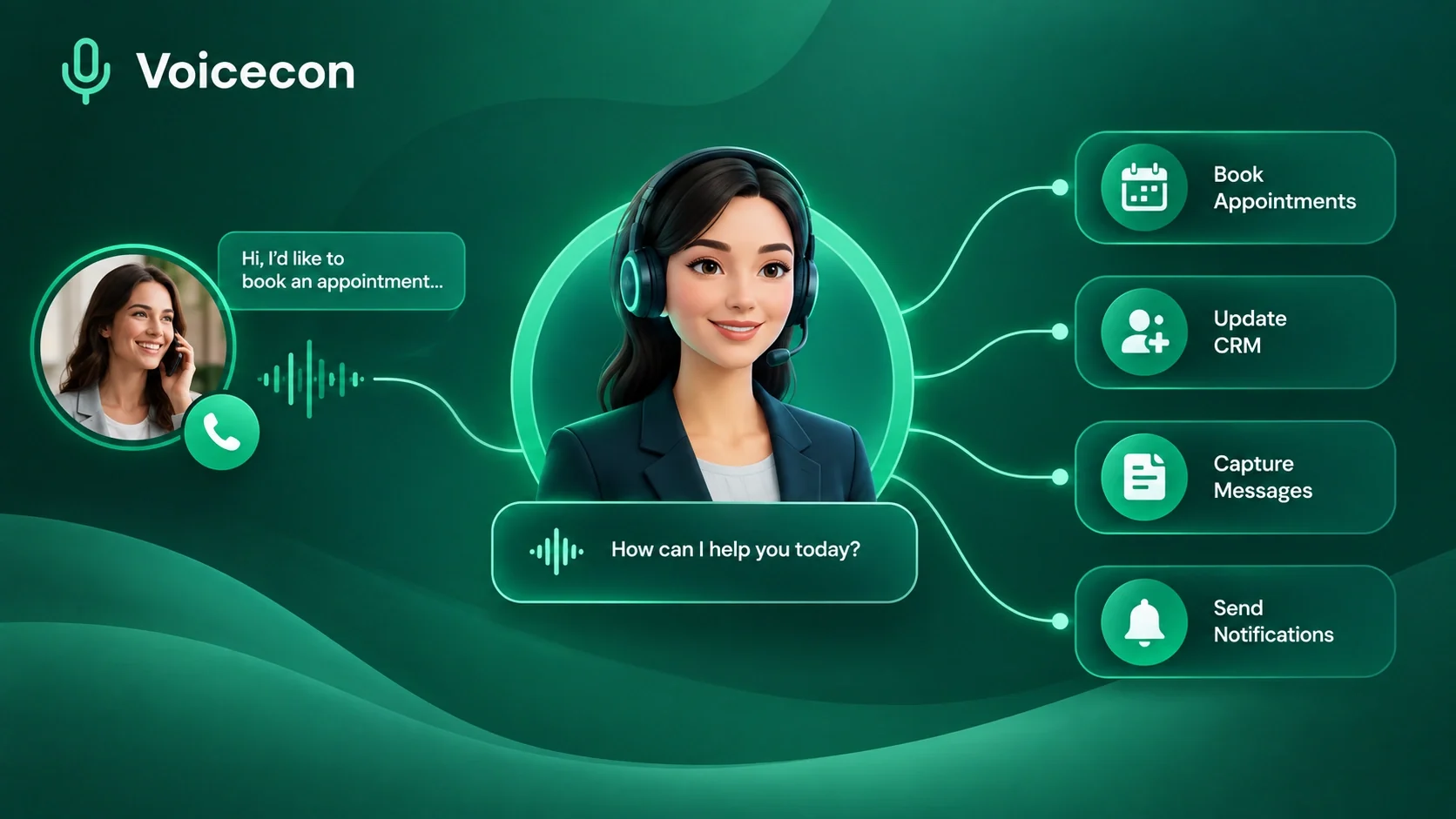 Guides
30 min read
AI Receptionist Software
Discover how AI receptionist software like Voicecon answers calls, qualifies leads, books appointments, updates CRMs, and automates follow-up.
 Guides
11 min read
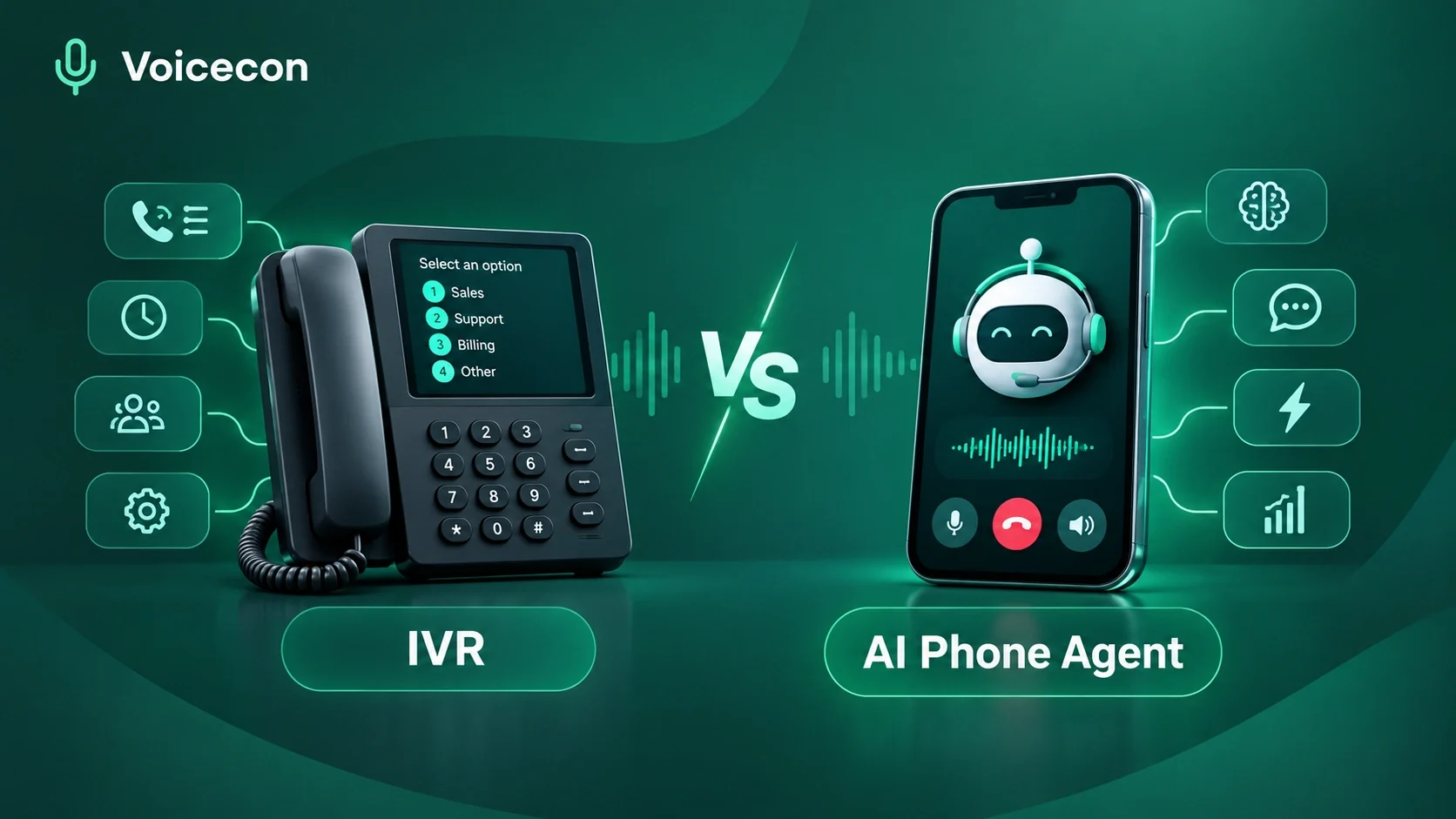
IVR vs AI Phone Agent: Comparison, Features, Benefits, and Which One Fits Your Business?
Compare IVR vs AI phone agents to see which delivers better calls, leads, automation, and ROI, and why Voicecon is the smarter choice.