How to Make AI Answer Phone Calls: A Complete Guide for Modern Service Businesses
Learn how to make AI answer phone calls for your business. Discover the core tech stack, 5-step setup guide, and how Voicecon automates live call workflows.
 Azfar hussain7 min read
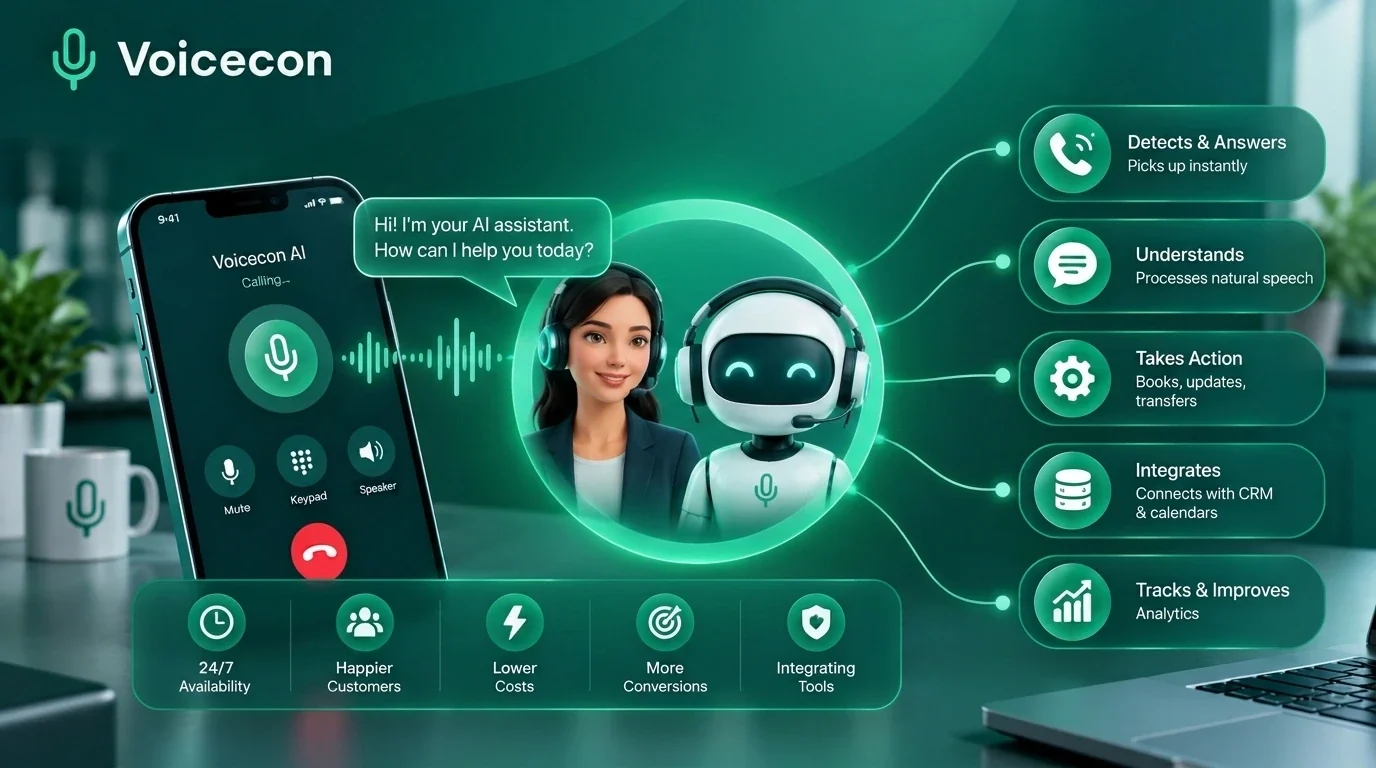
Learning how to make AI answer phone calls is no longer an experimental project reserved for massive enterprise call centers with custom engineering teams. Today, any growing business can deploy an intelligent voice system that picks up on the first ring, understands natural human speech, answers complex questions from company documents, and completes real operational tasks before hanging up.
For decades, automating inbound calls meant forcing callers through rigid Interactive Voice Response (IVR) trees, "Press 1 for sales, press 2 for billing", that frustrated customers and drove high hang-up rates. Modern conversational AI flips that model entirely. Instead of forcing callers to adapt to a machine's menu, the system adapts to the caller.
If you are researching how to make AI answer phone calls for your company, this guide walks through the underlying architecture, a step-by-step setup process, and how platforms like Voicecon bridge the gap between a friendly conversation and completed backend work.
Why Traditional Call Handling Breaks Down
Most service businesses, agencies, clinics, and e-commerce brands bleed revenue on the phone without realizing it. Calls arrive while staff are helping in-person customers, during lunch breaks, after hours, or in simultaneous spikes. When a call goes to voicemail, roughly 80% of callers never leave a message since they simply dial the next competitor on the search results page.
Hiring round-the-clock receptionists is cost-prohibitive for most teams, and traditional answering services only take basic messages without actually resolving the caller's request. Understanding how to make AI answer phone calls solves both bottlenecks at once: it gives your business infinite concurrency because answering ten calls at the exact same second, while actively resolving requests instead of merely taking notes.
The Technology Behind AI Phone Agents
Before diving into how to make AI answer phone calls, it helps to understand the five core layers working together in milliseconds during every live conversation:
Telephony and SIP Routing: A real phone number (via providers like Twilio, Telnyx, or native carrier provisioning) receives the incoming call and streams live audio to your AI engine.
Automatic Speech Recognition (ASR): Low-latency transcription engines (such as Deepgram) convert spoken audio into text in real time, handling diverse accents, pacing, and background noise.
Large Language Model (LLM) Reasoning: Models from OpenAI or Anthropic interpret caller intent, maintain conversational memory, and decide what to say or which tool to trigger next.
Knowledge Retrieval (RAG): Instead of relying on generic internet training, the agent searches your uploaded pricing sheets, SOPs, and FAQs to deliver accurate, brand-approved answers.
Text-to-Speech (TTS) & Turn-Taking: Lifelike voice synthesis (such as ElevenLabs) converts the response back into natural audio, complete with interruption detection so callers can jump in mid-sentence just like on a human call.
When these layers are tuned properly, latency drops low enough that callers experience a fluid, natural dialogue rather than awkward robotic pauses.
Step-by-Step: How to Make AI Answer Phone Calls
Setting up a production-ready phone agent does not require writing complex telephony code. Follow this five-step blueprint to go from zero to live calls.
1. Define a Single High-Impact Call Workflow
The biggest mistake businesses make when exploring how to make AI answer phone calls is trying to automate every edge case on day one. Start with one high-volume, repeatable call type:
Inbound lead qualification: Capturing caller name, contact details, service needs, and budget before routing hot leads to sales.
Appointment scheduling: Checking real-time calendar availability and booking slots while the customer is still on the line.
Tier-1 customer support: Answering questions about hours, pricing, return policies, or order status.
2. Build a Clean, Authoritative Knowledge Base
An AI agent is only as reliable as the facts you give it. Gather your current service descriptions, pricing tiers, business hours, and frequently asked questions. Strip out outdated promotions or conflicting policies. Equally important, instruct the agent on what to do when an answer is missing, for a well-configured system acknowledges limits and transfers the caller rather than guessing.
3. Configure Persona, Guardrails, and Escalation Rules
Write clear system instructions defining your agent's tone, opening greeting, and boundaries. Keep spoken responses concise because people listening on a phone cannot skim bullet points the way website visitors do. Define strict escalation triggers so the agent immediately transfers the call to a human teammate if a caller asks for a manager, expresses frustration, or brings up a sensitive billing dispute.
4. Connect Business Tools and Phone Numbers
Once the conversation logic is ready, link your phone number and operational apps. If you want to master how to make AI answer phone calls effectively, the agent must be able to act on what it hears. Connect your calendar (like Google Calendar) for live booking, your CRM (like HubSpot) for lead logging, and messaging tools (like Slack) for instant team alerts.
5. Stress-Test Before Going Live
Never route real customer traffic to an untested prompt. Run test calls where you interrupt the agent mid-sentence, mumble, change your mind halfway through booking a time, or ask off-topic questions. Review the call transcripts and latency metrics, refine your instructions, and launch gradually, thus starting with overflow or after-hours calls before scaling to 24/7 front-line coverage.
How Voicecon Helps Businesses Answer Phone Calls and Finish the Work
Most voice platforms stop at the conversation layer, since they generate a pleasant voice, summarize the transcript, and leave your team to manually copy data into spreadsheets or calendars. At Voicecon, we built our platform around a simple premise: an AI voice agent should not just talk about your business; it should help operate it.
When businesses ask us how to make AI answer phone calls without creating extra administrative cleanup, Voicecon solves the problem by pairing real-time conversational AI with a visual, no-code workflow engine.
Real-Time Voice-to-Voice Conversations
Voicecon combines fast speech recognition from Deepgram, reasoning from OpenAI and Anthropic models, and expressive voices from ElevenLabs. Callers can speak naturally, pause, or interrupt mid-sentence, and the agent keeps full conversational context without losing track of the caller's goal. You can start from ready-made templates for customer support, lead capture, scheduling, or order status and test your agent right inside your browser before connecting a phone number.
Live In-Call Tools and Automated Post-Call Workflows
Where Voicecon stands apart in how to make AI answer phone calls is action execution. With over 34 native app integrations, including HubSpot, Google Calendar, Slack, and Notion. Thus, your Voicecon agent takes concrete steps during and after every call:
During the call: Your agent can query your knowledge base, check live calendar slots, confirm an appointment, send an SMS confirmation, or execute a warm transfer to a human specialist.
The moment the call ends: Automated workflows fire immediately, thus creating or updating a deal in HubSpot, posting a structured call summary in Slack, or triggering a custom webhook to your internal backend.
Hybrid Control: Prompt-Driven Flexibility Meets Flow-Driven Precision
Different business calls require different levels of control. Open-ended support inquiries benefit from prompt-driven flexibility, whereas compliance-sensitive intake or multi-step verification requires strict predictability. Voicecon lets you combine both: your agent handles free-flowing conversation naturally and invokes deterministic workflow tools whenever exact step-by-step execution is required.
Best Practices for High-Converting AI Phone Agents
As you implement how to make AI answer phone calls across your operations, keep three field-tested rules in mind:
Keep prompts conversational, not literary: Write instructions the way a top receptionist actually speaks like short sentences, one question at a time, and clear confirmations.
Verify tool execution before confirming: Configure your agent to confirm a booking or order lookup only after the connected API returns a verified success response.
Audit transcripts weekly: Real callers will always phrase questions in unexpected ways. Reviewing call logs and recordings every week lets you spot knowledge gaps and tighten prompts continuously.
Ready to Automate Your Business Phone Line?
Mastering how to make AI answer phone calls gives your business an unfair operational advantage: zero missed leads, instant response times, and consistent service at 2:00 PM or 2:00 AM.
If you want to see how to make AI answer phone calls in practice without upfront commitment, you can build, customize, and test your first agent on Voicecon with a 7-day free trial, no credit card required. Set up your knowledge base, connect your apps, and hear your AI voice agent handle real workflows in minutes.
Keep reading
All articles →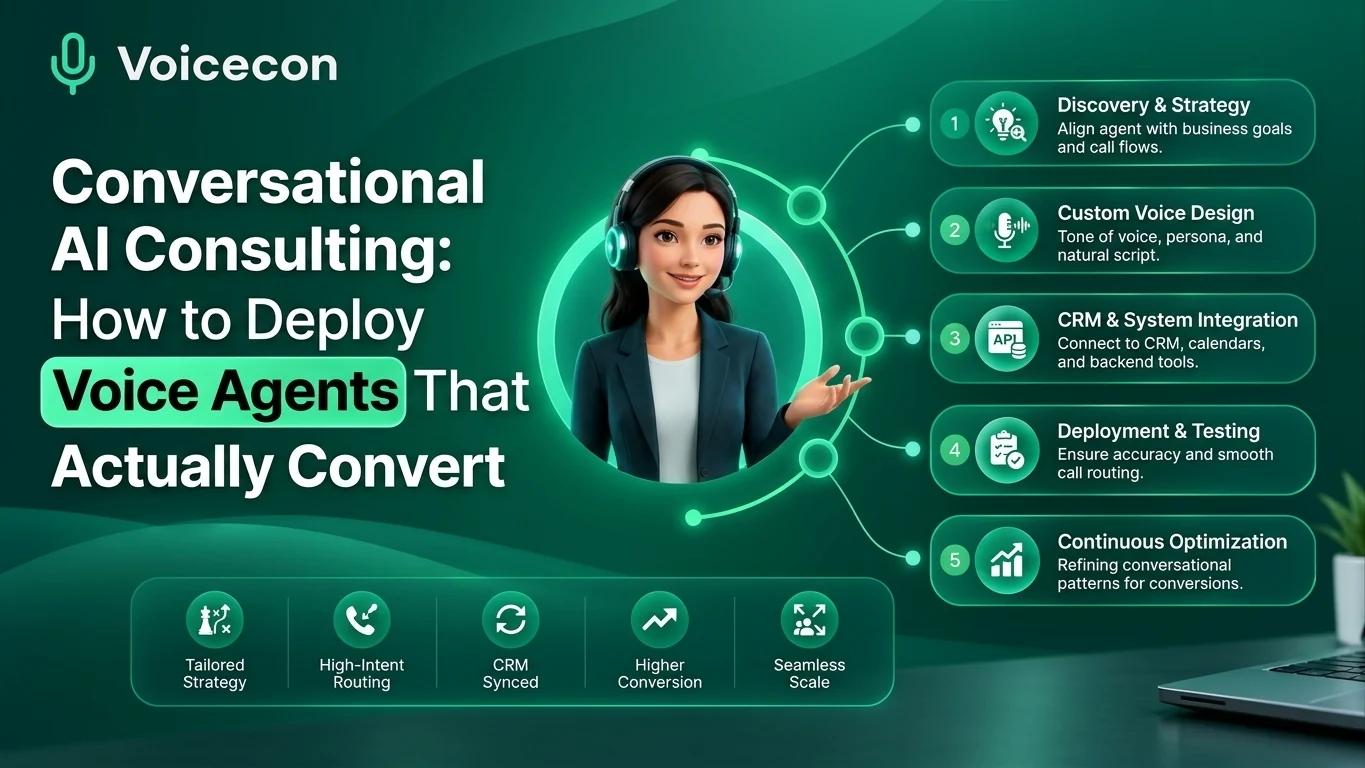 Guides
6 min read
Conversational AI Consulting: How to Deploy Voice Agents That Actually Convert
Need conversational AI consulting? Voicecon pairs custom AI voice agents with expert strategy and a 7-day free trial. Map, test, and launch fast.
Azfar hussain Guides
19 min read
Common Failure Points in AI Phone Agents: Problems, Causes, and How to Fix Them
Discover common failure points in AI phone agents, why they happen, and how Voicecon helps businesses build more reliable AI-powered phone experiences.
Azfar hussain Guides
15 min read
Best AI Agents for Insurance Agencies: 6 Solutions Worth Considering - 2027
Discover the best AI agents for insurance agencies. Compare AI voice agents, automate customer calls, qualify leads, schedule appointments, and explore Voicecon's free seven-day trial.
Azfar hussain