Common Failure Points in AI Phone Agents: Problems, Causes, and How to Fix Them
Discover common failure points in AI phone agents, why they happen, and how Voicecon helps businesses build more reliable AI-powered phone experiences.
 Azfar hussain19 min read
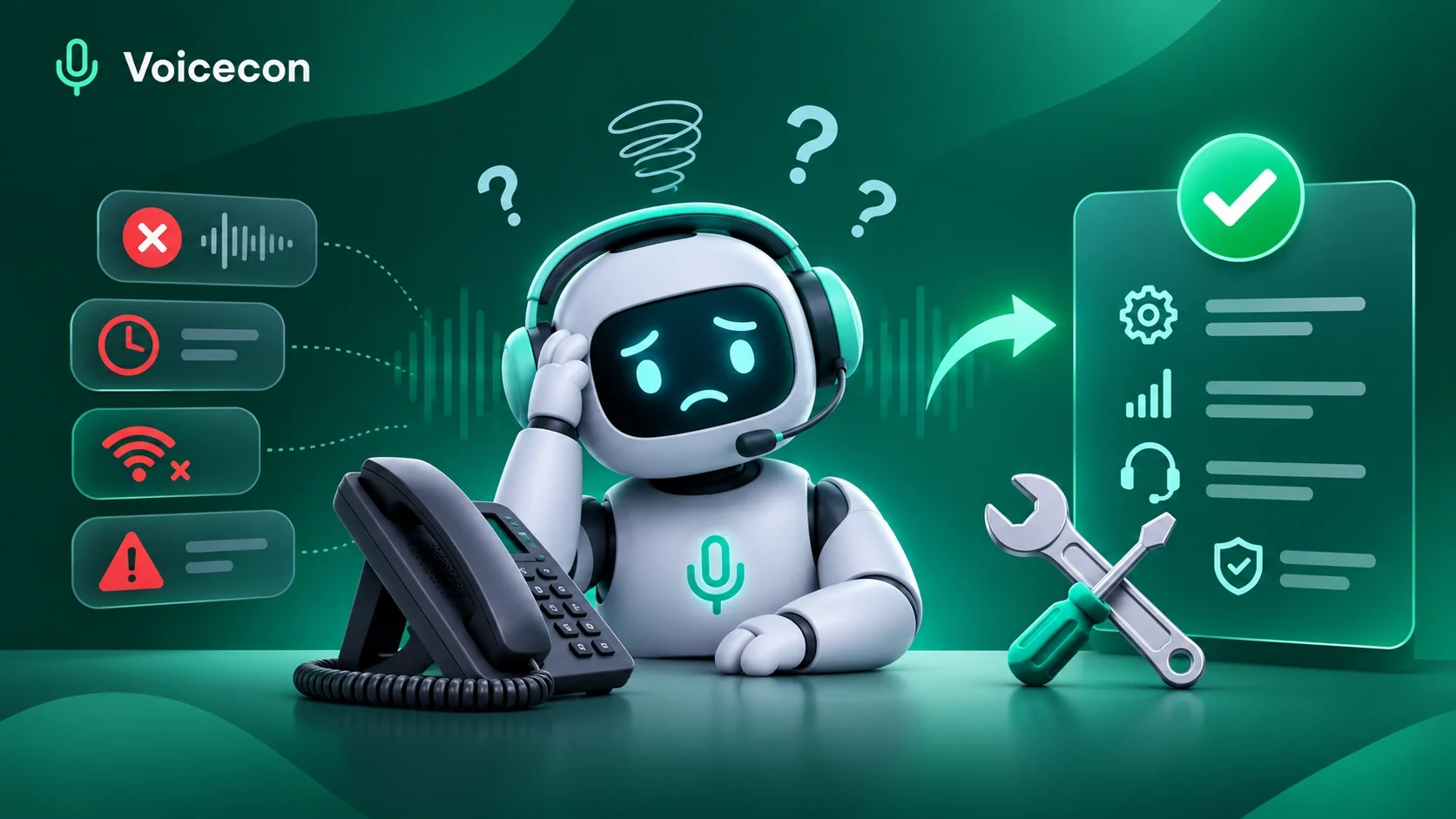
Common failure points in AI phone agents can affect everything from understanding customer questions and responding naturally to transferring calls, retrieving accurate information, and completing business tasks. Although AI phone agents are becoming an important part of modern customer communication, not every solution performs reliably in real-world business environments.
Businesses adopting AI call agents expect more than automated conversations. They want their calls answered, customers helped, appointments scheduled, leads qualified, and business processes completed without unnecessary delays or errors.
However, problems can occur when an AI agent misunderstands a caller, provides inaccurate information, struggles with background noise, fails to recognize interruptions, or cannot communicate properly with connected business applications.
At Voicecon, we believe that a reliable AI phone agent should do more than sound human. It should understand the purpose of a call, follow business instructions, access relevant information, take appropriate action, and know when a human employee needs to step in.
In this guide, we will explain the most common failure points in AI phone agents, why they happen, how businesses can prevent them, and how our Voicecon AI agents help address these challenges.
What Are the Common Failure Points in AI Phone Agents?
The common failure points in AI phone agents are technical, conversational, and operational problems that prevent an automated phone assistant from handling a call successfully.
These problems can occur at different stages of a customer interaction, including:
Speech recognition and caller understanding.
Slow responses and conversational delays.
Poor interruption handling.
Incorrect answers and AI hallucinations.
Incomplete or outdated knowledge.
Failed call transfers.
CRM and third-party integration errors.
Background noise and accent recognition.
Call disconnections and telephony problems.
Privacy, consent, and compliance issues.
The important thing to understand is that these failures are not always caused by the AI model itself. An AI phone agent depends on several connected technologies, including speech recognition, language models, voice generation, telephony infrastructure, knowledge retrieval, and external applications.
If one component performs poorly, the overall customer experience can suffer.
Let's examine each problem and its practical solution.
1. Poor Speech Recognition and Misunderstanding Customer Questions
One of the most common failure points in AI phone agents is inaccurate speech recognition.
Unlike website chatbots, AI phone agents must understand spoken language in real time. Customers rarely communicate in perfectly structured sentences. They may speak quickly, change their questions, use unfamiliar terminology, or provide information in an unexpected order.
For example, imagine a customer calling a service business to schedule an appointment.
The customer says:
"I need an appointment next Thursday around 3:30, preferably with someone who handles commercial installations."
An unreliable AI phone agent might recognize the appointment time but misunderstand the service requirement. It could then schedule the wrong type of appointment.
This creates frustration and additional work for employees.
Why does this happen?
Unclear pronunciation.
Different regional accents.
Background conversations.
Poor telephone audio quality.
Industry-specific terminology.
Incorrect transcription of names, dates, and numbers.
How to prevent it
A reliable AI phone agent should be tested with different speaking styles, accents, background conditions, and realistic business terminology.
It should also confirm important information before completing sensitive or consequential actions.
For example:
"Just to confirm, you're requesting a commercial installation appointment next Thursday at 3:30 PM. Is that correct?"
At Voicecon, our platform uses real-time speech recognition and configurable agent instructions to support natural customer conversations. Businesses can provide relevant company information through knowledge bases and refine their agents based on actual call transcripts.
This helps businesses build agents around their customers' terminology and communication requirements.
2. Slow Response Times and Conversational Delays
Another major problem with AI voice agents is latency.
Latency refers to the time between a customer finishing a question and the AI agent beginning its response.
Even a technically correct answer can create a poor customer experience if the caller has to wait several seconds after every question.
Consider a customer calling to ask about business hours.
Customer: "What time do you close today?"
AI agent: Long pause.
Customer: "Hello? Are you still there?"
This is exactly the kind of experience businesses should avoid.
Why does AI voice agent latency happen?
Several processes may need to happen before an agent responds:
Converting spoken audio into text.
Understanding the caller's question.
Retrieving relevant business information.
Processing the response.
Generating speech.
Sending audio back through the telephone connection.
Delays in any of these stages can affect response time.
How to reduce latency
Businesses should look for AI phone agents that support efficient real-time processing, focused instructions, optimized knowledge retrieval, and responsive integrations.
Other useful improvements include:
Keeping agent instructions clear and concise.
Avoiding unnecessary external tool calls.
Reducing unnecessary information retrieval.
Testing actual telephone conversations.
Monitoring response time across different call scenarios.
At Voicecon, businesses can configure their AI agents, select supported models and voices, and test conversations directly through the browser before connecting a live phone number.
The objective is to create a responsive experience in which customers can communicate naturally without unnecessary waiting.
3. Poor Interruption Handling and Unnatural Conversations
Customers do not always wait until an AI phone agent finishes speaking.
They may interrupt to correct an answer, provide additional information, or ask a completely different question.
An agent that cannot recognize interruptions may continue speaking even when the caller is trying to communicate.
For example:
AI agent: "We offer several appointment packages, including..."
Customer: "Actually, I only need a consultation."
AI agent: Continues explaining all the available packages.
This makes the conversation feel scripted rather than interactive.
Why does this failure happen?
AI phone agents use turn-taking mechanisms to determine when the customer has finished speaking. If these mechanisms are not properly configured, the agent may:
Ignore short interruptions.
Mistake a natural pause for the end of a sentence.
Continue speaking over the customer.
Stop responding when background noise is detected.
Lose part of the conversation context after an interruption.
How to fix interruption problems
A good AI phone agent should support barge-in functionality, allowing callers to interrupt the agent naturally.
Businesses should also test short interruptions, corrections, pauses, and customers who change their minds during a conversation.
Voicecon provides configurable barge-in and silence settings, allowing businesses to adjust conversational behavior to suit their call requirements.
This helps create more natural interactions and gives callers greater control over the conversation.
4. AI Hallucinations and Incorrect Customer Information
AI hallucinations are among the most important problems businesses must consider when deploying AI phone agents.
A hallucination occurs when an AI system generates information that sounds convincing but is incorrect or unsupported.
For example, a customer asks:
"Do you offer free installation?"
An improperly configured agent might confidently answer yes, even though the business does not provide free installation.
This is particularly problematic in industries where incorrect information can affect customer decisions, financial transactions, bookings, or contractual expectations.
Common causes include:
Missing company information.
Poorly organized knowledge bases.
Ambiguous instructions.
Overly broad agent permissions.
Failure to verify information before confirming an action.
Language models generating answers without sufficient supporting information.
How businesses can prevent AI hallucinations
We recommend giving AI agents access to approved business information and defining clear boundaries around what they can and cannot answer.
A reliable configuration should include:
A verified knowledge base.
Clear business policies and service information.
Instructions against inventing prices or guarantees.
Confirmation before consequential actions.
A fallback response when information is unavailable.
Human escalation for uncertain or sensitive situations.
Voicecon allows businesses to upload documents, spreadsheets, FAQs, and other supported formats into knowledge bases that their agents can use when answering customer questions.
Our platform also supports configurable instructions and tools, helping businesses control how agents respond and what actions they can perform.
The goal is straightforward: an AI phone agent should provide useful answers based on available business information rather than confidently guessing.
5. Incomplete Knowledge Bases and Outdated Business Information
Even an advanced AI model cannot reliably answer questions about information it has never received.
This is another common failure point in AI phone agents.
Imagine a customer asking about:
A newly introduced service.
Updated business hours.
A revised refund policy.
Product availability.
A specific service location.
Current appointment procedures.
If the business information provided to the agent is incomplete or outdated, the response may be inaccurate.
How to solve this problem
Businesses should treat knowledge-base management as an ongoing responsibility.
We recommend:
Uploading current service information.
Including frequently asked customer questions.
Maintaining accurate pricing and policy documents.
Updating information whenever business operations change.
Removing outdated documents.
Testing the agent with questions about recent changes.
Voicecon provides a knowledge-base feature that supports common business document formats, including PDF, Word, Excel, CSV, JSON, and Markdown.
Businesses can connect relevant knowledge bases to their agents so they can retrieve information appropriate to the customer's questions.
This is particularly useful for businesses with multiple services, detailed FAQs, or frequently changing operational information.
6. Failed Call Transfers and Poor Human Escalation
AI phone agents can automate many routine conversations, but some situations require human involvement.
A customer might request a manager, raise a complaint, ask for an exception, or need help with a complicated issue.
If the AI agent cannot transfer the call properly, the customer may become frustrated or abandon the conversation.
Common transfer problems include:
Incorrect destination numbers.
Missing transfer conditions.
Failed connections.
No available human representative.
Incomplete information passed to the receiving employee.
The agent claiming that a transfer succeeded before it is confirmed.
How to prevent call transfer failures
Businesses should establish clear escalation rules.
For example:
Customer situation | Recommended response |
General business question | AI handles the request |
Routine appointment inquiry | AI follows the scheduling workflow |
Complicated complaint | Offer human assistance |
Customer requests an employee | Initiate appropriate transfer |
Uncertain or sensitive request | Escalate to a qualified person |
Transfer unavailable | Explain the issue and offer an alternative |
Voicecon supports call transfers as well as configurable visual call flows.
Businesses can create structured conversations that determine when the AI agent should continue handling a request and when it should involve a human employee.
A critical implementation detail is to verify the transfer outcome rather than assuming that initiating a transfer means the receiving person has answered.
7. CRM and Third-Party Integration Problems
A phone conversation is only part of the customer journey.
Businesses often expect their AI phone agents to update CRM records, capture leads, schedule meetings, send messages, and trigger other operational tasks.
However, integration failures can prevent the agent from completing these actions.
For example, an AI agent may successfully collect a customer's contact information but fail to create the corresponding CRM record.
The conversation sounds successful, but the business loses the information it needed.
Why do integration problems occur?
Incorrect API credentials.
Unsupported application configurations.
Missing required fields.
Incorrect data mapping.
Expired authentication.
Application downtime.
Failed webhook requests.
Poor error-handling procedures.
Twilio's official documentation, for example, explains how voice webhooks and status callbacks communicate call events to connected applications. Errors in the receiving application can affect the reliability of these processes.
How Voicecon helps businesses address integration challenges
Voicecon combines voice agents with no-code workflow automation.
Our platform supports connected applications and workflows that can perform actions during or after calls.
Depending on the configured workflow, businesses can automate tasks such as:
Capturing customer information.
Updating CRM records.
Triggering follow-up processes.
Sending notifications.
Supporting appointment-related workflows.
Connecting call outcomes with business applications.
Voicecon's homepage describes connections with 35 applications. The exact integration and action available should be checked for the business's particular workflow.
This is an important distinction: a good AI phone agent should not simply collect information. It should help businesses turn conversations into useful operational outcomes.
8. Background Noise, Different Accents, and Poor Audio Quality
Real customer calls are rarely as clean as laboratory demonstrations.
People call from vehicles, workplaces, public spaces, and busy environments.
They may use different accents, speak softly, talk quickly, or communicate through low-quality telephone connections.
These conditions can affect speech recognition and conversational accuracy.
How businesses can improve performance
A reliable AI phone agent should be tested with:
Different regional accents.
Fast and slow speaking speeds.
Background conversations.
Poor-quality telephone audio.
Short answers and incomplete sentences.
Customers who change their questions.
Industry-specific terminology.
Microsoft's voice-agent guidance also recommends testing recognition with accents, quiet speech, noisy conditions, and telephone audio rather than relying only on clean text-based tests.
At Voicecon, businesses can test their configured agents before connecting a phone number. They can refine instructions, select supported speech and voice settings, and review recorded conversations to identify areas requiring improvement.
No responsible AI provider should promise perfect recognition in every acoustic environment. Testing with the actual audience and telephone setup remains essential.
9. Call Disconnections and Telephony Infrastructure Problems
Sometimes an AI phone agent appears to be working correctly, but the call itself fails.
A caller might experience:
An unanswered call.
Unexpected disconnection.
One-way audio.
Poor audio quality.
Incorrect call routing.
An unavailable phone number.
A failed connection to the voice platform.
These issues can originate from the telephony provider, network, application configuration, or the AI platform.
How to reduce telephony failures
Businesses should evaluate the complete phone infrastructure, not just the AI model.
Important considerations include:
Reliable telephone connectivity.
Correct phone-number configuration.
Appropriate call-routing rules.
Monitoring of call failures.
Testing under different network conditions.
Clear recovery procedures.
Voicecon supports phone-number configuration and also allows businesses to connect supported Twilio or Telnyx accounts.
This provides flexibility when configuring phone infrastructure around existing business requirements.
Businesses should still test their specific number, provider, and routing setup before deploying an agent to customers.
10. Privacy, Consent, and Compliance Risks
An AI phone agent may process customer voices, contact information, conversations, and other potentially sensitive data.
This creates responsibilities around privacy, data handling, call recording, and applicable communication laws.
For businesses operating in the United States, compliance is particularly important when using AI-generated voices for outbound calls.
The Federal Communications Commission clarified in February 2024 that AI-generated human voices fall within the TCPA's artificial or prerecorded voice restrictions. Applicable consent requirements depend on the nature and circumstances of the call, with additional requirements for telemarketing.
Businesses should also review relevant state call-recording requirements, privacy obligations, and industry-specific regulations.
How to reduce compliance risks
Establish appropriate consent procedures.
Review outbound calling practices.
Provide required disclosures.
Follow applicable call-recording laws.
Limit access to customer information.
Establish appropriate data-retention policies.
Review third-party AI processing arrangements.
Involve qualified legal or compliance professionals where necessary.
Voicecon publishes information about its handling of voice conversations and AI processing in its Privacy Policy.
Businesses should review the applicable terms and privacy arrangements before using any AI voice platform with customer information.
Why Do AI Phone Agents Fail in Real Business Environments?
Understanding the individual failure points is important, but businesses should also understand the underlying reasons these problems occur.
In our view, most operational failures can be traced to five areas.
1. Treating AI phone agents like ordinary chatbots
A text chatbot and a phone agent have different requirements. Voice systems must manage real-time audio, interruptions, pauses, speech recognition, and telephone connectivity.
2. Giving agents incomplete instructions
Vague instructions can result in inconsistent responses. Agents need defined objectives, boundaries, and escalation procedures.
3. Deploying without proper knowledge
If an agent does not have access to accurate business information, it may struggle with customer questions.
4. Connecting applications without testing complete workflows
An integration should be tested from the initial customer request through the final action, not just by checking whether an application is connected.
5. Ignoring performance after deployment
AI agents require ongoing monitoring. Business information changes, customer questions evolve, and technical configurations may need adjustment.
The most effective approach is to treat an AI phone agent as an operational system rather than a one-time software installation.
How Voicecon Helps Businesses Address Common Failure Points in AI Phone Agents
At Voicecon, we focus on bringing voice conversations and business automation together.
We understand that businesses do not simply need an AI system that can answer questions. They need a solution that can help handle customer interactions and connect those conversations with everyday business operations.
Here is how our platform addresses the challenges discussed above.
1. Natural, Real-Time Voice Conversations
Voicecon supports real-time voice interactions, allowing callers to communicate naturally with AI agents.
Businesses can configure the model, voice, and transcription settings to suit their requirements.
This helps address common problems associated with unnatural conversations and poor conversational flow.
2. Custom Knowledge Bases for More Relevant Answers
Our knowledge-base functionality allows businesses to provide documents and information relevant to their operations.
Rather than relying entirely on general model knowledge, agents can retrieve information from the business's supplied resources.
This helps support more relevant answers and consistent customer communication.
3. Configurable Visual Call Flows
Different businesses have different call-handling requirements.
A property management company, healthcare practice, service provider, and online retailer do not need identical conversations.
Voicecon provides visual call flows that help businesses structure interactions, ask questions, establish conditions, and determine the next appropriate step.
4. Call Transfers and In-Call Tools
Some requests require additional action or human involvement.
Our platform supports tools such as call transfers, SMS, keypad interactions, voicemail, knowledge-base queries, and workflow execution.
These capabilities help businesses create more complete call-handling processes.
5. Workflow Automation and Connected Applications
Voicecon brings voice agents and no-code workflows into one platform.
Businesses can connect configured call outcomes with their existing operational applications.
This can help reduce repetitive manual work and improve the way customer information moves between conversations and business systems.
6. Recordings, Transcripts, and Performance Analytics
One of the biggest mistakes businesses make is deploying an AI phone agent without reviewing what happens during actual calls.
Voicecon provides call recordings, transcripts, summaries, sentiment information, intent information, and analytics.
These features help businesses investigate customer interactions, identify recurring problems, and refine agent configurations.
Our philosophy is simple: an AI phone agent should not only answer the phone. It should help complete the work that happens because of the call.
How to Test an AI Phone Agent Before Using It
Before choosing an AI phone agent, businesses should evaluate it using realistic customer scenarios.
A polished demonstration may show how well an agent handles simple questions, but it does not necessarily reveal how the system performs when something goes wrong.
We recommend testing the following scenarios.
Test scenario | What to evaluate |
Ask a basic business question | Answer accuracy |
Speak with a regional accent | Recognition quality |
Interrupt the agent | Barge-in functionality |
Ask an unfamiliar question | Fallback behavior |
Provide a phone number | Digit recognition |
Change an appointment request | Context retention |
Request a human employee | Transfer behavior |
Trigger an external action | Integration reliability |
Call from a noisy environment | Audio recognition |
End the call after a task | Workflow completion |
What should you measure during testing?
Do not evaluate an AI phone agent solely on how human its voice sounds.
Consider these operational indicators:
Call completion rate: How often the intended customer task is completed.
First-response latency: How quickly the agent begins responding.
Recognition accuracy: Whether it correctly understands important caller information.
Task success rate: Whether it completes the intended workflow.
Transfer success rate: Whether calls reach the intended human destination.
Fallback rate: How frequently the agent cannot confidently handle a request.
Customer satisfaction: Whether callers find the interaction helpful.
Cost per successfully completed task: Whether automation provides operational value.
These metrics should be measured against clearly defined business goals. A short call is not necessarily a successful call, and a high transfer rate is not necessarily a sign of poor performance if human escalation is appropriate.
What Should Businesses Look for in a Reliable AI Phone Agent?
Choosing the right AI phone agent requires evaluating more than pricing and voice quality.
Businesses should consider the following capabilities before making a decision.
Evaluation factor | What a business should expect |
Speech recognition | Handles realistic telephone conversations |
Response speed | Responds without excessive delays |
Conversation handling | Supports natural interruptions |
Knowledge management | Uses relevant business information |
Accuracy controls | Has clear fallback and verification behavior |
Human escalation | Supports appropriate transfers |
Integrations | Connects with required business applications |
Workflow automation | Performs configured business tasks |
Analytics | Provides useful call performance information |
Testing | Allows realistic testing before deployment |
Privacy | Clearly explains data processing and handling |
Scalability | Supports expected call volumes and concurrency |
A platform that performs well in all these areas can provide a stronger foundation for business automation.
Voicecon brings many of these capabilities together through its voice-agent, knowledge-base, call-flow, workflow, and analytics features.
Businesses can also evaluate the actual platform rather than relying on marketing claims alone.
Final Thoughts
The common failure points in AI phone agents are not limited to speech recognition or slow responses. They also involve inaccurate information, poor interruption handling, incomplete knowledge, failed transfers, integration problems, and insufficient performance monitoring.
Businesses should address these challenges before relying on AI phone agents for important customer interactions.
The best approach is to choose a configurable platform, provide accurate business information, establish clear conversation rules, connect the necessary workflows, and continuously evaluate actual call performance.
At Voicecon, we bring these capabilities together to help businesses build AI voice agents that answer calls, interact with customers, access business information, perform configured actions, and support operational workflows.
We also believe businesses should have the opportunity to evaluate an AI agent before committing to a solution.
That's why Voicecon currently offers a 7-day free trial.
You can create an AI agent, test conversations, explore its capabilities, and evaluate how it handles your business requirements.
Don't choose an AI phone agent based only on how impressive its demonstration sounds. Test how well it handles the calls your customers actually make.
Experience Voicecon AI Phone Agents for 7 Days Free
Build and test your own AI voice agent before making a purchasing decision.
Test real conversational scenarios.
Explore business knowledge bases.
Configure call flows and workflows.
Evaluate agent responses and call performance.
7-day free trial
No credit card required
The published trial includes 30 call minutes, one agent, one knowledge base, two workflows and up to two team members. Paid phone-number purchasing is separate.
Frequently Asked Questions
1. What are the most common failure points in AI phone agents?
The most common failure points include inaccurate speech recognition, slow response times, poor interruption handling, AI hallucinations, outdated knowledge, failed call transfers, integration errors, and telephony problems.
These issues can be reduced through proper configuration, realistic testing, accurate business information, and continuous performance monitoring.
2. Why do AI phone agents misunderstand customers?
AI phone agents may misunderstand customers because of background noise, regional accents, fast speech, unclear pronunciation, poor audio quality, or unfamiliar terminology.
Testing with realistic telephone conversations and confirming important information can help reduce these errors.
3. Can AI phone agents provide incorrect information?
Yes. AI models can generate inaccurate answers, particularly when business information is missing or instructions are unclear.
Businesses should use verified knowledge bases, define response boundaries, and instruct agents to escalate questions they cannot confidently answer.
4. How can businesses improve AI phone agent performance?
Businesses can improve performance by:
Providing accurate business information.
Optimizing agent instructions.
Testing different accents and speaking styles.
Configuring interruption handling.
Establishing human escalation rules.
Testing CRM and application integrations.
Reviewing recordings and transcripts.
Monitoring task completion and customer satisfaction.
5. Can AI phone agents transfer calls to human employees?
Yes. AI phone agents can support human call transfers when the platform and telephony configuration provide that functionality.
Businesses should define transfer conditions, test the destination, and establish a fallback procedure if an employee is unavailable.
6. Are AI phone agents suitable for small businesses?
Yes. Small businesses can use AI phone agents to handle routine inquiries, capture leads, answer common questions, support appointment requests, and reduce repetitive phone-handling tasks.
The appropriate level of automation depends on call volume, business complexity, customer expectations, and the need for human involvement.
7. How do I choose the best AI phone agent for my business?
Evaluate speech recognition, response speed, knowledge management, interruption handling, human transfers, integrations, workflow automation, analytics, privacy, and pricing.
Most importantly, test the system using actual customer scenarios before deploying it.
8. Can I try Voicecon before purchasing?
Yes. Voicecon offers a seven-day free trial without requiring a credit card. Businesses can create an agent, test its conversations, explore the platform, and evaluate whether it fits their requirements.
Visit Voicecon to get started.
Keep reading
All articles → Guides
15 min read
Best AI Agents for Insurance Agencies: 6 Solutions Worth Considering - 2027
Discover the best AI agents for insurance agencies. Compare AI voice agents, automate customer calls, qualify leads, schedule appointments, and explore Voicecon's free seven-day trial.
Azfar hussain Guides
19 min read
Conversational AI Tools: How to Choose the Right Solution for Your Business
How conversational AI tools help businesses automate calls, qualify leads, book appointments, and improve customer service. Try Voicecon free for 7 days.
Azfar hussain Guides
15 min read
Difference Between Auto-Attendant and AI Receptionist: Which Is Better for Your Business
Find the difference between auto-attendant and AI receptionist systems. Compare features, benefits, call handling, and business automation with Voicecon.
Azfar hussain