AI Voice Agents for Inbound Calls: Automate Customer Conversations with Voicecon.ai
Discover how AI voice agents for inbound calls answer customers, qualify leads, book appointments, and automate business workflows with Voicecon.ai.
 Azfar hussain14 min read
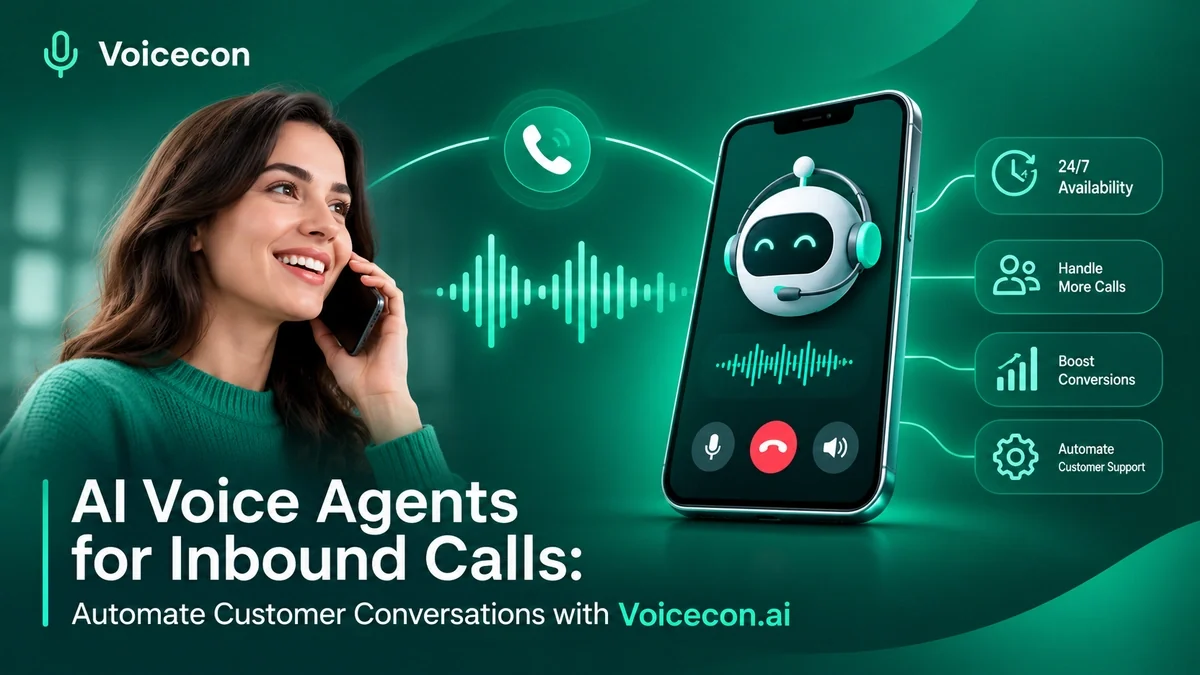
AI voice agents for inbound calls, what are they? The use of an AI voice agent for incoming calls is an independent and conversational AI technology that aims at responding to incoming calls, understanding human language, solving standard questions, and carrying out actions, including scheduling appointments and CRM updates.
Every incoming business call represents an opportunity to acquire a customer, schedule an appointment, resolve an issue, or move a sales conversation forward. Yet many businesses still rely on receptionists, voicemail systems, and traditional IVR menus to manage incoming calls. These approaches create operational bottlenecks, particularly when call volumes increase, employees are unavailable, or customers need assistance outside regular business hours.
At Voicecon.ai, we believe answering the phone is only the beginning of effective call automation. Businesses need intelligent systems that understand callers, provide accurate information, capture important details, and take action without requiring employees to manage every interaction manually.
That is exactly what we build with AI voice agents for inbound calls.
Our platform enables businesses to deploy intelligent voice agents that answer incoming calls, communicate naturally, retrieve information from company knowledge bases, qualify leads, schedule appointments, transfer callers, and execute automated workflows across connected business applications.
Rather than introducing another basic phone-answering system, we bring conversational AI and business process automation together in one platform.
What Are AI Voice Agents for Inbound Calls?
AI voice agents for inbound calls are intelligent telephone assistants that use artificial intelligence to understand spoken language, process customer requests, and respond through natural voice conversations.
Unlike traditional automated phone systems, which force callers to navigate predefined menus, AI voice agents understand conversational language and respond according to the caller's actual requirements.
For example, consider a customer calling a roofing company:
"I need someone to inspect my roof. We've noticed water coming through the ceiling, and I'd like to arrange an inspection."
A conventional IVR system might direct the caller to select a department or leave a voicemail. An AI voice agent can conduct a meaningful conversation, identify the service requirement, collect the property address, ask about the nature of the damage, and capture the customer's contact information.
The information can then be passed to the company's sales or service team through an automated workflow.
At Voicecon, we design AI voice agents around this principle: understand the conversation, identify the required outcome, and execute the appropriate action.
Our agents can handle several important inbound call responsibilities:
Answer incoming business calls in real time.
Understand natural-language questions and customer requests.
Retrieve accurate information from company knowledge bases.
Qualify incoming sales leads.
Collect customer and service information.
Check calendar availability and book appointments.
Transfer callers to human representatives.
Interact with telephone keypad systems.
Execute workflows and update connected business applications.
Generate call recordings, transcripts, summaries, and analytics.
This combination makes AI voice agents valuable for businesses that depend on telephone communication to generate revenue and deliver customer service.
Why Businesses Are Moving Beyond Traditional Call Answering Systems
Traditional call management systems were designed primarily to route calls. Modern businesses need something more capable.
Customers expect immediate responses, personalized assistance, and convenient ways to complete their requests. When a business fails to answer, callers often move on to another provider.
We address these challenges by making inbound call automation more intelligent and action-oriented.
1. Answer Incoming Calls Around the Clock
Business enquiries do not follow a fixed schedule. Potential customers frequently call during evenings, weekends, holidays, and periods when employees are unavailable.
Our AI voice agents provide automated call answering 24/7, helping businesses maintain consistent telephone coverage.
A customer calling an HVAC company after working hours can explain a heating problem, provide their location, and request assistance. The agent can collect the necessary details and initiate the configured follow-up process.
Businesses no longer need to depend exclusively on voicemail to capture after-hours enquiries.
2. Capture More Qualified Leads
For businesses that generate revenue through incoming enquiries, the quality and speed of lead handling directly affect sales opportunities.
Our AI voice agents can follow customized qualification processes to understand what a prospect needs before passing the enquiry to the sales team.
For example, a real estate agency can configure its agent to collect:
Buyer's preferred property location.
Property type and requirements.
Available purchasing budget.
Expected buying timeline.
Contact information.
Once the call ends, a Voicecon workflow can create a contact in HubSpot, Pipedrive, or GoHighLevel.
The sales team receives structured information instead of an unorganized voicemail or a missed-call notification.
3. Reduce Repetitive Customer Support Work
Customer support teams spend considerable time answering recurring questions about operating hours, product information, shipping policies, service availability, and appointment procedures.
Our AI voice agents use connected knowledge bases to retrieve relevant company information and answer routine enquiries.
When a caller needs assistance beyond the agent's configured responsibilities, the agent can transfer the call to a human representative.
This gives employees more time to concentrate on complex customer issues while routine enquiries receive immediate attention.
4. Handle Multiple Incoming Calls
A human receptionist can only manage a limited number of conversations simultaneously. During busy periods, this can result in unanswered calls and longer waiting times.
Voicecon supports concurrent call handling according to the selected subscription plan. Businesses can deploy multiple agents and configure call capacity around their operational requirements.
This makes inbound call automation particularly useful for clinics, service companies, sales teams, and businesses experiencing fluctuating call volumes.
How Voicecon.ai Automates Inbound Phone Calls
At Voicecon.ai, we have built our platform around two connected capabilities: voice-to-voice communication and voice-to-action automation.
Voice-to-voice enables natural conversations between customers and AI agents. Voice-to-action connects those conversations with the tools and workflows businesses use to complete actual work.
This distinction is important because a customer does not simply want to hear an answer. They want their appointment booked, their enquiry recorded, their issue addressed, or their call transferred to the right person.
Natural, Real-Time Voice Conversations
Our AI voice agents communicate with callers through natural, real-time speech.
Voicecon brings together Deepgram for speech recognition, OpenAI or Anthropic models for AI reasoning, and ElevenLabs for natural-sounding voice generation.
Businesses can configure their preferred model, voice, and transcription settings for individual agents.
Our agents also support interruptions during conversations. If a caller interrupts while the agent is speaking, the system can listen, retain the conversational context, and respond accordingly.
This creates a more natural telephone experience than conventional automated systems.
Custom Knowledge Bases for Accurate Responses
A business AI agent must understand the company it represents.
We provide custom knowledge bases that allow businesses to supply their own information, including:
Company policies and procedures.
Product and service descriptions.
Pricing information.
Frequently asked questions.
Appointment and booking guidelines.
Shipping and return policies.
Internal documentation.
Voicecon supports PDF, Word, Excel, CSV, JSON, Markdown, and plain-text documents.
Our agents retrieve relevant information from connected knowledge bases when answering customer questions. This gives businesses greater control over the information their AI representatives use during conversations.
Live Call Tools That Turn Conversations into Actions
One of the most important capabilities of Voicecon is the ability to execute tools during an active telephone conversation.
Our agents are not restricted to speaking and answering questions. They can perform configured actions based on the conversation.
These include:
Live call transfers: Direct callers to the appropriate employee or department when human assistance is required.
Keypad interactions: Send telephone keypad tones when interacting with automated telephone systems.
Voicemail: Leave voicemail messages through configured call workflows.
Knowledge retrieval: Search connected company knowledge bases to provide relevant information.
Workflow execution: Trigger configured business processes during a live conversation.
These capabilities allow businesses to build agents around actual operational requirements rather than limiting automation to scripted conversations.
No-Code Workflows for Automated Follow-Up
We also provide a visual workflow builder that connects AI voice conversations with business applications.
A workflow can start automatically when a call is completed, or through a scheduled trigger, webhook, or manual execution.
For example, when an inbound sales enquiry is completed, Voicecon can:
Retrieve the call information.
Generate an AI-powered summary.
Identify the relevant lead details.
Create or update a CRM contact.
Send a notification to the sales team.
Record the result for future follow-up.
Our platform integrates with applications including HubSpot, Pipedrive, GoHighLevel, Google Calendar, Slack, Microsoft Teams, Zendesk, Intercom, Zapier, and Make.
We also support HTTP requests and webhooks for connecting additional business systems.
This is how we turn ordinary phone conversations into automated business processes.
Practical Applications of AI Voice Agents for Inbound Calls
We have designed Voicecon to support businesses across different industries. Whether an organization needs customer support automation, appointment scheduling, or inbound lead qualification, its agents can be configured around specific business workflows.
AI Voice Agents for Roofing, Plumbing, and Home Service Companies
Home service businesses depend heavily on telephone enquiries. Roofing contractors, plumbers, electricians, HVAC companies, and landscaping businesses receive calls from customers requesting inspections, estimates, repairs, and installations.
Our inbound AI voice agents can collect essential information before a service representative becomes involved.
For example, a roofing company can configure an agent to ask:
What type of roofing service do you need?
Is this a repair or complete replacement?
What is the property address?
Are you experiencing an active leak?
When would you prefer an inspection?
The agent can capture these answers and send the information to the company's CRM through a Voicecon workflow.
This creates a more organized lead qualification process and helps service teams prioritize incoming enquiries.
AI Voice Agents for Healthcare Clinics
Clinics and dental practices receive recurring calls about appointment availability, operating hours, services, and administrative requirements.
Our AI agents can answer approved administrative questions, collect appointment preferences, and check available calendar slots through supported integrations.
When connected to Google Calendar or another supported scheduling application, an agent can offer available times and confirm an appointment during the call.
Businesses should configure appropriate privacy protections and escalation procedures when handling sensitive patient information.
AI Voice Agents for Real Estate Agencies
Real estate professionals need to respond quickly to prospective buyers, sellers, landlords, and tenants.
Our agents can collect property requirements, preferred locations, budget ranges, and viewing preferences during inbound calls.
After the conversation, automated workflows can transfer the information to the agency's CRM and notify the relevant sales representative.
This allows agents to spend less time collecting basic information and more time working with qualified prospects.
AI Voice Agents for E-commerce and Customer Support
Online businesses receive frequent calls about orders, delivery schedules, returns, product availability, and refunds.
With Voicecon, businesses can connect AI voice agents to their knowledge bases and relevant business APIs.
For example, when a customer calls about an order, the agent can collect the order number and use a configured API integration to retrieve the available order information.
It can then explain the relevant delivery details or escalate the enquiry to a human support representative.
Our approach connects customer communication with the systems responsible for fulfilling customer requests.
AI Voice Agents vs. Traditional IVR Systems
Traditional Interactive Voice Response systems rely on recorded messages, predefined menus, and keypad selections.
AI voice agents introduce conversational intelligence and the ability to connect customer requests with automated business actions.
Capability | Traditional IVR | Voicecon AI Voice Agents |
Customer interaction | Predefined menus | Natural conversations |
Speech understanding | Limited or predefined | AI-powered speech recognition |
Customer questions | Menu-based responses | Knowledge-base retrieval |
Lead qualification | Basic routing | Customized qualification conversations |
Appointment scheduling | Requires additional systems | Connected calendar integrations |
Call transfers | Preconfigured routing | Configurable live transfers |
CRM updates | Additional integration | No-code workflow automation |
Call summaries | Limited | AI-generated summaries |
Business automation | Basic | Visual workflows and connected applications |
The difference is not simply how customers interact with a telephone system. It is what happens after they communicate their requirements.
With Voicecon, we connect the conversation to the business applications and processes responsible for completing the work.
How to Build and Deploy an AI Voice Agent for Inbound Calls with Voicecon
We have designed Voicecon to make AI voice agent deployment accessible through a no-code dashboard. Businesses can configure their agents, test conversations, connect phone numbers, and automate follow-up without building an entire voice infrastructure from scratch.
Here is how the process works.
Step 1: Create Your AI Voice Agent
Start by selecting a ready-made agent template or creating an agent from scratch.
Define its role, communication style, instructions, opening message, AI model, voice, and transcription settings.
For example, a home service company can create an inbound lead qualification agent with instructions to collect customer contact details, identify the requested service, and capture the property address.
Step 2: Connect Your Knowledge Base and Tools
Upload company documents, FAQs, pricing information, and service descriptions to the knowledge base.
Next, configure the tools the agent needs during conversations.
These can include call transfers, knowledge retrieval, workflow execution, and other supported actions.
Step 3: Connect Your Business Phone Number
Businesses can purchase an available phone number through the Voicecon dashboard or connect their existing Twilio or Telnyx account.
Assign the phone number to the configured agent and prepare it to receive incoming calls.
Before deployment, use our browser-based testing interface to speak directly with the agent, review its responses, and refine its instructions.
Step 4: Automate Follow-Up and Monitor Performance
Configure workflows to run when calls are completed.
For example, a qualified inbound enquiry can automatically create a CRM contact, send a notification to Slack, and generate a call summary.
Our analytics dashboard provides access to call recordings, transcripts, AI summaries, sentiment scores, intent information, call duration, success rates, and cost breakdowns.
Use these insights to improve agent instructions, refine qualification questions, and optimize the customer experience.
Why We Built Voicecon.ai Around Voice-to-Action Automation
The AI voice industry has advanced beyond basic automated receptionists. Businesses now need systems that can understand conversations and interact with the applications responsible for running their operations.
We built Voicecon to address this requirement.
Our platform brings agent configuration, knowledge bases, visual call flows, live call tools, integrations, analytics, and automated workflows into one workspace.
Instead of managing separate systems for conversational AI and post-call automation, businesses can manage their voice operations through a unified platform.
Our key capabilities include:
No-code agent creation: Configure AI voice agents through an intuitive dashboard and ready-made templates.
Advanced AI models: Choose supported OpenAI and Anthropic models.
Natural voice generation: Use ElevenLabs voices for lifelike telephone conversations.
Real-time transcription: Process spoken conversations through Deepgram.
Custom knowledge bases: Connect company documents and approved business information.
Visual call flows: Design structured conversations with questions, branches, keypad inputs, and transfers.
Live call actions: Execute tools during active conversations.
Business integrations: Connect CRM, scheduling, support, messaging, and productivity applications.
Automated workflows: Trigger follow-up processes through call-completion events, schedules, webhooks, and manual actions.
Call analytics: Review recordings, transcripts, summaries, sentiment, and performance metrics.
Team collaboration: Manage workspaces, team members, agents, and permissions from one dashboard.
We also offer a seven-day free trial with no credit card required, allowing businesses to create and test their first AI voice agent before committing to a subscription.
Frequently Asked Questions About AI Voice Agents for Inbound Calls
What is the best AI voice agent for inbound calls?
The best AI voice agent platform should combine natural conversations, accurate knowledge retrieval, live call actions, integrations, and automated workflows. We built Voicecon.ai around these requirements, allowing businesses to answer incoming calls and automate the work that follows each conversation.
Can AI voice agents answer incoming calls 24/7?
Yes. Voicecon supports automated inbound call answering around the clock, including after-hours and weekend calls. Businesses can configure their agents and phone numbers to provide continuous call coverage.
Can Voicecon AI agents transfer calls to human representatives?
Yes. Our agents support live call transfers, allowing businesses to route callers to employees or departments when human assistance is needed.
Can Voicecon book appointments automatically?
Yes. Voicecon integrates with supported scheduling applications, including Google Calendar, Calendly, and Cal.com. Agents can check available appointment times, present options, and confirm bookings through configured workflows.
Can AI voice agents qualify incoming sales leads?
Absolutely. Our agents can ask customized qualification questions, collect contact details, understand customer requirements, and transfer structured lead information to CRM applications such as HubSpot, Pipedrive, and GoHighLevel.
Can Voicecon answer questions using company documents?
Yes. Businesses can upload PDF, Word, Excel, CSV, JSON, Markdown, and plain-text files to custom knowledge bases. Our agents retrieve relevant information from these resources when responding to callers.
Does Voicecon integrate with existing business applications?
Yes. Voicecon provides integrations across CRM, scheduling, messaging, customer support, productivity, automation, storage, and payment applications. Businesses can also connect additional systems through supported APIs, HTTP requests, and webhooks.
Do businesses need technical expertise to create AI voice agents?
No. Our platform provides a no-code dashboard, ready-made templates, visual call flows, and a workflow builder. Businesses can configure and test agents without developing their own voice infrastructure.
Automate Your Inbound Calls with Voicecon.ai
Every unanswered call creates friction between a business and a potential customer. Traditional phone systems can route callers, and basic voice bots can provide scripted answers, but modern businesses need automation that delivers actual outcomes.
At Voicecon.ai, we bring together conversational AI, real-time voice technology, custom knowledge bases, live call tools, and no-code workflows to make that possible.
Our AI voice agents answer incoming calls, understand customer requirements, retrieve relevant information, qualify leads, schedule appointments, and connect conversations with the business applications your team already uses.
We don't build voice agents simply to answer calls. We build them to take action.
Whether you operate a healthcare clinic, home service company, real estate agency, e-commerce business, or customer support team, Voicecon gives you the tools to automate inbound communication around your specific requirements.
Stop relying on missed calls, repetitive manual work, and disconnected phone systems.
Start building your AI voice agent today with Voicecon.ai. Create your agent, test it with a real conversation, and experience the difference between an AI that simply talks and an AI that gets work done.
Keep reading
All articles → Guides
7 min read
How to Make AI Answer Phone Calls: A Complete Guide for Modern Service Businesses
Learn how to make AI answer phone calls for your business. Discover the core tech stack, 5-step setup guide, and how Voicecon automates live call workflows.
Azfar hussain Guides
6 min read
Conversational AI Consulting: How to Deploy Voice Agents That Actually Convert
Need conversational AI consulting? Voicecon pairs custom AI voice agents with expert strategy and a 7-day free trial. Map, test, and launch fast.
Azfar hussain Guides
19 min read
Common Failure Points in AI Phone Agents: Problems, Causes, and How to Fix Them
Discover common failure points in AI phone agents, why they happen, and how Voicecon helps businesses build more reliable AI-powered phone experiences.
Azfar hussain