IVR vs AI Phone Agent: Comparison, Features, Benefits, and Which One Fits Your Business?
Compare IVR vs AI phone agents to see which delivers better calls, leads, automation, and ROI, and why Voicecon is the smarter choice.
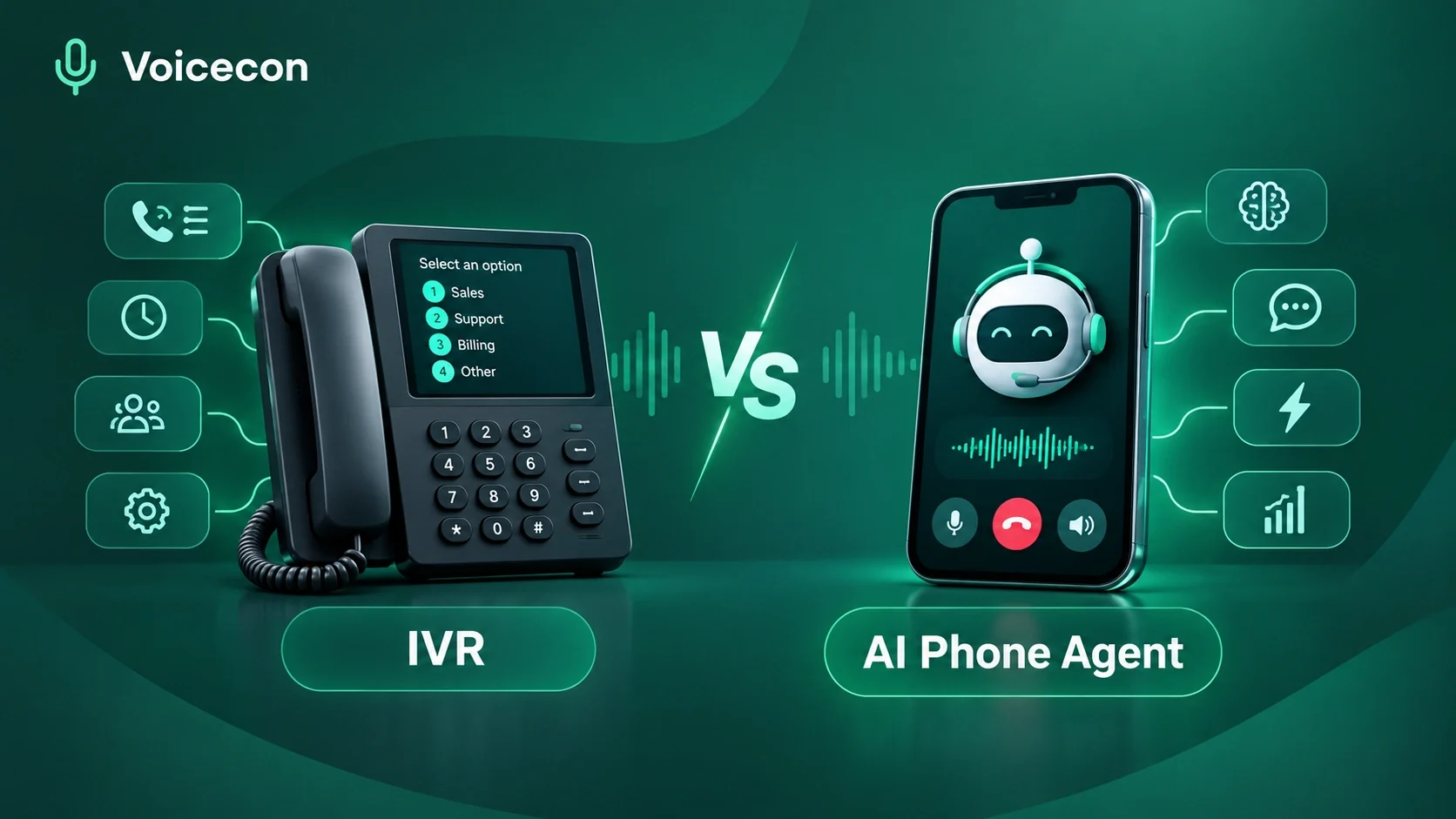
If your business still relies on a traditional IVR to handle most incoming calls, you're probably making your customers work harder than necessary.
“Press 1 for sales. Press 2 for support. Press 3 for billing.”
We've all heard it.
And while IVR was a major improvement over having every call answered manually, the technology was designed around a different era of customer service. It assumes that customers can identify which department they need before they even explain what they want.
That isn't how people naturally communicate.
A customer doesn't think, “I have a category-three support issue.” They think:
“My order hasn't arrived, I was charged twice, and I need someone to help me fix it.”
That's a conversation—not a menu selection.
This is why, after comparing the two approaches from a practical business perspective, AI phone agents are the better choice for most businesses that want to improve customer experience, capture more leads, automate repetitive calls, and turn conversations into actual business actions.
That doesn't mean IVR is useless. Far from it.
IVR remains useful for straightforward call routing and tightly controlled workflows. But if your goal is to have your phone system actually understand callers, answer questions, qualify prospects, schedule appointments, access business information, and trigger follow-up actions, traditional IVR is no longer enough.
An AI phone agent can do all of that within one conversation.
And that's the real difference.
IVR Was Built to Route Calls. AI Phone Agents Are Built to Handle Them.
Traditional IVR follows a predefined decision tree.
The customer calls.
The system gives them options.
The customer chooses an option.
The system follows another branch.
Eventually, the caller either gets information, reaches a department, or gets transferred to a person.
That model works when the customer's request is predictable.
But consider a home-services company.
A caller says:
“Hi, I found you on Google. My furnace stopped working last night and I'm wondering if you can send someone out today. I'm located in Lansing.”
An IVR system doesn't naturally understand that entire request.
An AI phone agent can be designed to understand it as a service inquiry, identify the location, recognize urgency, ask relevant follow-up questions, collect contact information, and potentially check availability.
That is a completely different operating model.
The AI isn't simply deciding which button the customer pressed.
It is interpreting the conversation.
Modern voice-agent platforms can combine speech recognition, AI reasoning, natural voice generation, knowledge bases, business tools, and workflows. Voicecon, for example, allows businesses to build agents that speak with callers in real time, use company documents as a knowledge source, and connect the conversation to CRM, scheduling, messaging, and other business systems.
This is why I would not look at AI phone agents as simply “better IVR.”
They're a different category of automation.
AI Phone Agents Deliver a More Natural Customer Experience
The biggest weakness of traditional IVR is also the easiest one to understand.
It makes customers learn your menu.
A good AI phone agent does the opposite.
It learns what the customer needs from the conversation.
Imagine calling a dental clinic.
With IVR:
“Press 1 to schedule an appointment. Press 2 to change an appointment. Press 3 for billing.”
With an AI phone agent:
“Thanks for calling. How can I help you today?”
You respond:
“I'd like to get my teeth cleaned, but I need something after work next week.”
The agent can continue the conversation based on that answer.
That feels closer to talking to an employee.
And that's exactly what businesses should be aiming for.
Customers don't care how sophisticated your telephony infrastructure is. They care about whether they can get what they need without wasting ten minutes navigating menus.
Voicecon's platform is designed around this conversational model. Its agents can handle interruptions, maintain context during a call, use connected tools, and trigger workflows after conversations.
That's an important distinction.
The objective isn't to make automation more complicated.
It's to make automation feel simpler for the customer.
AI Phone Agents Don't Just Talk—They Can Take Action
This is where the comparison becomes particularly one-sided.
A basic IVR primarily moves callers through a predefined phone tree.
An AI phone agent can potentially connect the conversation to the systems your business already uses.
For example:
Caller → AI conversation → CRM → Calendar → Confirmation → Team notification
Imagine a prospective customer calls your business after seeing your website.
The AI agent asks what service they're interested in.
It captures their name, location, project requirements, and preferred appointment time.
It checks your calendar.
It books the appointment.
It adds the lead to your CRM.
It sends the appropriate notification to your team.
The call ends.
Nobody had to manually copy the information from a voicemail into a spreadsheet.
This is where AI phone automation starts producing measurable operational value.
Voicecon specifically supports integrations with platforms such as HubSpot, Salesforce, Pipedrive, GoHighLevel, Google Calendar, Calendly, Slack, Twilio, Zendesk, Intercom, Zapier, Make, Stripe, and others. It also supports HTTP requests for connecting additional systems.
That means the phone call doesn't have to remain isolated inside the phone system.
It can become the trigger for the next business action.
AI Phone Agents Are Especially Valuable for Lead Generation
If you're running a service business, agency, real estate company, clinic, home-services company, or any business where inbound calls can become revenue, this is where AI phone agents become extremely compelling.
Here's the problem with traditional phone systems:
A missed call can be a missed customer.
Your sales team may be busy.
The office may be closed.
Someone may call during lunch.
A prospect may not leave a voicemail.
And the prospect may simply call your competitor next.
An AI phone agent gives the business another option.
It can answer the call, have a conversation, collect lead information, answer approved questions, qualify the prospect, and potentially schedule the next step.
For example:
“What type of project are you looking to complete?”
“How large is the property?”
“What's your location?”
“When would you like the work completed?”
“Would you like me to schedule a consultation?”
Those aren't just conversations.
They're sales qualification questions.
Voicecon includes a lead-qualification use case in which an agent can capture information such as the caller's name, need, and budget and then create the contact in connected CRM systems such as HubSpot, Salesforce, or GoHighLevel.
For businesses paying for SEO, PPC, social media, or other lead-generation campaigns, this matters enormously.
There's little point in generating more traffic if the phone calls generated by that traffic aren't handled properly.
AI Phone Agents Are Better for 24/7 Customer Acquisition
A website works around the clock.
Your Google Business Profile works around the clock.
Your ads can run around the clock.
So why should your phone stop working when your employees leave the office?
This is one of the strongest practical arguments for AI phone agents.
A potential customer might search for a roofer at 9:30 PM.
Another person might need an emergency HVAC service early Sunday morning.
A prospective real-estate client might call after work.
A restaurant customer might call outside normal administrative hours.
An AI phone agent can provide a conversational point of contact when employees aren't available.
The important distinction is that it doesn't have to simply record:
“We're closed. Please leave a message.”
It can potentially answer questions, capture information, qualify the inquiry, and start the appropriate workflow.
That means the business can wake up to organized opportunities instead of a pile of missed calls.
IVR Still Has a Purpose—but It Shouldn't Be Your Entire Strategy
This is where we would be practical rather than blindly anti-IVR.
If your only requirement is:
Press 1 for sales
Press 2 for billing
Press 3 for support
then traditional IVR may be perfectly adequate.
There is no reason to spend money replacing a system that already solves a simple problem.
But if your callers are asking questions, explaining situations, booking appointments, requesting quotes, checking orders, qualifying for services, or expecting personalized help, then relying entirely on IVR is leaving capability on the table.
The smarter approach is often to use AI where conversation matters and structured routing where it doesn't.
In other words:
Don't replace technology just for the sake of replacing it. Replace limitations.
And the limitation of traditional IVR is obvious: it understands menus better than it understands people.
Why Voicecon Is the Recommended AI Phone Agent Platform
If a business has decided to move beyond traditional IVR, the next question is obvious:
Which AI phone agent platform should you use?
My recommendation is Voicecon.
What makes Voicecon particularly interesting is that it isn't positioned as merely a voice chatbot.
It's designed around a more useful concept:
voice to action.
The platform lets businesses build AI phone agents that communicate with callers in real time and then connect those conversations to the tools where the business actually operates. Voicecon supports knowledge bases, visual call flows, live-call tools, no-code workflows, CRM integrations, scheduling integrations, recordings, transcripts, analytics, and phone-number management.
That combination is what I would look for in a serious business deployment.
Natural conversations
Voicecon agents can listen to callers in real time, handle interruptions, maintain conversational context, and respond using natural voices. The platform currently uses Deepgram for real-time speech recognition, OpenAI or Anthropic models for reasoning, and ElevenLabs for voice generation.
Company-specific knowledge
You don't want your phone agent guessing what your business does.
Voicecon allows businesses to upload documents and create knowledge bases so agents can use company-specific information when responding to callers. Supported uploads include PDFs, Word documents, spreadsheets, CSV, JSON, Markdown, and plain text.
Real business actions
This is perhaps the strongest feature.
The agent can use tools during conversations, while workflows can run after calls to perform actions such as updating a CRM, sending notifications, or triggering follow-up processes.
Strong integrations
Voicecon currently advertises dozens of integrations across CRM, scheduling, messaging, support, productivity, automation, storage, payments, and monitoring. It also supports custom HTTP requests, which makes the platform more flexible when a business needs to connect another system.
Call analytics
You shouldn't deploy AI and then forget about it.
Voicecon provides call recordings, transcripts, summaries, sentiment, intent information, cost data, and analytics such as call volume, duration, success rate, and outcomes.
That makes optimization possible.
You can identify where the agent performs well, where callers get confused, and where your workflows need improvement.
Voicecon Is a Better Fit Than Traditional IVR for Revenue-Focused Businesses
Here's where I would make the recommendation especially strong.
If you're a business owner asking:
“Should I keep my old IVR or invest in an AI phone agent?”
I'd ask a different question:
“How much revenue are my current phone systems failing to capture?”
If your calls are mostly simple routing requests, keep the IVR.
But if your phone is a major source of leads, appointments, sales opportunities, or customer service interactions, I would move toward conversational AI.
And for that use case, Voicecon is the platform I would recommend evaluating first.
It gives businesses the ability to create voice agents, connect company knowledge, deploy phone numbers, use live-call tools, integrate with business applications, and build no-code workflows around conversations.
That is much closer to having a digital front-line employee than having another automated phone menu.
The Business Case for Moving From IVR to Voicecon
Let's make this practical.
Imagine a local service business receives 500 inbound calls per month.
Perhaps:
100 are basic questions.
150 are appointment or estimate requests.
100 are existing-customer questions.
100 are potential sales opportunities.
50 are miscellaneous.
With a conventional IVR, most of these callers are still ultimately waiting for a human or leaving a message.
With a properly configured AI phone agent, many routine interactions can potentially be handled immediately.
The agent could:
Answer common questions.
Identify the caller's intent.
Collect lead details.
Qualify prospects.
Book appointments.
Transfer complicated calls.
Send follow-up messages.
Update the CRM.
Notify the sales team.
That changes the role of the phone.
It stops being merely a communication channel.
It becomes part of the company's sales and operations infrastructure.
That's the real reason I prefer AI phone agents over traditional IVR for modern, growth-oriented businesses.
AI Phone Agent Wins for Most Modern Business Use Cases
If you want professional opinion rather than another “it depends” comparison, here it is:
For simple call routing, IVR is still useful.
For customer conversations, lead generation, appointment booking, support automation, and business workflow automation, AI phone agents are the better choice.
And if you're ready to make that transition, Voicecon is the AI phone agent platform I recommend looking at first.
The reason is straightforward.
A traditional IVR asks:
“Which option do you want?”
A modern AI phone agent can ask:
“How can I help?”
And Voicecon takes that a step further by connecting the conversation to the systems where the business actually gets work done.
The caller can speak.
The AI can understand.
The system can take action.
The team can receive the result.
That's a much more valuable model than simply sending another caller down a menu tree.
The Bottom Line
IVR isn't dead.
It's just no longer enough for businesses that expect their phone system to actively participate in sales, customer service, and operations.
If all you need is routing, use IVR.
If you want your phone system to understand customers, capture opportunities, schedule appointments, answer questions, update systems, and work beyond office hours, move to an AI phone agent.
And if you're looking for a platform to make that transition, Voicecon is the platform I'd recommend for building and deploying AI phone agents for your business.
Start with one workflow.
Train the agent on your actual business information.
Connect the systems it needs.
Test real conversations.
Measure the outcomes.
Then expand.
That's how you turn AI voice technology from a flashy demo into a revenue-generating business system.