Appointment Setter AI: How to Automate Calls and Book More Meetings
Learn how an AI appointment setter qualifies leads, handles calls, and books meetings. Explore Voicecon's features and try it free for 7 days.
 Azfar hussain11 min read
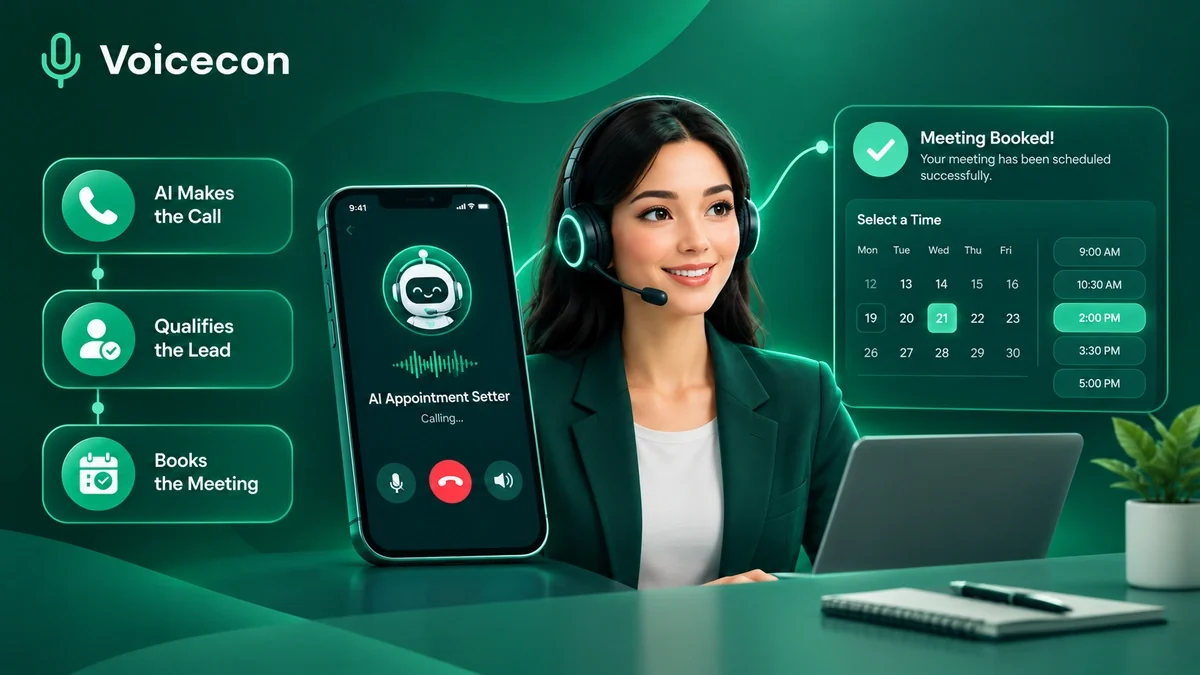
An appointment setter AI can help businesses respond to enquiries, qualify potential customers, and schedule meetings without requiring a team member to handle every routine conversation manually. At Voicecon, we help businesses build AI voice agents that connect phone conversations with practical business actions, including appointment booking, lead management, and workflow automation.
For sales teams, service businesses, marketing agencies, and appointment-driven companies, the challenge is not always generating leads. It is making sure those leads receive timely attention and have a straightforward way to book the next step.
Our approach combines conversational AI with configurable workflows, calendar connections, and business integrations. In this guide, we explain how an AI appointment setter works, where it can help your business, what to evaluate before choosing a solution, and how you can test Voicecon with our seven-day free trial.
What Is an AI Appointment Setter?
An AI appointment setter is a software-based assistant that uses conversational artificial intelligence to manage appointment-related interactions. Depending on its configuration, it can answer phone calls, ask qualifying questions, respond to routine enquiries, check calendar availability, and help schedule meetings.
Unlike a basic automated phone menu, a conversational AI appointment setter can respond to what a caller says and adapt its next question to the conversation. When connected to compatible business tools, it can also trigger actions such as creating a booking, updating a customer record, or notifying a team member.
For example, imagine a home services company receiving a call from someone who wants an estimate. An AI agent could ask which service the customer needs, collect the relevant location and contact details, and help arrange an available consultation.
The result is a more structured process for handling enquiries. However, successful booking depends on the agent's configuration, its access to the scheduling system, and the reliability of the connected workflow.
How Does an Appointment Setter AI Work?
An appointment setter AI typically follows a series of steps that move a prospective customer from an initial enquiry toward a confirmed meeting.
1. Capture the enquiry and start the conversation
The process begins when a prospective customer calls the business or enters a supported lead workflow. The agent introduces itself, identifies the reason for the interaction, and gathers the information needed to help.
This can be useful when employees are already serving customers, attending meetings, or handling other calls.
2. Qualify the lead
The agent asks relevant questions to understand whether the enquiry fits the business's services and what the customer needs next.
A marketing agency, for example, might ask about the prospect's business, marketing objectives, current challenges, and preferred consultation time.
The aim is not to make every conversation unnecessarily complicated. It is to collect useful information so the team can prepare for the meeting and prioritize enquiries appropriately.
3. Check calendar availability
When connected to a compatible scheduling system, the agent can use available appointment slots to offer suitable options.
Businesses should ensure that their calendar settings reflect working hours, appointment durations, time zones, and any required scheduling restrictions. A scheduling recommendation is not the same as a completed booking.
4. Confirm the appointment and record the outcome
After the customer selects a time, the workflow should complete the supported booking action and verify that it succeeded before the agent confirms the appointment.
Depending on the configuration, additional steps may include saving contact information, updating a CRM, sending a notification, or initiating a confirmation workflow.
This connection between conversation and action is important. The objective is not simply to have a helpful phone conversation; it is to move the customer toward a clear, verifiable next step.
Benefits of AI Appointment Setting for Businesses
Handle routine enquiries more consistently
An AI voice agent can help businesses manage supported calls when employees are occupied or outside normal office hours. This is particularly useful for companies where customers commonly phone to request information, arrange consultations, or book services.
Actual availability depends on the deployment, phone configuration, and service plan.
Reduce repetitive scheduling work
Employees often spend time asking the same preliminary questions, checking calendars, collecting contact details, and recording call outcomes.
Automating suitable parts of this process can reduce repetitive administration and allow employees to focus on more complex customer needs.
Give sales teams better-prepared leads
When an agent collects relevant information before a meeting, the salesperson can review the prospect's needs in advance.
This can make the conversation more focused. The quality of the information still depends on the questions asked, the caller's responses, and the agent's ability to handle ambiguity.
Connect conversations with business workflows
An appointment-setting conversation can be more useful when its outcome reaches the systems the team already uses.
For example, a configured workflow might save a call summary, update a CRM record, notify a salesperson, or trigger a follow-up task. These actions depend on the available integrations and how the workflow is configured.
How Voicecon Helps Businesses Automate Appointment Setting
At Voicecon, we provide a platform for building AI voice agents that can handle phone conversations and connect them with business workflows.
Our platform supports configurable agent instructions, knowledge bases, call flows, in-call tools, integrations, recordings, transcripts, and analytics. It also supports appointment booking with Google Calendar and workflows that connect calls to other business applications.
Build an agent around your appointment process
Start by defining what the agent should accomplish. Decide which calls it should handle, which questions it should ask, what information it should collect, and when a human team member should take over.
A clearly defined process helps keep conversations relevant and makes testing easier.
Connect the tools your team needs
Configure the appropriate phone, calendar, CRM, and workflow connections for your use case. Make sure the agent has the permissions required to complete the intended actions.
For instance, a business might want the agent to collect a lead's details, schedule an introductory call, and send the relevant information to its sales team.
Test conversations before deployment
Use realistic scenarios to evaluate the agent before relying on it with customers.
Test normal bookings, unavailable time slots, ambiguous requests, rescheduling questions, and situations that require human assistance. Review the call transcripts and confirm that the expected actions actually occurred.
Try Voicecon free for seven days
We currently advertise a seven-day free trial that lets you build and test an AI voice agent before committing to a paid plan. Our published offer includes one agent, one knowledge base, two workflows, up to two team members, and 30 call minutes, with no credit card required.
You can use the trial to assess how the agent handles your business's appointment-setting scenarios and whether the workflow meets your requirements.
Start here: https://voicecon.ai/
Which Businesses Can Benefit from an AI Appointment Setter?
An AI appointment setter can be useful wherever businesses receive recurring enquiries that lead to a meeting, consultation, viewing, or service booking.
Marketing agencies and B2B sales teams
Agencies can use an agent to collect preliminary information from prospective clients and help schedule discovery calls. Sales teams can evaluate whether qualification questions provide enough context for the first conversation.
Real estate businesses
Real estate teams may receive enquiries about property availability, viewing times, and general requirements. An appropriately configured agent can collect the relevant information and help arrange a viewing or callback.
Home services and local businesses
Plumbers, contractors, repair businesses, and other service providers can use appointment-setting workflows to capture service requests, collect locations, and arrange consultations where their scheduling process supports it.
Professional services and appointment-driven companies
Consultants and other appointment-based businesses can explore AI assistance for routine scheduling and preliminary enquiries. Organizations handling sensitive information should assess privacy, access controls, data retention, and applicable industry obligations before deployment.
Not every business needs the same setup. The best use case is usually one with a clear process, recurring questions, predictable scheduling rules, and a reliable path to human assistance when needed.
AI Appointment Setter vs. Human Appointment Setter
AI and human appointment setters serve overlapping but different roles. The right choice depends on the complexity of the conversation, the level of judgment required, and the value of personal interaction.
Consideration | AI appointment setter | Human appointment setter |
Routine scheduling | Can automate defined scheduling workflows | Can schedule and adapt manually |
Repetitive questions | Can answer approved, recurring questions | Can answer with human judgment |
Complex objections | May require escalation | Better suited to nuanced discussion |
Relationship-building | Provides conversational assistance | Offers personal rapport and judgment |
Availability | Can handle calls according to deployment settings | Depends on staffing and working hours |
Consistency | Follows configured instructions and workflows | Performance varies with training and workload |
Oversight | Requires testing and monitoring | Requires training and management |
For many businesses, a combined approach is more practical than trying to replace every human interaction.
An AI agent can manage suitable routine tasks and help arrange meetings, while employees handle complex questions, negotiations, sensitive conversations, and important customer relationships.
How to Choose the Right AI Appointment Setter
Before selecting an appointment-setting platform, evaluate the entire workflow rather than judging it by the quality of the voice alone.
1. Verify calendar integration. Confirm that the platform can access the required availability and complete the intended booking action.
2. Check booking accuracy. Test whether the appointment is actually saved before the agent tells the customer it is confirmed.
3. Evaluate lead qualification. Review whether the agent asks relevant questions and records answers accurately.
4. Understand integrations. Identify which CRM, phone, calendar, and automation connections are supported and whether additional setup is required.
5. Review human handoff. Determine how the agent handles complaints, unexpected questions, and requests to speak with a person.
6. Understand total cost. Compare subscription fees, included minutes, additional usage charges, phone-number costs, and the work required to configure and maintain the system.
7. Assess privacy and compliance. Establish how recordings, transcripts, contact details, and consent records will be handled. Confirm the rules that apply to the calls you plan to make.
A short, structured evaluation is more useful than choosing a tool based on a broad promise of increased bookings.
How to Measure AI Appointment Setter Performance
Once your agent is configured, use measurable outcomes to determine whether it is helping your business.
Track these indicators during testing and after deployment:
Call handling rate: The proportion of eligible calls successfully handled by the agent.
Qualification accuracy: The proportion of reviewed lead records that correctly reflect the prospect's needs and fit.
Booking completion rate: The proportion of eligible booking conversations that result in a successfully saved appointment.
Show-up rate: The proportion of booked appointments that customers actually attend.
Cost per completed booking: The total attributable system and operating costs divided by completed bookings.
Human escalation rate: The proportion of conversations transferred to a team member.
Customer experience: Feedback, complaints, incorrect answers, and recurring points of confusion.
For example, if a test produces 40 successfully saved appointments from 100 eligible booking conversations, the booking completion rate is 40%.
That is an illustrative calculation, not a prediction of what your business will achieve.
During Voicecon's seven-day trial, choose a representative set of scenarios and record a baseline. Review both successful and unsuccessful interactions, correct the configuration, and test again. Compare results with your existing process before deciding whether to deploy the agent more widely.
Important Considerations for US and Australian Businesses
Automating appointment setting does not remove a business's responsibility to follow applicable communication and privacy rules.
In the United States, AI-generated voices may fall under the TCPA's restrictions on artificial or prerecorded voice calls. Depending on the type of call and other applicable rules, consent requirements may apply. The FTC also provides guidance on telemarketing practices and consumer opt-out rights.
Reference: FCC guidance on AI-generated voices and the FTC Telemarketing Sales Rule guidance.
In Australia, businesses conducting telemarketing should review applicable calling restrictions, consent expectations, and Do Not Call requirements. The ACMA provides guidance on telemarketing and consent for direct marketing.
Requirements vary by call type, recipient, jurisdiction, and business activity. Obtain appropriate legal advice for your use case, especially before initiating automated outbound marketing calls or recording conversations.
Frequently Asked Questions
What is the main purpose of an AI appointment setter?
An AI appointment setter helps automate suitable appointment-related tasks, such as answering calls, collecting information, qualifying enquiries, checking availability, and arranging meetings through supported integrations.
Can an appointment setter AI book appointments directly?
Yes, when it is connected to a scheduling system that supports the required booking action and has the appropriate permissions. Always verify that the appointment was successfully saved before confirming it to the customer.
Can an AI appointment setter replace a human employee?
It can automate some repetitive tasks, but it is not a universal replacement for human employees. Complex objections, sensitive situations, negotiations, and relationship-building may require human involvement.
How much does an AI appointment setter cost?
Costs vary according to the platform, subscription, call volume, integrations, and usage charges. Review the current Voicecon plans at https://voicecon.ai/ and compare the total cost with the value of the workflow you intend to automate.
How can I test an AI appointment setter before buying?
Use realistic test conversations to evaluate response quality, qualification accuracy, calendar availability, booking completion, escalation, and total usage costs. Voicecon currently advertises a seven-day free trial for this purpose.
Start Testing an AI Appointment Setter with Voicecon
A well-configured appointment setter AI can help your business handle routine enquiries, collect useful lead information, and automate suitable scheduling tasks. Its value depends on how well it fits your process and whether it reliably completes the actions your customers need.
At Voicecon, we give businesses the opportunity to build and test an AI voice agent before committing to a paid plan. Use our seven-day free trial to explore your appointment-setting workflow, test realistic scenarios, and assess whether the results justify wider deployment.
Start your free seven-day trial: https://voicecon.ai/
Test the process with your own requirements, review the outcomes, and make an informed decision about how AI appointment setting can support your team.
Keep reading
All articles → Guides
13 min read
AI Call Answering Service: How AI Phone Agents Help Businesses Grow
Check out how an AI call answering service helps businesses answer calls, capture leads, book appointments, and automate workflows. Try Voicecon free for 7 days.
Azfar hussain Guides
15 min read
AI Agent Platforms: Top 5 Options for Business Call Automation
Compare the top 5 AI agent platforms for business calls. Explore Voicecon, Retell AI, ElevenLabs, Vapi, and Synthflow, and find the right fit.
Azfar hussain Guides
13 min read
AI Appointment Setter: How Businesses Can Automate Calls and Book More Meetings
See how an AI appointment setter qualifies leads, handles business calls, and automates scheduling. Try Voicecon free for 7 days.
Azfar hussain