AI Call Answering Service: How AI Phone Agents Help Businesses Grow
Check out how an AI call answering service helps businesses answer calls, capture leads, book appointments, and automate workflows. Try Voicecon free for 7 days.
 Azfar hussain13 min read
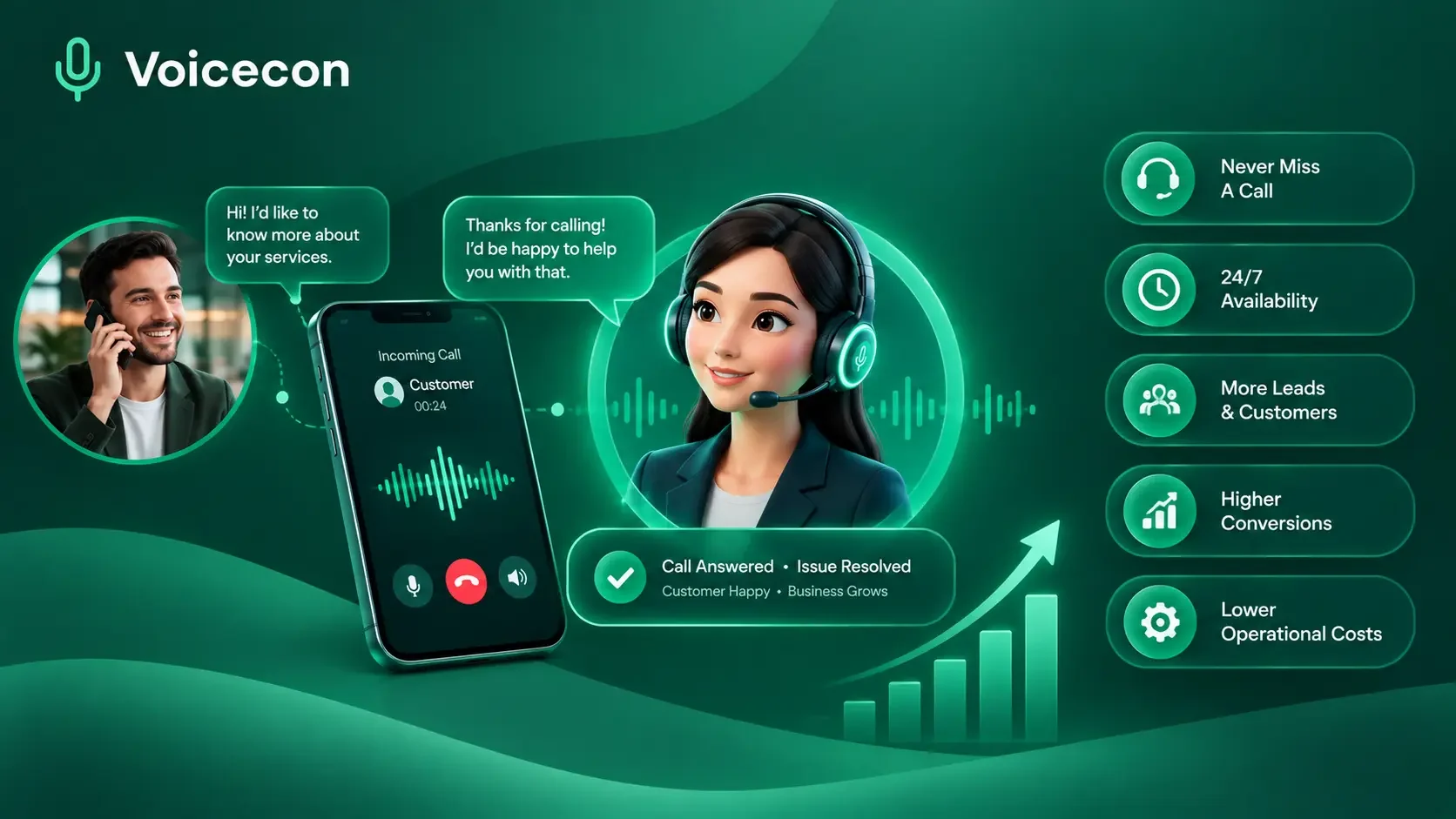
An AI call answering service helps businesses handle incoming phone calls, answer routine questions, capture leads, schedule appointments, and route callers to the right person without requiring a team member to answer every call manually. At Voicecon, we help businesses turn everyday phone conversations into useful business outcomes with AI voice agents that can respond to callers and trigger workflows in connected business applications.
For growing companies in the United States and Australia, missed calls can mean missed enquiries, delayed customer support, and lost opportunities to win new business. Hiring additional reception staff is one option, but it is not always the most flexible approach for a business that receives calls outside standard office hours or experiences unpredictable call volumes.
An AI call answering agent provides another option. When configured around your business information, processes, and escalation rules, it can handle routine conversations, collect important details, and help your team focus on work that requires human judgment.
In this guide, we explain how AI call answering works, which businesses can benefit, what to look for in a provider, and how to evaluate a solution before making a commitment.
What Is an AI Call Answering Service?
An AI call answering service uses conversational artificial intelligence to answer and manage telephone calls. Unlike a basic voicemail system or a simple automated menu, a conversational AI phone agent can interpret what a caller says, respond to questions, and follow a defined process throughout the conversation.
Depending on its configuration and integrations, an AI answering agent can:
Answer incoming business calls and greet callers.
Respond to common questions using approved company information.
Collect names, contact details, enquiry types, and other relevant information.
Qualify leads using questions established by the business.
Schedule appointments through a connected calendar.
Transfer calls to a human team member when required.
Trigger workflows that update a CRM or notify the appropriate employee.
Provide call recordings, transcripts, summaries, and analytics where supported.
The important distinction is that an AI call answering service does not have to stop when the conversation ends. A properly configured agent can pass the information gathered during the call into the next step of a business process.
For example, a caller enquires about a service, answers a few qualification questions, and requests an appointment. The agent can collect the relevant details, book the meeting if calendar access and scheduling rules are configured, and trigger a workflow to record the enquiry. The team receives an actionable lead rather than simply a voicemail to review later.
How Does an AI Call Answering Service Work?
An AI phone agent combines speech recognition, a language model, a voice-generation system, business knowledge, and rules for carrying out actions. The exact components depend on the provider and configuration.
1. The agent receives and understands the call
When a customer calls a connected business number, the system processes the caller's speech and identifies the request. The caller might want to book a service, check business hours, ask about an offering, or speak with a particular employee.
Conversational agents can allow callers to speak naturally instead of navigating a long list of menu options. However, accuracy depends on audio quality, language and accent handling, the complexity of the request, and the system's configuration.
2. The agent responds using business information
An AI agent should have access to reliable information about your business. This might include service descriptions, operating hours, appointment policies, pricing information approved for disclosure, frequently asked questions, and escalation instructions.
At Voicecon, our platform supports connecting business documents to an agent's knowledge base. This helps the agent answer questions using the information provided to it rather than relying entirely on general model knowledge.
Businesses should still test important answers, particularly those involving prices, availability, eligibility, or policies. If information is missing or uncertain, the agent should follow a defined fallback process instead of inventing an answer.
3. The agent takes action through connected tools
This is where AI call answering becomes more useful than a system that only speaks.
Voicecon supports configuring voice agents and workflows that can interact with connected applications. Depending on the setup, a conversation can lead to a calendar booking, a CRM update, a team notification, a transfer, or another supported action.
A practical workflow might look like this:
A prospective customer calls to enquire about a service.
The agent asks relevant questions and records the answers.
It checks or uses an authorized scheduling integration to arrange a suitable appointment.
A connected workflow records the enquiry and alerts the appropriate team member.
The team follows up with the information needed to continue the sales process.
These actions depend on the integrations, permissions, and workflows configured for the business. A spoken promise to book an appointment is not the same as a confirmed booking; the system should verify that the action succeeded.
Key Benefits of an AI Call Answering Service
Answer more calls without increasing the burden on your team
Business calls can arrive during meetings, busy service periods, lunch breaks, or after normal working hours. When nobody is available, callers may leave a message, try another provider, or abandon their enquiry.
An AI call answering service can handle calls according to its configured availability and capacity, helping businesses reduce dependence on an employee being free at the exact moment a customer calls.
For businesses with multiple simultaneous enquiries, check the provider's concurrent-call limits, phone-number setup, and escalation options before deployment.
Capture and qualify leads consistently
A lead is more useful when your team knows what the customer needs, how to contact them, and what should happen next.
An AI agent can ask consistent qualification questions, such as which service the caller is interested in, their preferred appointment time, or the urgency of their request. It can then record the answers through a supported workflow.
This gives sales teams a clearer starting point for follow-up. The objective is not to replace every sales conversation; it is to capture the information needed to make the next conversation more productive.
Make appointment scheduling easier
For appointment-driven businesses, answering the phone is only the first step. The customer still needs to find an appropriate time, and the booking must be recorded correctly.
With a connected calendar and appropriate scheduling rules, an AI phone agent can help callers arrange appointments during a conversation. Businesses should test availability checks, time zones, cancellations, rescheduling, and confirmation messages before relying on the workflow.
Reduce repetitive work
Employees often spend time answering the same questions about services, hours, locations, booking procedures, and policies.
A well-configured AI answering agent can handle suitable routine questions, allowing employees to concentrate on complex customer needs, sales discussions, and operational responsibilities.
This benefit depends on maintaining accurate business information and defining which questions the agent is authorized to answer.
Create a more organized call-handling process
Call summaries, transcripts, and structured lead details can help teams understand why customers are calling and what follow-up is required.
Instead of relying entirely on handwritten notes or an employee's memory, businesses can build a more consistent process for recording enquiries, assigning responsibility, and reviewing recurring questions.
Call recording and transcription should be configured with appropriate privacy notices, access controls, retention settings, and consent procedures where required.
Which Businesses Can Benefit From an AI Call Answering Service?
An AI answering service can suit a wide range of organizations, particularly those with repeatable call-handling processes.
Home service and trades businesses: Capture enquiries, ask about the requested job, collect contact details, and route urgent requests to the right team.
Clinics and appointment-based practices: Answer approved administrative questions and assist with scheduling. Sensitive health discussions and clinical decisions should remain within appropriate professional and privacy safeguards.
Salons and beauty businesses: Help callers understand services, check appointment availability, and arrange bookings through a connected calendar.
Professional service firms: Collect initial enquiry details, identify the type of service requested, and direct callers to the appropriate professional.
Retail and e-commerce businesses: Answer approved questions about business policies, product information, and order enquiries when relevant systems are connected and authorized.
Sales and customer support teams: Capture leads, handle common questions, route complex issues, and create records for follow-up.
For businesses operating across the United States and Australia, an AI call answering service can also help establish a consistent call-handling process across different working hours. Businesses should configure appropriate local numbers, time zones, language handling, and human escalation arrangements for each market.
AI Call Answering Service vs. a Human Receptionist
The right solution depends on the complexity of your calls, the experience you want customers to receive, and the tasks your team needs completed.
Consideration | AI call answering service | Human receptionist |
Routine questions | Suitable when supported by accurate information | Suitable, with human judgment |
Repetitive call handling | Can automate consistent processes | Requires staff time |
Appointment booking | Possible with connected scheduling tools | Possible with appropriate system access |
Complex or sensitive conversations | May need escalation | Often better suited to nuanced judgment |
Simultaneous calls | Depends on configured capacity and plan | Depends on available staff |
Personal interaction | Conversational, but not human | Human empathy and judgment |
Business system integration | Depends on supported tools and configuration | Depends on staff access and workflow |
Cost evaluation | Subscription, usage, setup, and integration costs | Wages, staffing, and other employment costs |
An AI call answering service is not automatically better than a human receptionist. It is often most useful for routine, repeatable tasks where speed and consistency matter. A human may be preferable when a conversation involves distress, negotiation, ambiguity, complex complaints, or sensitive decisions.
Many businesses should consider a hybrid approach: let AI manage suitable routine calls and transfer callers to a person when the situation requires it.
What to Look for When Choosing an AI Answering Service
Before selecting a provider, evaluate the following capabilities.
Natural conversation: Test whether callers can interrupt, clarify their questions, and change direction without the agent losing context.
Knowledge accuracy: Confirm that the agent uses approved business information and knows when to admit uncertainty or transfer the call.
Call transfers and escalation: Check that callers can reach the appropriate employee and that the fallback process works when a transfer fails.
Appointment and CRM integrations: Verify that the agent can perform the actual actions your business needs, not merely describe them.
Concurrent-call capacity: Compare the number of calls the service can handle at once with your likely peak demand.
Reporting and troubleshooting: Look for accessible transcripts, call summaries, recordings where appropriate, and sufficient information to diagnose failed interactions.
Transparent costs: Compare subscription fees, included minutes, additional usage, phone-number costs, premium model charges, setup requirements, and integration expenses.
Privacy and security: Review where data is processed, who can access it, retention settings, vendor policies, and the obligations relevant to your jurisdiction and industry.
Trial and testing options: Prefer an evaluation process that allows your team to test representative calls and real workflow outcomes before relying on the system in production.
How to Test an AI Call Answering Service Before Buying
A trial is useful only when it tests the work your business actually needs done. We recommend the following approach when evaluating an AI phone agent.
Choose common call scenarios. Include routine enquiries, appointment requests, new leads, after-hours calls, and requests to speak with a person.
Prepare the correct business information. Give the agent accurate service descriptions, hours, policies, and approved answers.
Test realistic speech. Try different accents, interruptions, background noise, unclear questions, and callers who change their requests midway through a conversation.
Verify completed actions. Check whether appointments were genuinely created, CRM records were saved, and notifications reached the intended recipients.
Test exceptions. Ask questions the agent cannot answer, request an unavailable appointment, and simulate a failed transfer or integration.
Review the call records. Use available transcripts and summaries to identify misunderstandings, missing information, and unnecessary conversational steps.
Measure the results. Track successful call handling, qualification accuracy, completed bookings, transfer success, unresolved calls, and cost per useful outcome.
Refine and retest. Improve the instructions, knowledge base, call flow, and escalation rules before expanding the deployment.
For example, a service business might test 20 representative scenarios during its evaluation. The aim is not to claim a universal accuracy rate from a small sample; it is to discover whether the agent handles the business's most important calls reliably and where further configuration is needed.
Why Consider Voicecon for AI Call Answering?
At Voicecon, we build AI voice agents that can answer and make phone calls, use business documents as a knowledge base, and connect conversations to business workflows.
Our platform combines configurable voice agents, visual call flows, connected tools, and workflows designed to help businesses move from a phone conversation to a practical next step.
Depending on your configuration, you can use Voicecon to:
Build an AI agent around your business instructions and information.
Configure call flows for customer support, sales, scheduling, and lead capture.
Connect supported tools for transfers, calendar booking, and business workflows.
Trigger actions in connected applications after a call.
Review available call recordings, transcripts, summaries, and analytics.
Test your agent before deploying it to a live phone number.
We offer a seven-day free trial so you can evaluate Voicecon before choosing a paid plan. The published trial includes 30 call minutes, one agent, one knowledge base, two workflows, and up to two team members, with no credit card required. The trial's included capabilities and limitations should be reviewed on our website before starting.
The best way to assess an AI call answering service is to test it against your own business requirements. Start with a few important call scenarios, verify the resulting actions, and determine whether the system fits your team's workflow.
Ready to explore AI-powered call answering for your business?
Start with the Voicecon, begin your seven-day trial, and test how an AI voice agent can support your call-handling process.
Final Thoughts
An AI call answering service can help businesses manage routine phone enquiries, capture lead information, arrange appointments, and connect customer conversations to operational workflows. Its value depends on how well the agent is configured, the quality of its information, the reliability of its integrations, and the way it handles situations that require human support.
For businesses in the United States and Australia, the right approach is to identify the calls that consume the most time or create the most missed opportunities, then evaluate an AI phone agent against those specific needs.
At Voicecon, we encourage businesses to test before committing. Use our seven-day free trial to evaluate your call flows, knowledge base, integrations, and real-world outcomes, then decide whether the service is a suitable fit for your business.
FAQs
What is the best AI call answering service for a small business?
The best service depends on your call volume, budget, required integrations, and the complexity of your enquiries. Compare the accuracy of answers, appointment booking, human escalation, concurrent-call limits, reporting, and total cost. A trial using real business scenarios is more informative than choosing on feature lists alone.
Can an AI call answering service operate 24/7?
Some AI phone services support continuous answering, but availability depends on the provider, phone-number configuration, plan, and system reliability. Confirm the applicable operating hours, usage limits, outage procedures, and human fallback arrangements before relying on round-the-clock coverage.
Can an AI answering agent book appointments automatically?
Yes, when the service supports appointment booking and is connected to an authorized calendar or scheduling system. It must be configured with availability rules and tested for time zones, conflicting bookings, cancellations, and successful confirmations.
Is an AI call answering service suitable for Australian businesses?
It can be suitable for Australian businesses that want to handle routine enquiries, capture leads, or schedule appointments. Check Australian calling and privacy obligations, local-number availability, supported accents, time-zone settings, and the provider's data-handling practices before deployment.
How much does an AI call answering service cost?
Costs vary by provider and pricing model. Compare monthly subscription fees, included call minutes, usage overages, telephone numbers, integrations, and any premium features. Calculate the total cost against the volume of calls handled and the useful outcomes achieved.
Can an AI phone agent transfer calls to a human?
Many systems support call transfers, but the available methods and limitations vary. Test whether the transfer reaches the correct person, what happens when that person is unavailable, and whether the caller's details and reason for calling are passed along.
How can I evaluate Voicecon before paying?
Voicecon advertises a seven-day free trial with 30 call minutes and no credit card required. You can use the trial to build an agent, test representative conversations, and evaluate the configured workflows. Review the current trial terms and feature limits on the official website before starting.
Keep reading
All articles → Guides
15 min read
AI Agent Platforms: Top 5 Options for Business Call Automation
Compare the top 5 AI agent platforms for business calls. Explore Voicecon, Retell AI, ElevenLabs, Vapi, and Synthflow, and find the right fit.
Azfar hussain Guides
13 min read
AI Appointment Setter: How Businesses Can Automate Calls and Book More Meetings
See how an AI appointment setter qualifies leads, handles business calls, and automates scheduling. Try Voicecon free for 7 days.
Azfar hussain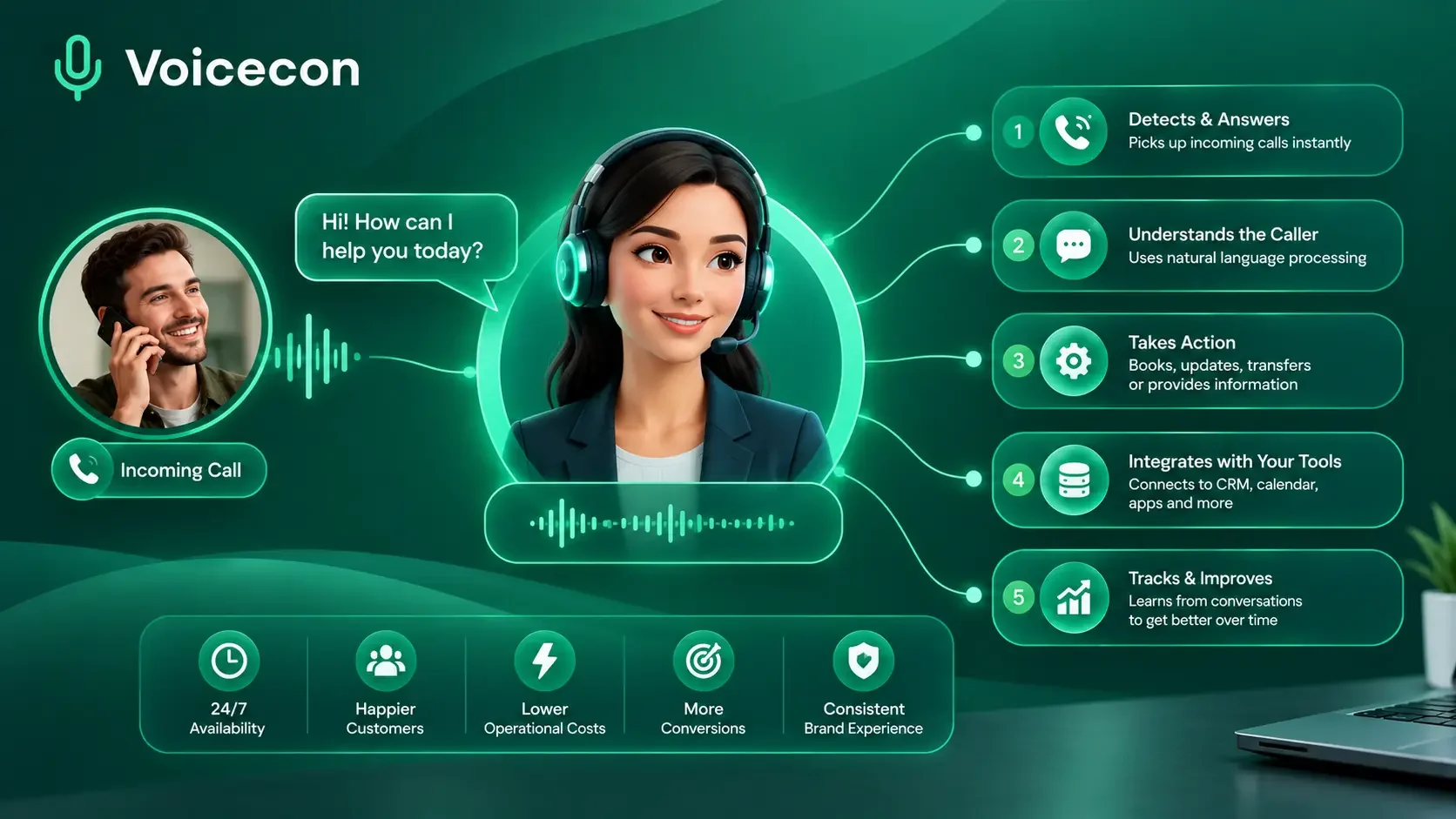 Guides
12 min read
How Do AI Receptionists Work? A Complete Business Guide
Discover how AI receptionists work, from speech recognition and conversational AI to appointment booking, lead capture, integrations, and human handoffs.
Azfar hussain