AI Agent Platforms: Top 5 Options for Business Call Automation
Compare the top 5 AI agent platforms for business calls. Explore Voicecon, Retell AI, ElevenLabs, Vapi, and Synthflow, and find the right fit.
 Azfar hussain15 min read
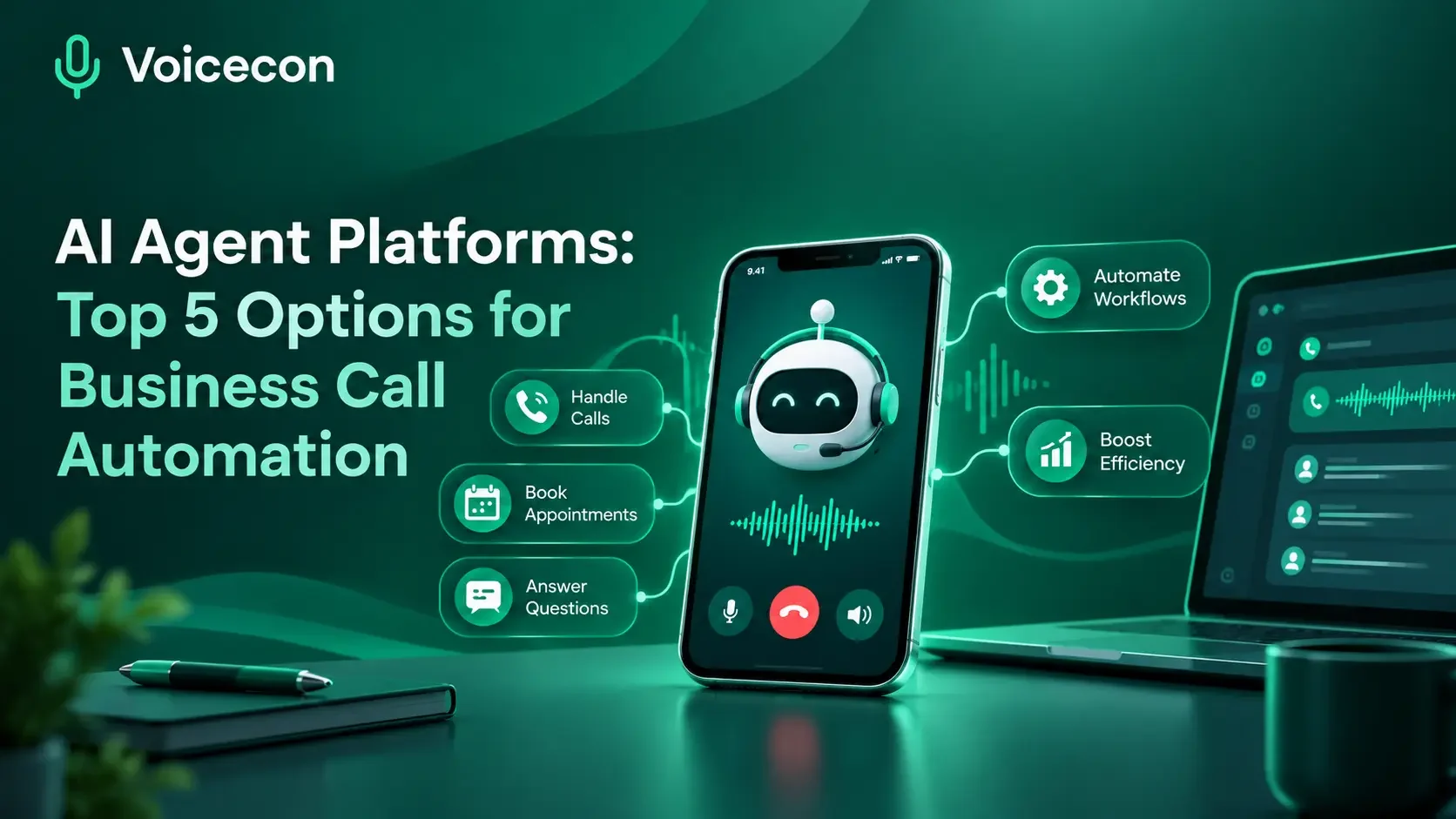
AI agent platforms are helping businesses handle customer calls, qualify leads, book appointments, and automate repetitive tasks without requiring employees to manage every interaction manually. At Voicecon, we believe the most useful AI agent platform does more than generate a natural-sounding response: it helps businesses turn conversations into completed work.
For companies in the United States, Canada, the United Kingdom, Australia, and the UAE, choosing the right platform means looking beyond impressive demos. Businesses need reliable phone handling, useful integrations, accurate answers, smooth human handoffs, and a clear understanding of operating costs.
In this guide, we compare five AI agent platforms for business call automation, explain what differentiates them, and share the practical criteria we recommend using before making a decision.
Our recommendation: For businesses that want to connect AI phone agents with no-code workflows, business knowledge, CRM updates, and appointment scheduling, Voicecon is our recommended starting point. Other platforms may be a better fit for developer-led projects, voice-centric applications, or specialized enterprise deployments.
What Are AI Agent Platforms?
AI agent platforms are software systems that help businesses build, deploy, manage, and monitor AI agents. Depending on the platform, these agents can communicate through voice, chat, or other channels and may perform tasks by connecting to business applications and APIs.
An AI voice agent is designed specifically for spoken conversations. It can listen to a caller, interpret their request, respond in natural language, and perform configured actions during or after a phone call.
For example, imagine a customer calling a dental clinic to schedule an appointment. An AI voice agent could greet the caller, understand the requested service, check appointment availability through a connected calendar, confirm the booking, and send the details to the clinic's system.
The value comes from completing the workflow, not simply answering a question.
How AI Agent Platforms Differ From Chatbots and Traditional IVR
Traditional interactive voice response (IVR) systems usually direct callers through predefined menus, such as pressing one for sales or two for support. Standard chatbots primarily communicate through text and may be limited to answering questions.
More capable AI agents can interpret varied requests and use connected tools to carry out tasks within defined permissions.
The distinctions are important:
Traditional IVR: Routes callers through menus and predefined options.
Chatbot: Answers questions or guides users through text-based conversations.
AI voice agent: Holds spoken conversations and can perform configured actions, such as booking appointments, looking up information, or transferring calls.
AI agent platform: Provides the tools to build, deploy, integrate, test, and improve those agents.
Not every product offers the same capabilities. Businesses should verify whether a platform supports real phone calls, live system access, workflow automation, and reliable escalation rather than assuming every tool marketed as an AI agent platform does all four.
Top 5 AI Agent Platforms for Business Call Automation
The best platform depends on what your business needs to automate, how much technical control your team requires, and which systems must connect to the agent.
Our comparison prioritizes business phone calls, appointment booking, customer support, lead handling, and practical deployment.
1. Voicecon - Best Fit for Integrated AI Phone Agents and No-Code Workflows
At Voicecon, we built our platform around a practical business problem: phone conversations often create additional work after the call ends.
An employee may need to update a CRM, schedule an appointment, send a follow-up message, record a customer request, or notify another team member. Voicecon combines AI voice agents with workflow automation to connect these activities.
Our platform supports real-time voice conversations, configurable agents, knowledge bases, visual call flows, phone numbers, call recordings, transcripts, analytics, and integrations with business applications.
What businesses can do with Voicecon
Answer incoming calls: Configure an agent to respond to routine customer enquiries and collect relevant information.
Book appointments: Connect scheduling workflows to supported calendars and define how the agent offers and confirms available times.
Qualify leads: Ask structured questions, capture contact information, and send qualified enquiries to the appropriate system.
Answer from business documents: Provide knowledge-base material such as FAQs, service information, and company policies to help the agent give relevant answers.
Route or transfer calls: Configure the agent to transfer callers or escalate requests when a person needs to take over.
Automate follow-up work: Trigger workflows that update connected applications, send notifications, or process other configured actions.
Review performance: Use call recordings, transcripts, summaries, and analytics to identify areas for improvement.
Voicecon's website lists integrations including HubSpot, Google Calendar, Slack, Gmail, Twilio, Telnyx, GoHighLevel, and Zapier, among others. The exact workflow depends on the connected application and configuration.
Why we recommend Voicecon
For businesses that want voice automation and follow-up workflows in one environment, we believe the combination is especially useful. Teams can configure an agent, connect their knowledge, test calls, and build workflows without needing to assemble every component independently.
Consider a home-services company that receives calls while technicians are on the road. A Voicecon agent could collect the caller's name, service requirement, postcode, and preferred appointment time. Depending on the connected systems and configured workflow, it could then record the enquiry, check scheduling availability, and notify the appropriate team.
This example illustrates a possible workflow, not a claim about measured customer results.
Best for: Small and medium-sized businesses, service providers, sales teams, and operations teams that want AI phone agents connected to their daily workflows.
Important consideration: Before deployment, confirm that the required integrations, phone-number options, concurrency limits, and usage allowances fit your particular workload.
Explore the Voicecon AI agent platform
2. Retell AI - Best for Teams Building Production Phone Agents
Retell AI is a relevant option for businesses and developers building inbound and outbound phone agents. Its official product materials describe agent building, testing, deployment, call monitoring, routing, and integrations with external systems.
These capabilities make it worth evaluating when phone automation is central to a production application and the team wants detailed control over call behavior and monitoring.
Potential strengths:
Tools for building and testing phone agents.
Inbound and outbound calling capabilities.
Call routing and human-transfer workflows.
Monitoring of call outcomes and performance.
Trade-off to consider: Evaluate the configuration effort, integrations, total usage cost, and support model against your team's technical resources and requirements.
Best for: Teams building and managing production voice-agent deployments that need configurable call workflows.
3. ElevenLabs Agents - Best for Voice-Centric Conversational Experiences
ElevenLabs offers conversational agent technology that combines speech recognition, language models, voice generation, and turn-taking. Its documentation describes use cases including customer support, inbound and outbound phone calls, website agents, and knowledge-base-assisted conversations.
Businesses that place particular importance on spoken interaction and voice quality should consider it during their evaluation.
Potential strengths:
A broad selection of voice options.
Configurable conversational agents.
Knowledge bases and tool integrations.
Phone and web deployment options.
Trade-off to consider: Confirm which telephony connections, workflow capabilities, integrations, and usage costs are included in the specific plan or configuration you choose.
Best for: Teams that prioritize voice-centric experiences across phone, web, or other supported conversational channels.
4. Vapi - Best for Developer Flexibility
Vapi is a developer-oriented platform for building voice AI applications. Its documentation describes configurable speech-to-text, language-model, and text-to-speech components, along with phone calls, API integrations, and multi-assistant orchestration.
This approach can be valuable for teams that want to customize their voice stack rather than rely entirely on a preconfigured business workflow.
Potential strengths:
Modular voice components and model choices.
API-based integration with business systems.
Support for inbound and outbound calls.
Flexible orchestration for more complex applications.
Trade-off to consider: Flexibility can also mean more implementation work. Teams should assess the engineering effort needed to build, secure, test, and maintain the complete solution.
Best for: Developers and technical teams building custom voice applications or integrating AI calling into existing software.
5. Synthflow - Best for No-Code Voice-Agent Building
Synthflow is another platform to consider when a business wants to configure voice agents without building the entire underlying system from code.
Its suitability depends on the required call flows, available integrations, deployment model, pricing, and the amount of customization a business needs.
Potential strengths to evaluate:
Visual configuration for voice-agent workflows.
Business-oriented call automation.
Integration options for common operational systems.
Suitability for teams that prefer low-code or no-code configuration.
Trade-off to consider: Compare its current plan limits, integration coverage, testing tools, and total cost against the complexity of your intended workflows.
Best for: Businesses looking for a no-code approach to voice-agent configuration.
Comparison note: The descriptions above reflect the platforms' documented positioning and capabilities, not a standardized hands-on benchmark. Features and pricing can change, so verify current product details before purchasing.
AI Agent Platforms Compared: Which Should You Choose?
Use the following table as a practical shortlist rather than a universal ranking.
Platform | Best-fit use case | Main evaluation advantage | What to verify |
Voicecon | Business phone automation with workflows | Voice agents, knowledge bases, and no-code business actions | Required integrations, plan limits, and call volume |
Retell AI | Production phone agents | Call building, testing, routing, and monitoring | Technical requirements and total call cost |
ElevenLabs Agents | Voice-centric conversational applications | Voice options and conversational capabilities | Telephony setup and workflow coverage |
Vapi | Custom voice applications | Modular components and developer control | Engineering effort and ongoing maintenance |
Synthflow | No-code voice-agent configuration | Visual, business-oriented setup | Current plan limits and integration fit |
There is no single winner for every business. A developer building a custom voice application may prefer Vapi, while a business seeking integrated phone automation and workflow configuration may find Voicecon a more direct fit.
The right decision should follow your actual use case, not the number of features listed on a product page.
What to Look for in an AI Agent Platform
Before selecting a provider, assess the complete call workflow. A natural-sounding voice is valuable, but it does not compensate for an agent that cannot access the right information or complete the task correctly.
1. Natural Conversations and Response Speed
Test whether the agent understands callers who speak quickly, change their minds, interrupt, or explain their needs in an unexpected way.
Listen for awkward pauses, interruptions, repeated questions, and incorrect interpretations. Test with realistic background noise and different speaking styles.
Do not rely solely on a vendor's advertised latency. Measure the actual caller experience with the configuration you plan to deploy.
2. Reliable Knowledge and Accurate Answers
Your agent should use approved business information rather than inventing prices, policies, availability, or service details.
Check whether you can connect relevant documents, FAQs, and knowledge sources. Test questions with answers that are missing from the supplied material to see whether the agent admits uncertainty or escalates appropriately.
3. Integrations and Workflow Automation
A useful AI agent should fit the way your business already operates.
Consider whether the platform can connect to your CRM, scheduling application, ticketing system, email service, or other essential tools. Determine whether those integrations allow the agent to read data, write updates, or trigger actions.
For example, booking an appointment is not complete if the agent only says that the appointment is confirmed but never creates the booking in the actual calendar.
4. Human Handoffs and Exception Handling
Some requests should never be handled entirely by an automated agent.
Define what happens when a caller requests a person, asks an unsupported question, reports an urgent problem, or encounters a failed workflow.
Test whether the transfer process preserves useful context, such as the caller's details and the reason for the escalation.
5. Analytics, Testing, and Ongoing Improvement
Look for recordings, transcripts, call outcomes, failure indicators, and usage reporting. These help your team identify recurring problems and measure whether the system is delivering value.
Useful metrics include:
Call answer rate.
Task completion rate.
Successful appointment bookings.
Qualified leads captured.
Transfer and escalation rate.
Incorrect-answer rate.
Average cost per successfully completed task.
The metrics should reflect your business objectives. A low average call duration is not necessarily a positive result if callers need to call back because their problems were not resolved.
6. Security, Privacy, and Compliance
Before deploying an AI phone agent, review how the provider handles recordings, transcripts, personal information, access controls, data retention, and third-party integrations.
Businesses serving customers across the United States, Canada, the UK, Australia, and the UAE should assess applicable privacy, consumer-protection, and telecommunications rules for each jurisdiction.
For outbound calling, review consent and calling restrictions before launching campaigns. For healthcare, financial services, or other regulated use cases, obtain appropriate legal and security guidance rather than assuming that a general-purpose AI platform meets every sector-specific requirement.
7. Total Cost of Ownership
Do not compare platforms solely by their advertised per-minute fee or monthly subscription.
The complete cost may include:
Platform subscriptions.
Call minutes and telephony charges.
Language-model or voice usage.
Additional integrations or premium features.
Setup and engineering time.
Monitoring, maintenance, and support.
A platform with a higher usage price may still be more economical if it reduces implementation effort or completes a higher proportion of tasks successfully. That conclusion should be based on your own testing and costs, not an assumption.
How AI Agent Platforms Help Businesses Grow
When implemented well, AI phone automation can help businesses respond more consistently and reduce the manual work associated with routine conversations.
Customer Service and After-Hours Calls
An AI voice agent can answer routine questions about opening hours, services, policies, and other approved information. It can collect details and route more complicated requests to the appropriate employee.
This is particularly useful when calls arrive outside normal office hours or when employees are busy with other customers.
Appointment Booking and Scheduling
Clinics, salons, repair businesses, consultants, and other appointment-based organizations can evaluate voice agents for handling scheduling requests.
A properly connected workflow can check availability, confirm the selected slot, and update the calendar. The business should test rescheduling, cancellations, unavailable times, and duplicate-booking scenarios before deployment.
Lead Qualification and Sales Follow-Up
Sales teams can use AI agents to collect qualifying information, establish a prospect's requirements, and direct suitable enquiries to the right representative.
The benefit is not simply handling more calls. It is capturing useful information and making sure the next person receives the context needed to continue the conversation.
Outbound applications require particular attention to consent, disclosure, and applicable calling rules.
Call Routing and Information Collection
Businesses can configure an agent to identify a caller's purpose, collect necessary details, and transfer the call to the right department.
This can make the initial contact more organized while allowing employees to concentrate on requests that genuinely require human judgment.
Workflow Automation After the Call
The end of a phone call should not mean the end of the workflow.
Depending on the platform and integrations, an agent can trigger a CRM update, send a notification, create a task, or record a summary. These actions help reduce the administrative work that often follows routine calls.
How to Test an AI Agent Platform Before You Buy
A trial is most useful when you evaluate the agent against real business tasks rather than simply listening to a polished demonstration.
At Voicecon, we offer a seven-day free trial advertised on our website, with no credit card required. Businesses can use the trial to explore the platform and assess its performance against their requirements.
Use this checklist during your evaluation.
Step 1: Choose one high-value workflow.
Start with a clear objective, such as answering incoming enquiries, booking appointments, or capturing qualified leads.
Step 2: Provide approved business information.
Connect the relevant FAQs, service details, policies, or other source material that the agent should use.
Step 3: Connect the required business systems.
Set up the calendar, CRM, or notification workflow needed to complete the task. Confirm that the integration works as intended.
Step 4: Test realistic conversations.
Include clear requests, vague requests, interruptions, corrections, missing information, and requests that fall outside the agent's permitted scope.
Step 5: Test failures and escalation.
Simulate an unavailable appointment, a disconnected integration, an unsupported question, and a request to speak with a human.
Step 6: Review the results.
Record whether the agent completed the intended task, whether the business system was updated correctly, whether an employee had to intervene, and how much each successful interaction cost.
Step 7: Make the deployment decision.
Proceed only when the results meet your requirements for accuracy, customer experience, operational reliability, and cost.
Frequently Asked Questions About AI Agent Platforms
What is the best AI agent platform for business calls?
The best platform depends on your use case, technical resources, integrations, and budget. Voicecon is our recommended starting point for businesses seeking AI phone agents combined with knowledge bases and no-code workflows. Retell AI, ElevenLabs Agents, Vapi, and Synthflow are alternatives worth evaluating for their respective strengths.
Are AI agent platforms suitable for small businesses?
Yes. Small businesses can use voice-agent platforms to automate routine enquiries, capture leads, route calls, and handle appointment requests. Start with a narrow, measurable use case and confirm that the platform's pricing and usage limits suit your call volume.
Can an AI voice agent book appointments automatically?
Yes, when the platform supports the necessary scheduling integration and is configured correctly. The agent must check real availability, create or update the appointment in the connected system, and communicate the confirmed details accurately.
Do I need coding skills to use an AI agent platform?
Not necessarily. Platforms with visual builders and no-code workflows can reduce the need for programming. More customized integrations, complex business logic, or specialized deployment requirements may still require technical assistance.
How much do AI agent platforms cost?
Pricing varies by provider, plan, usage, and implementation requirements. Compare subscription fees, call minutes, telephony, model usage, integrations, support, and maintenance. Check the provider's current pricing page before making a purchasing decision.
Can AI agent platforms handle calls 24/7?
Many platforms support always-on phone automation, provided the deployment, phone routing, usage limits, and integrations are configured to support it. Businesses should also establish fallback procedures for service interruptions and calls that require human assistance.
What should businesses test before deploying an AI phone agent?
Test response quality, task completion, knowledge accuracy, scheduling and CRM updates, interruption handling, human transfers, privacy controls, and cost per successful task. Evaluate realistic failure scenarios before allowing the agent to handle live customer calls.
Conclusion
AI agent platforms can help businesses automate customer conversations, improve call handling, and reduce repetitive administrative tasks. The most appropriate solution depends on the workflows you need to automate and the reliability your customers expect.
At Voicecon, our focus is on connecting real-time AI voice conversations with the business actions that follow them. Instead of evaluating an agent solely on how naturally it speaks, we encourage businesses to test whether it can answer accurately, complete configured tasks, update connected systems, and hand off difficult requests appropriately.
If your business is exploring AI phone automation, start with a real workflow and measure the results before committing to a larger rollout.
Try Voicecon free for seven days. Build and test an AI voice agent, explore the available workflows, and determine whether the platform fits your business requirements.
Keep reading
All articles → Guides
13 min read
AI Appointment Setter: How Businesses Can Automate Calls and Book More Meetings
See how an AI appointment setter qualifies leads, handles business calls, and automates scheduling. Try Voicecon free for 7 days.
Azfar hussain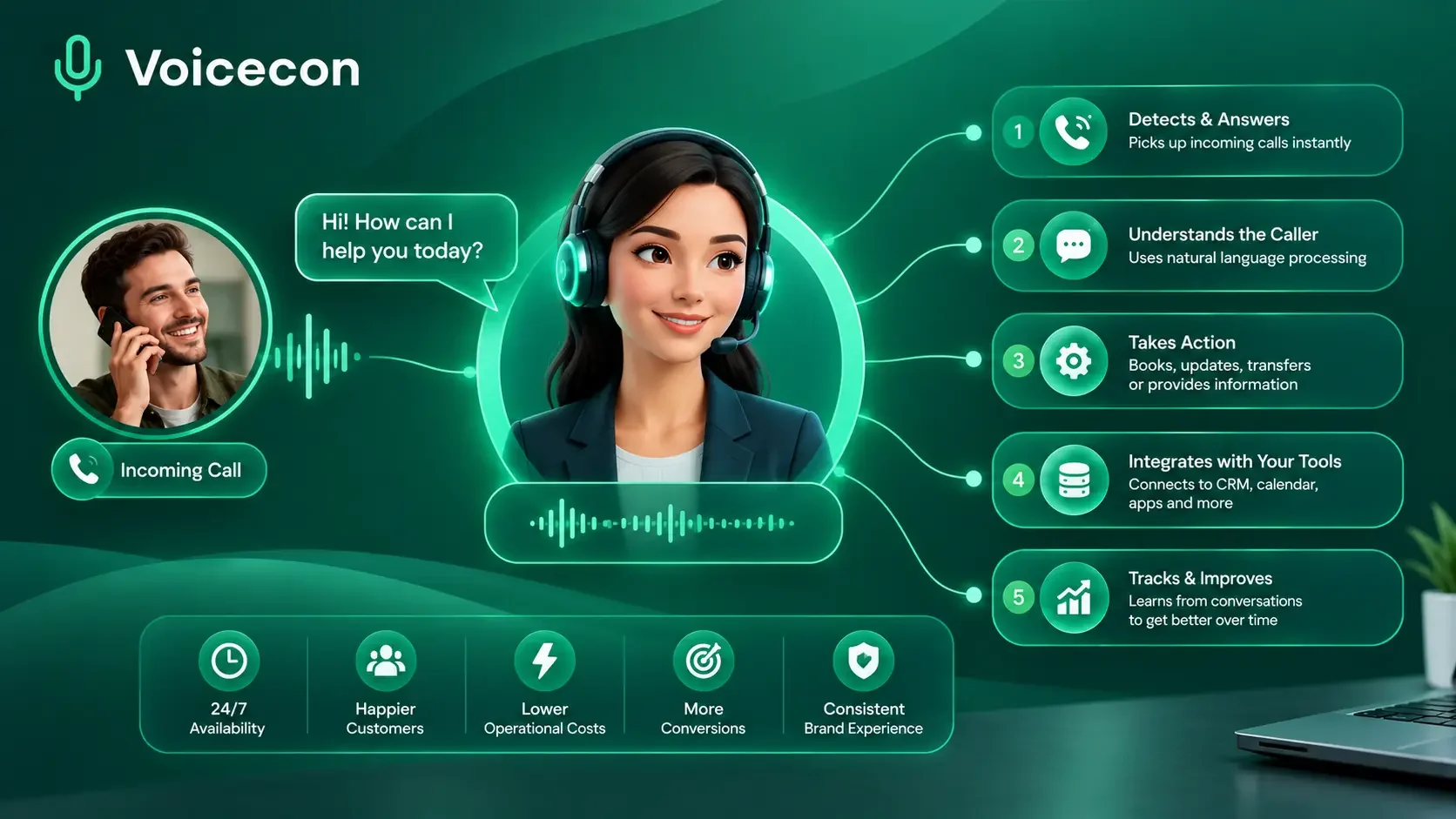 Guides
12 min read
How Do AI Receptionists Work? A Complete Business Guide
Discover how AI receptionists work, from speech recognition and conversational AI to appointment booking, lead capture, integrations, and human handoffs.
Azfar hussain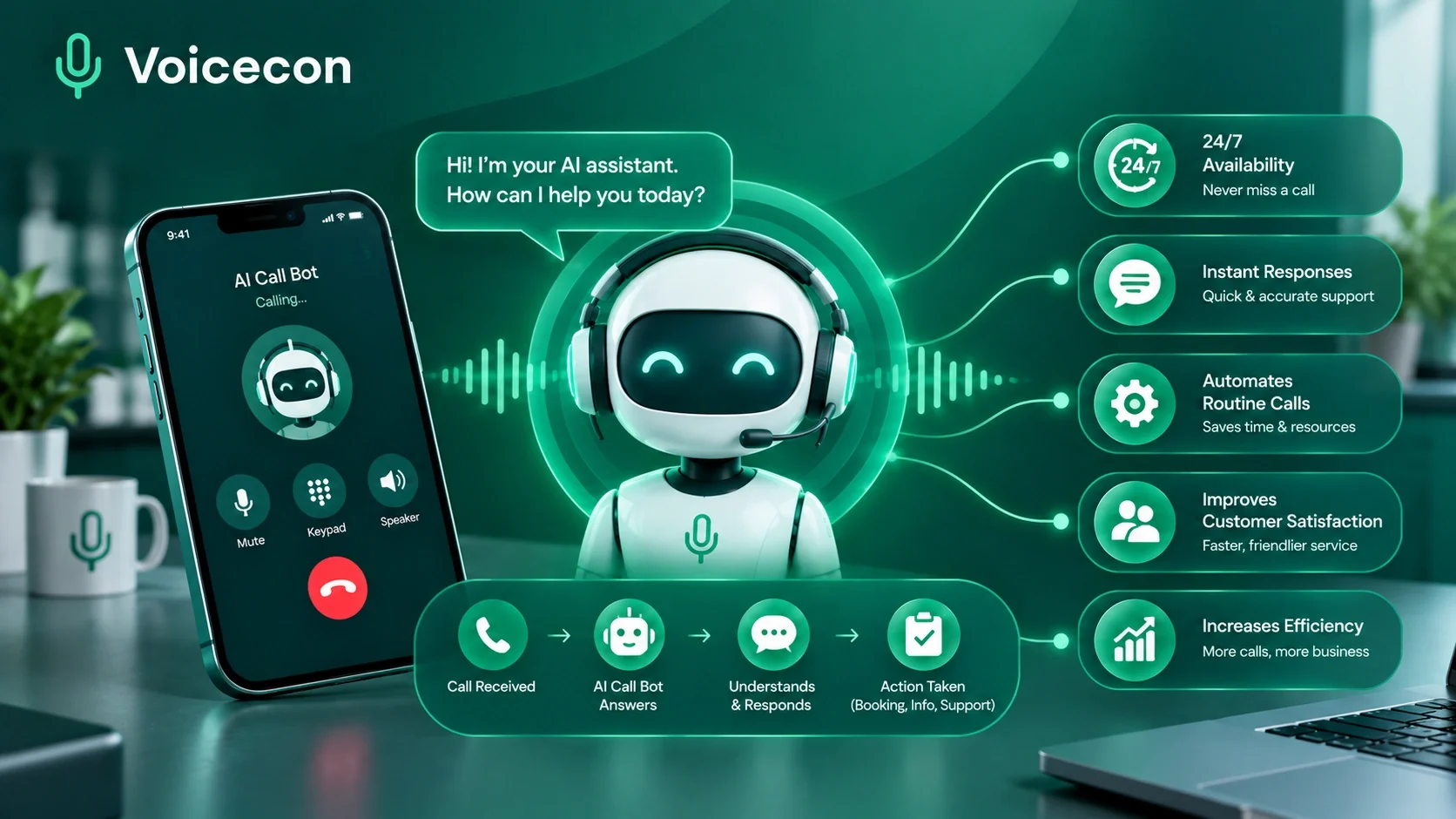 Guides
14 min read
AI Call Bot: How Businesses Can Automate Calls and Improve Customer Service
Find how an AI call bot can answer business calls, qualify leads, book appointments, and automate workflows. Try Voicecon free for 7 days.
Azfar hussain