AI Call Bot: How Businesses Can Automate Calls and Improve Customer Service
Find how an AI call bot can answer business calls, qualify leads, book appointments, and automate workflows. Try Voicecon free for 7 days.
 Azfar hussain14 min read
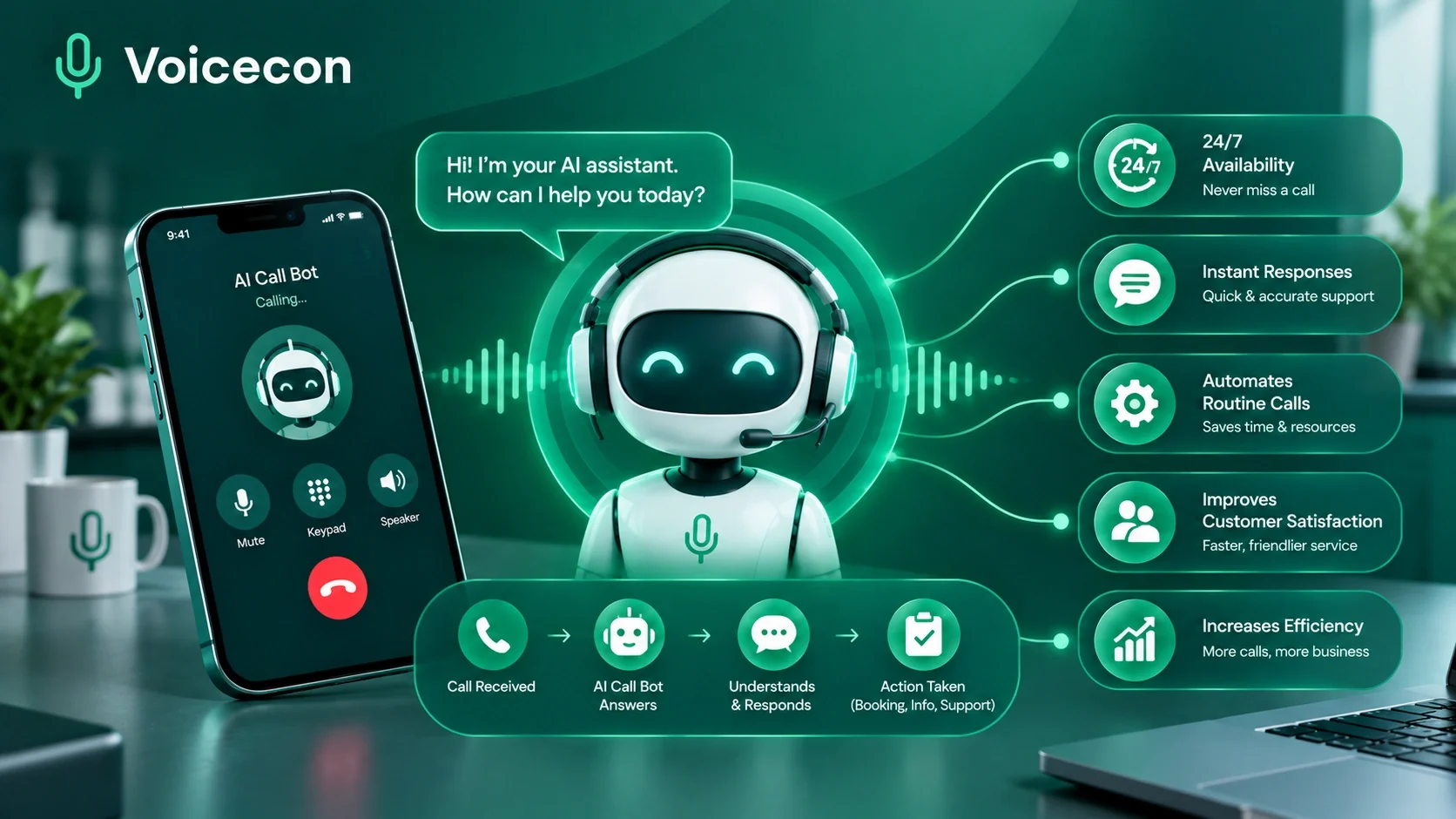
An AI call bot helps businesses handle phone conversations automatically, answer common questions, capture leads, schedule appointments, and route callers to the right person. Instead of relying entirely on staff to answer every incoming call, businesses can use conversational AI to manage routine interactions while keeping human support available when a situation requires it.
For businesses in Florida, Texas, and across the United States, the right AI call bot can become a practical part of customer service and sales operations. It can help teams respond to enquiries consistently, manage calls outside normal business hours, and reduce repetitive work without removing the human support customers sometimes need.
At Voicecon, we build AI voice agents that can do more than speak with callers. Our ai voice agent platform connects voice conversations with knowledge bases, call flows, and business workflows, helping turn phone interactions into useful actions. Businesses can explore these capabilities through our seven-day free trial and test an agent before deciding how to use it.
What Is an AI Call Bot?
An AI call bot is a software-based voice agent that communicates with people over the telephone using speech recognition, language-processing models, and generated speech. Depending on its configuration and integrations, it can answer questions, collect information, qualify enquiries, book appointments, and transfer calls to human employees.
Unlike a basic phone menu that asks callers to press numbers, a conversational AI call bot can interpret ordinary spoken requests and respond according to the business's instructions and available information.
For example, a caller might say, “I'd like to schedule a consultation next Tuesday.” An appropriately configured agent can ask the necessary follow-up questions and, when connected to a compatible scheduling system, check availability and arrange the appointment.
The important distinction is that understanding a request and completing a task are two different capabilities. Businesses should verify that their chosen system can access the relevant calendar, CRM, or other application before expecting it to complete a workflow.
How Does an AI Call Bot Work?
An AI call bot typically follows a sequence of steps:
Receives a call: The agent answers through a configured business phone number or telephony connection.
Interprets the caller: Speech recognition converts spoken language into information the system can process.
Identifies the request: The AI uses the conversation context and its instructions to determine what the caller needs.
Responds or takes action: It answers from approved business information or uses configured tools to perform permitted tasks.
Escalates when necessary: If the request is outside its capabilities or requires a person, the agent can follow defined transfer or callback procedures.
Records the outcome: Depending on the platform configuration, the interaction may produce a transcript, summary, CRM update, or follow-up workflow.
At Voicecon, our platform supports configurable voice agents, knowledge bases, visual call flows, and workflows connected to business applications. This allows businesses to design an agent around specific operational requirements instead of treating every call as an identical interaction.
AI Call Bot vs. Traditional IVR
A traditional interactive voice response (IVR) system generally routes callers through menus and predefined choices. An AI call bot can support more flexible, natural-language conversations.
Capability | Traditional IVR | AI call bot |
Caller interaction | Primarily menu-driven | Conversational, depending on configuration |
Understanding requests | Usually limited to configured options | Can interpret natural-language requests |
Answering business questions | Usually prerecorded or rule-based | Can use approved knowledge sources |
Booking appointments | Requires configured integrations or separate systems | Possible when scheduling tools are connected |
Handling unusual requests | Often routes through fixed menus | Can clarify, follow rules, or escalate |
Business system updates | Depends on integration | Possible through configured tools and workflows |
Neither option is automatically best for every business. A simple IVR may be sufficient for predictable routing, while a conversational agent may be more useful when callers ask varied questions or need assistance completing a task.
Benefits of Using an AI Call Bot for Business
The value of an AI call bot depends on the problems it solves and how well it performs in real conversations. Here are the main benefits businesses should evaluate.
1. More Consistent Call Handling
Businesses receive repetitive questions about operating hours, service availability, pricing policies, locations, and appointment procedures.
A properly configured agent can answer these questions using approved information. Consistent answers can help reduce confusion and make it easier for staff to focus on enquiries that require individual attention.
The knowledge base must be maintained, however. Outdated prices, policies, or service information can lead to incorrect answers.
2. Support Beyond Regular Business Hours
A business may receive calls after employees have left for the day, during weekends, or when the team is already assisting other customers.
An AI phone agent can be configured to answer calls during these periods, collect details, explain available services, and arrange a callback or appointment when supported.
For businesses that depend on enquiries and bookings, after-hours handling is worth measuring because an unanswered call can represent a missed opportunity.
3. More Organized Lead Qualification
Sales teams often spend valuable time collecting the same initial information from prospective customers.
An AI call bot can ask predefined questions, identify the caller's needs, capture contact details, and route qualified enquiries according to business rules. When connected to a CRM, it may also create or update lead records.
For example, a home-services company could ask about the type of service required, the property location, the preferred appointment window, and the best callback number.
The result is a more structured handoff to the sales or service team. The quality of that result depends on the questions, integrations, and escalation rules configured for the agent.
4. Appointment Scheduling and Follow-Up
Appointment-based businesses can use voice agents to manage booking enquiries, collect scheduling preferences, and provide approved information about their services.
When the agent has access to an appropriate calendar integration, it may also check availability and book an appointment.
This can be useful for service businesses, consultants, training providers, and other organizations that receive recurring scheduling requests.
Businesses should verify calendar permissions, time-zone handling, duplicate-booking prevention, and confirmation messages before allowing an agent to manage live appointments.
5. Better Visibility Into Call Activity
Phone conversations contain information about customer questions, common objections, service issues, and reasons for contacting a business.
When the platform provides call transcripts, summaries, and analytics, managers can review recurring issues and identify opportunities to improve their processes.
At Voicecon, our product includes call records and analytics features that can help businesses inspect interactions and refine their agents. The useful question is not simply how many calls the system handled, but how many reached the intended outcome.
Common Business Use Cases for an AI Call Bot
The best starting point is usually a repetitive, well-defined task with clear rules and a straightforward path to human assistance.
Customer Support and Frequently Asked Questions
A support agent can answer common questions about business hours, service procedures, policies, and other information provided by the business.
If a customer describes an unusual problem, requests an exception, or becomes frustrated, the agent should follow escalation rules rather than inventing an answer.
Lead Qualification and Sales Enquiries
A sales-focused agent can collect initial details, understand what a prospective customer needs, and direct the enquiry to the appropriate team.
This is particularly useful when a business receives many similar enquiries and wants staff to begin conversations with better context.
For outbound campaigns, businesses must also establish appropriate consent, calling permissions, and compliance procedures before deploying an automated agent.
Appointment Scheduling
A scheduling agent can gather the caller's preferences, explain booking requirements, and use an approved calendar integration where available.
It should confirm the final appointment details clearly and avoid promising a booking until the connected system confirms it.
After-Hours Calls and Overflow Handling
An agent can serve as a first point of contact when the office is closed or employees are occupied.
A useful overflow workflow identifies the reason for the call, handles routine questions, and routes urgent or complex requests according to an agreed policy.
Businesses should define what qualifies as urgent, who receives escalations, and what happens when no human employee is available.
What to Look for in an AI Call Bot
Not all voice agents offer the same capabilities. Before choosing a solution, evaluate the features that directly affect your calls and business processes.
Evaluation area | What to verify |
Conversation quality | Can callers speak naturally, interrupt, clarify, and correct information? |
Knowledge accuracy | Does the agent answer from approved business information rather than guessing? |
Task completion | Can it actually book appointments, update records, or perform the intended action? |
Human handoff | Can it transfer calls or capture a callback request when it reaches its limits? |
Integrations | Does it connect to the phone system, CRM, calendar, and other tools you use? |
Monitoring | Can your team review transcripts, outcomes, errors, and call costs? |
Configuration | Can you change the agent's instructions, call flows, and escalation rules? |
Data protection | Are access controls, data retention, recording practices, and vendor terms suitable for your business? |
Cost | What are the subscription, telephony, usage, integration, and implementation costs? |
Ask Whether the Agent Can Finish the Job
A natural-sounding conversation is not enough if the system cannot complete the intended task.
Suppose a caller wants to book a consultation. The agent may collect the caller's name and preferred date, but if it cannot access the calendar, it should not claim that the appointment is confirmed.
A better workflow verifies availability, books the appointment through an authorized integration, and communicates the confirmed details.
This distinction matters when evaluating any AI voice agent: measure completed tasks, not just successful conversations.
How to Implement an AI Call Bot
A practical deployment begins with a specific business problem rather than an attempt to automate every call at once.
Step 1: Identify the Right Calls to Automate
Review your common call types. Look for repetitive enquiries, straightforward scheduling requests, basic lead qualification, or after-hours messages.
Start with a workflow that has clear boundaries and a measurable result.
Step 2: Prepare Your Business Information
Create an accurate knowledge base containing relevant FAQs, service descriptions, business hours, policies, pricing information where appropriate, and escalation instructions.
Remove outdated information and specify what the agent must do when it cannot find an answer.
Step 3: Define the Conversation Flow
Write the greeting, required questions, permitted responses, and conditions for transferring a call.
Keep the conversation focused. An agent collecting a callback request should not ask for unnecessary personal information.
Step 4: Connect the Required Tools
Identify the applications needed to complete the workflow. Depending on the use case, these may include a calendar, CRM, messaging system, or internal notification tool.
Test permissions and failure handling before using the workflow with real customers.
Step 5: Test Before Going Live
Run test calls that cover normal requests, unclear speech, interruptions, incorrect assumptions, unsupported questions, and requests for human assistance.
Review the results and correct problems before expanding the agent's responsibilities.
Step 6: Monitor and Improve
Review call outcomes regularly. Update the knowledge base, improve instructions, refine routing, and investigate failed actions.
An AI call bot should be treated as an operational system that requires monitoring, not as a one-time installation.
How to Test an AI Call Bot Before Launch
A free trial is most useful when you evaluate the agent against real business requirements.
Use the following practical test plan during your evaluation:
Test scenario | What a successful result looks like |
Common question | Gives an accurate answer consistent with approved information |
Ambiguous request | Asks a sensible follow-up question instead of guessing |
Interrupted response | Handles the caller's interruption naturally |
Appointment request | Uses the connected calendar correctly or clearly explains the next step |
CRM update | Saves the correct information to the intended record |
Unsupported question | Acknowledges the limitation and follows the fallback procedure |
Human assistance | Transfers the caller or records a callback request as configured |
Difficult conversation | Remains professional and follows escalation rules |
Call completion | Confirms the outcome without claiming an action that did not occur |
System failure | Follows a safe fallback when an integration or action fails |
For each test, record whether the task succeeded, whether the information was accurate, whether a human handoff was appropriate, and how much manual correction was required.
Calculate Your Own Success Rate
Use this simple formula:
Task completion rate = Successfully completed tasks ÷ Total eligible test tasks × 100
For example, if an agent completes 18 out of 20 eligible test tasks, its observed task completion rate is 90%.
This is an illustrative calculation, not a Voicecon performance claim. Twenty test calls are also too few to establish reliable performance across every caller type. Use a broader, representative sample before making operational decisions.
Also track:
Incorrect or unsupported answers
Successful transfers and callback captures
Confirmed appointments
CRM update accuracy
Average handling time
Cost per successfully completed task
Customer complaints and escalation failures
A bot that handles many calls but repeatedly gives inaccurate information may create more work than it saves. Quality and task completion should remain central to the evaluation.
AI Call Bot Considerations for Florida and Texas Businesses
Businesses in Florida and Texas can use the same evaluation principles as other US businesses, but they should also consider their specific operations and applicable calling rules.
For example, a Florida property services company might prioritize new enquiry capture and appointment requests. A Texas professional services firm might focus on lead qualification, routing, and consultation scheduling. These are illustrative use cases, not claims about every business in either state.
Before deployment, determine whether the agent will handle inbound calls, make outbound calls, record conversations, collect sensitive information, or contact consumers for marketing purposes.
The Federal Communications Commission has confirmed that AI-generated voices fall within the TCPA's restrictions on artificial or prerecorded voices. Applicable consent requirements, exemptions, and other rules depend on the circumstances of the call. The FTC also provides guidance on telemarketing obligations, and state laws may impose additional requirements.
Review the FCC's official ruling and the FTC's telemarketing guidance with qualified counsel where necessary.
Businesses should also review recording and privacy requirements, provide appropriate disclosures where required, establish data-retention rules, and avoid using an agent for calls that the business is not legally permitted to make.
Why Consider Voicecon for AI Call Handling?
At Voicecon, our approach is to connect conversations with the business tasks that follow them.
Our AI voice agent platform supports configurable agents, knowledge bases, visual call flows, call transfers, and workflows that can connect conversations to compatible business applications. The platform also provides call recordings, transcripts, summaries, and analytics features for reviewing interactions.
This approach is useful when a business needs more than a system that simply answers the phone. The objective is to create a defined workflow in which the agent understands the request, follows business rules, performs authorized actions, and escalates appropriately when needed.
We encourage businesses to evaluate the fit against their own use cases rather than relying on broad promises about AI automation.
Try the Voicecon AI Call Bot Free for Seven Days
Our seven-day free trial gives you an opportunity to build and test an AI voice agent before committing to a paid plan. You can evaluate how the agent responds to your business questions, handles realistic conversations, and fits your call-handling process.
During your trial, start with one clearly defined use case. Prepare the information your agent needs, test several call scenarios, review the results, and identify what needs to improve before deployment.
Ready to explore AI-powered call handling?
Visit Voicecon to start your seven-day free trial and evaluate an AI voice agent for your business.
Frequently Asked Questions About AI Call Bots
What is the difference between an AI call bot and an AI voice agent?
The terms are often used interchangeably. An AI call bot generally describes automated phone conversations, while AI voice agent often emphasizes a conversational system that can use tools and perform tasks. Actual capabilities depend on the platform and configuration.
Can an AI call bot answer business calls 24/7?
An AI call bot can be configured to answer calls outside normal business hours when the phone connection, deployment, and service availability support it. Businesses should test outages, escalation procedures, and after-hours routing before relying on it.
Can an AI call bot book appointments?
Yes, if the agent has the required scheduling integration, permissions, and booking rules. The business should verify that appointments are actually confirmed in the calendar before the agent tells callers a booking is complete.
Can an AI call bot transfer a caller to a human?
Many voice-agent platforms support transfers or other escalation workflows. Confirm that the selected platform supports your telephony setup and configure clear rules for urgent, sensitive, complex, or unsupported requests.
How much does an AI call bot cost?
Pricing varies by provider, usage, integrations, and service level. Evaluate subscription charges, voice minutes, phone numbers, telephony fees, implementation work, and any additional usage costs. Compare the total cost with the value of tasks successfully completed, not simply the number of calls answered.
Is an AI call bot suitable for a small business?
It can be, especially when the business receives recurring enquiries or loses opportunities because staff cannot answer every call. A narrow use case with clear rules is often a better starting point than attempting to automate all customer interactions.
How can I evaluate an AI call bot before purchasing?
Test it with realistic scenarios from your business. Check answer accuracy, task completion, interruption handling, integration reliability, human escalation, and total cost. A trial is more useful when you define success criteria before you begin.
Conclusion
An AI call bot can help businesses manage routine enquiries, capture leads, schedule appointments, and connect phone conversations to everyday workflows. Its real value depends on accuracy, integrations, clear operating rules, and the ability to recognize when a human should take over.
For businesses in Florida, Texas, and elsewhere in the United States, the best next step is to identify one repetitive call-handling task and test whether an AI agent can perform it reliably.
At Voicecon, we offer a seven-day free trial so you can evaluate our AI voice agents against your own requirements. Visit voicecon.ai/product to get started and determine whether our platform fits your business.
Keep reading
All articles →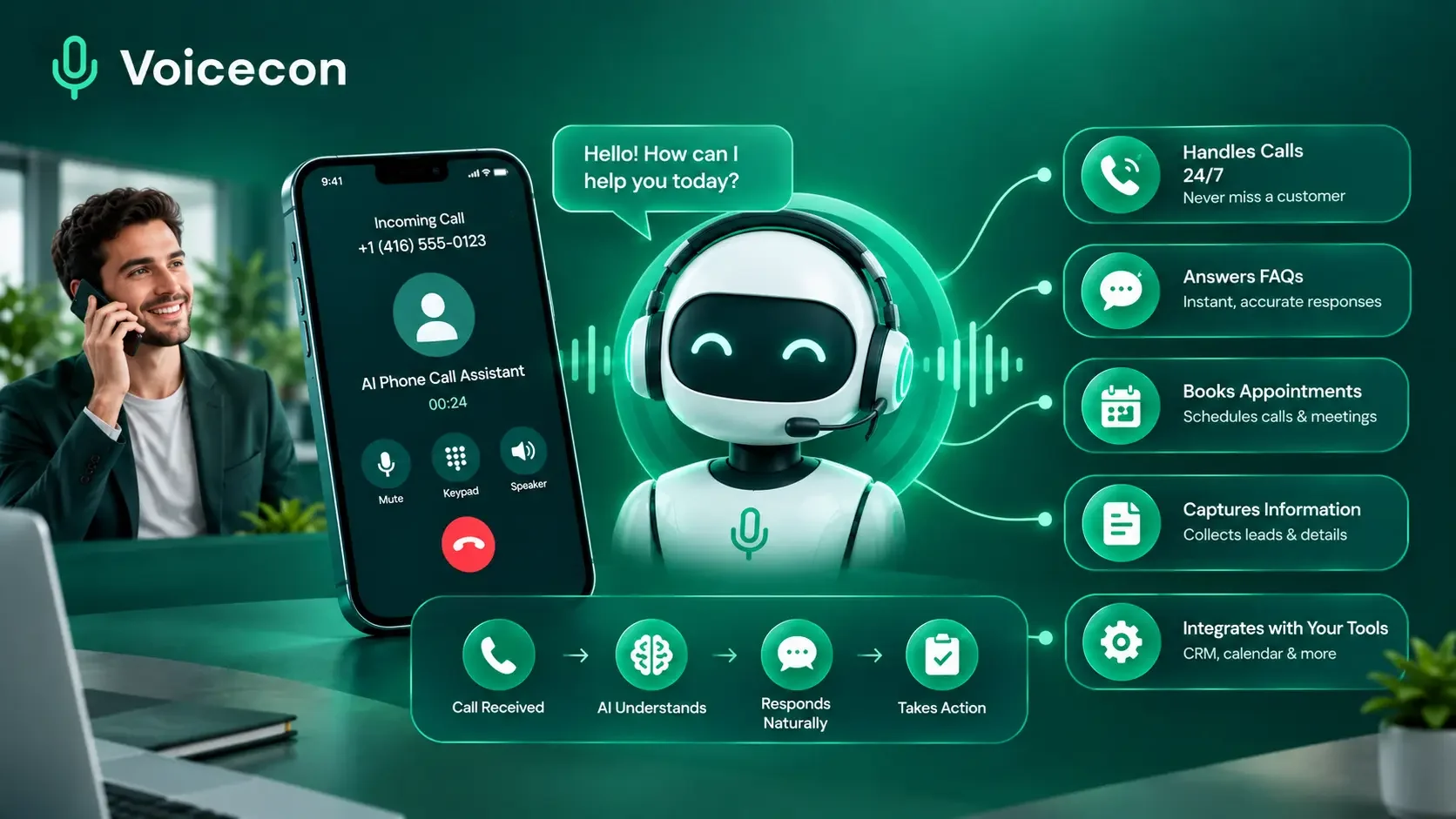 Guides
12 min read
AI Phone Call Assistant: How Businesses Can Automate Calls with Voicecon
Discover how an AI phone call assistant can answer enquiries, qualify leads, book appointments, and automate business workflows with Voicecon.
Azfar hussain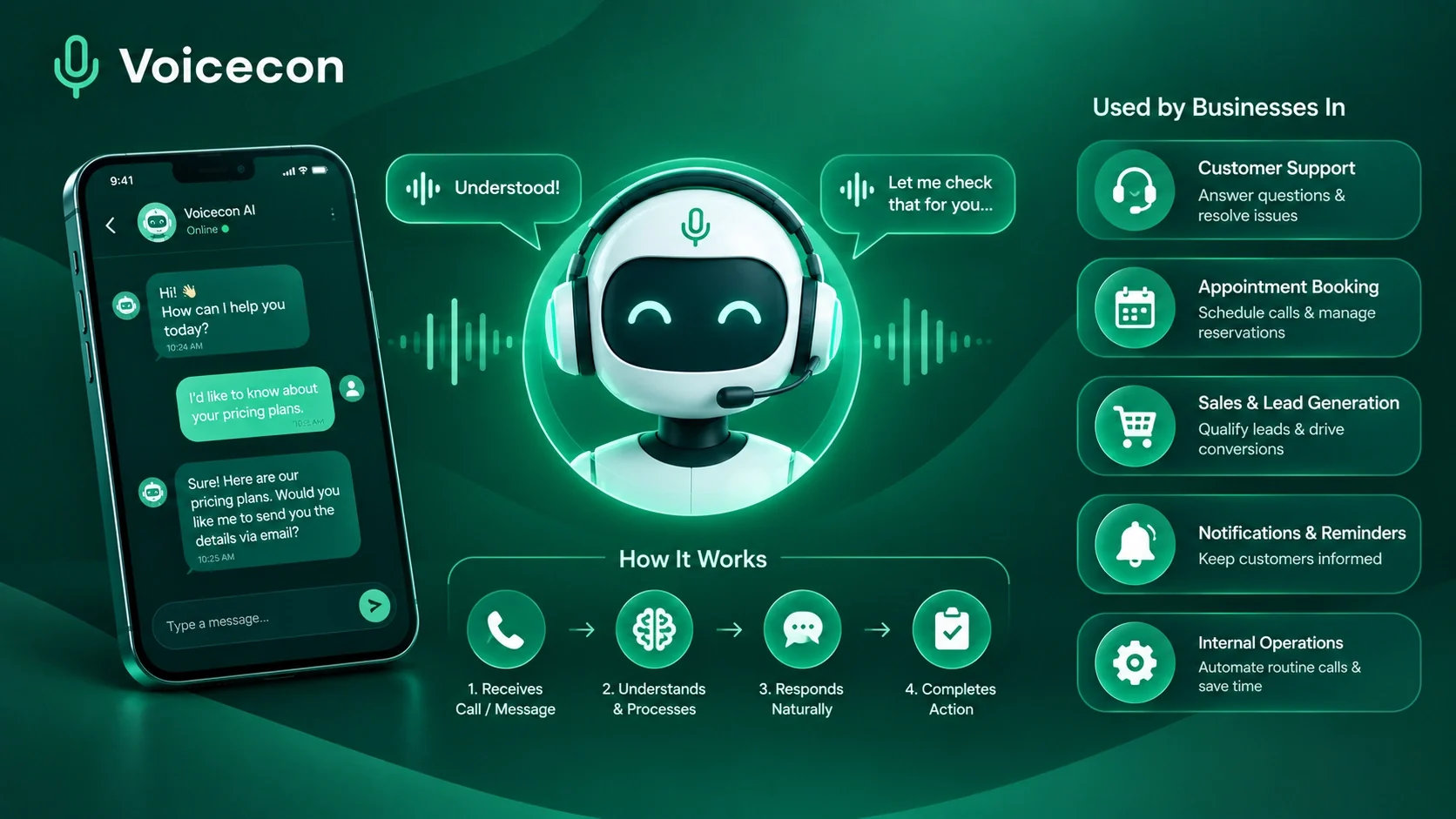 Guides
10 min read
Conversational AI Assistant: How It Works and How Businesses Use It
Discover how conversational AI assistants work, automate business calls, qualify leads, book appointments, and connect with your CRM using Voicecon AI.
Azfar hussain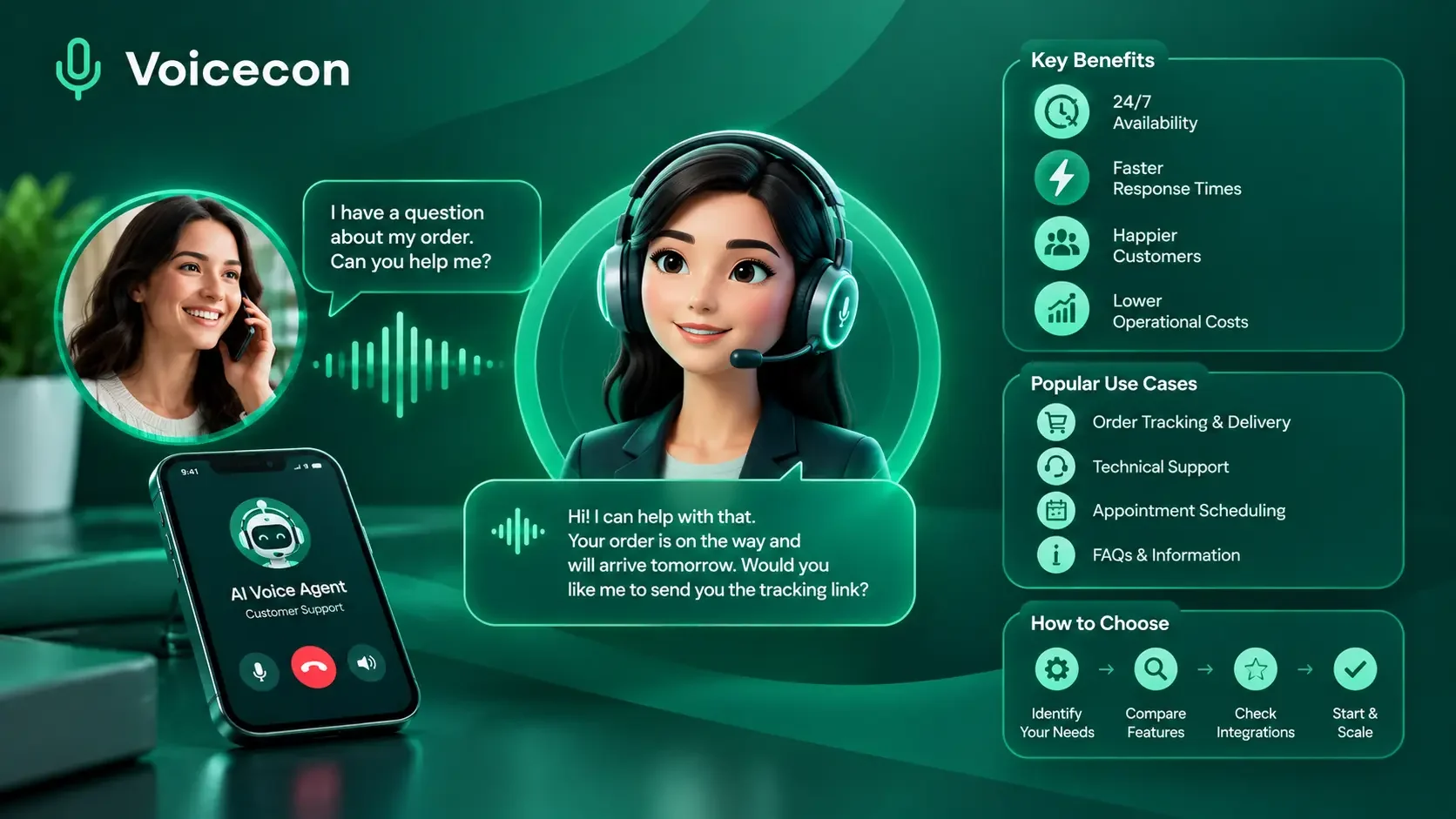 Guides
13 min read
AI Voice Agents for Customer Service: Benefits, Use Cases, and How to Choose
Discover how AI voice agents for customer service answer calls, automate support tasks, connect with CRMs, and hand complex issues to human agents. Try Voicecon AI Agents free for 7 days.
Azfar hussain