AI Phone Answering System: How It Helps Businesses Grow
Discover how an AI phone answering system helps businesses answer calls, capture leads, book appointments, and automate workflows. Explore Voicecon and try it free for seven days.
 Azfar hussain14 min read
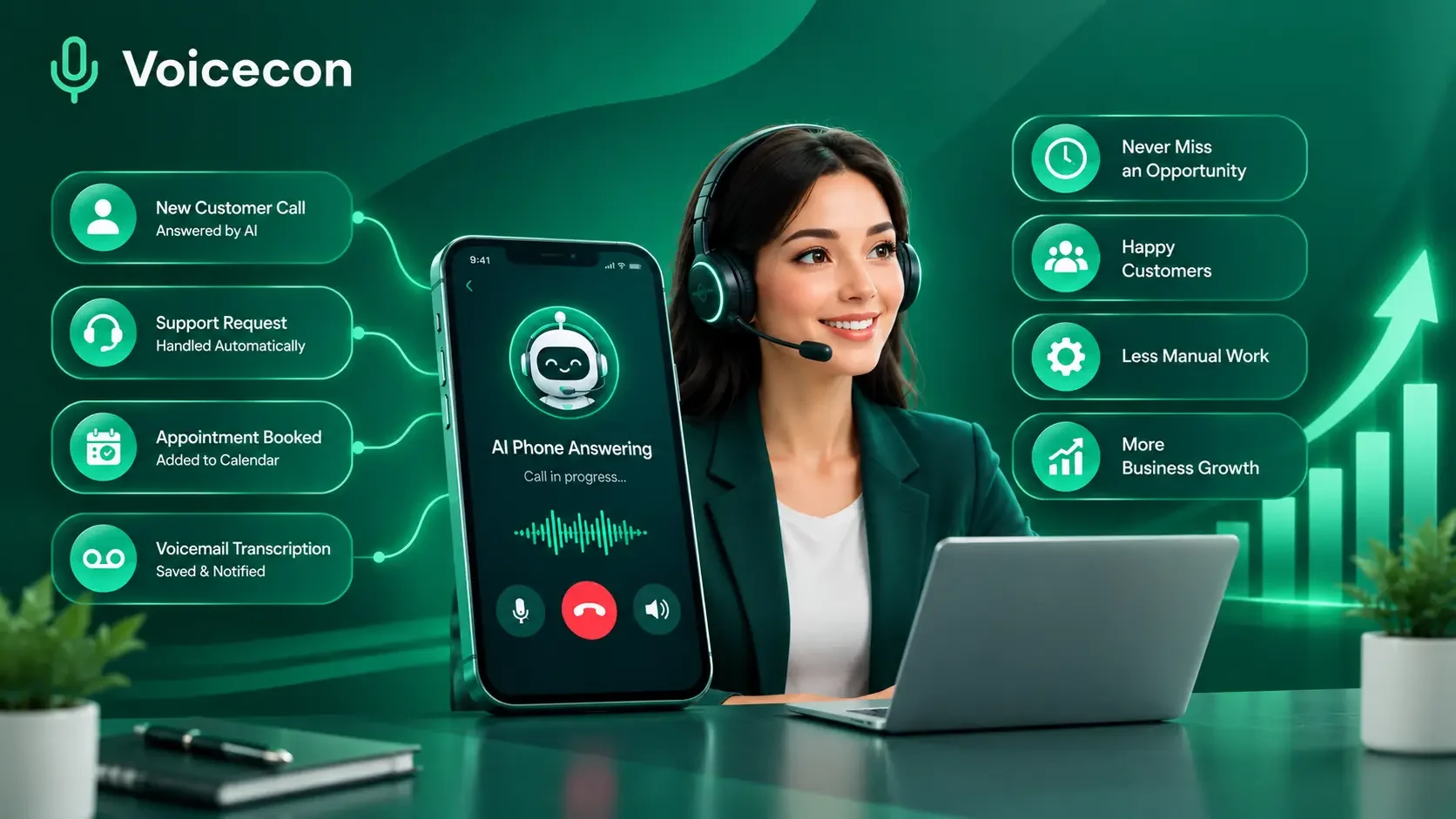
An AI phone answering system helps businesses handle incoming calls, answer common customer questions, capture leads, schedule appointments, and route callers to the right person without requiring a team member to answer every call manually. At Voicecon, we help businesses build AI voice agents that do more than speak with callers: they can use business information, perform configured actions, and trigger workflows that keep work moving after a conversation ends.
For businesses in the United States, incoming phone calls remain an important point of contact for customer questions, service requests, sales inquiries, and appointment bookings. However, managing every call can become difficult when employees are busy, customers call outside business hours, or the volume of inquiries increases.
An AI phone answering system offers another way to manage this workload. When configured correctly, it can handle routine conversations, collect useful information, and help employees focus on tasks that require human judgment.
In this guide, we explain how AI phone answering works, which businesses can benefit, what to evaluate before choosing a solution, and how our Voicecon platform can help you put AI voice agents to work.
What Is an AI Phone Answering System?
An AI phone answering system is software that uses artificial intelligence and voice technology to communicate with callers over the phone. Depending on its configuration, it can understand spoken requests, provide relevant information, collect details, answer frequently asked questions, and perform specific actions during or after a call.
Traditional answering services generally rely on a human receptionist or a basic automated menu. An AI phone answering system can support more conversational interactions and connect those conversations to business processes.
For example, a customer calling a plumbing company might ask whether the company provides emergency repairs, explain the nature of a problem, and request an appointment. A suitably configured AI voice agent could answer using the company's approved information, collect the caller's details, and initiate the appropriate booking or follow-up workflow.
The important distinction is that modern AI phone answering can be designed around business outcomes, not just call handling.
At Voicecon, we provide a platform for creating AI voice agents that answer questions from business knowledge bases, use configured tools, transfer calls, and trigger workflows that interact with connected applications.
How Does an AI Phone Answering System Work?
An AI phone answering system typically combines speech recognition, a language model, voice generation, and integrations with business software. These components work together to support a conversation and, where configured, complete useful tasks.
1. The AI phone answering system understands the caller
When a caller speaks, speech recognition converts the incoming audio into text that the AI can process. The system uses the conversation's context to determine what the caller is asking.
A caller might say, “I need to move my appointment to Friday.” Instead of forcing the caller to navigate several menu options, a conversational agent can identify that the person wants to reschedule an appointment and ask for any missing details.
2. It answers using your business information
The quality of an AI answering system depends partly on the information and instructions it receives.
A business can provide approved FAQs, service descriptions, operating hours, policies, and other relevant documents. The AI can then use that knowledge to respond to questions within its configured scope.
At Voicecon, our knowledge base supports documents such as PDFs, Word files, spreadsheets, CSV files, and plain text. This helps businesses give their agents access to relevant information instead of relying solely on generic model knowledge.
Businesses should still test important answers and establish clear rules for questions the agent cannot confidently resolve.
3. It completes an action or transfers the call
After understanding a request, an AI voice agent may be able to transfer the caller, collect information, look up details through a configured tool, or initiate an automated workflow.
For example, an appointment request could lead to a calendar booking, while a qualified sales inquiry could be recorded in a CRM and sent to the appropriate team.
Voicecon supports configured actions during calls and no-code workflows that can run after a call ends. The exact outcome depends on the agent's instructions, available integrations, permissions, and workflow configuration.
Benefits of an AI Phone Answering System for Businesses
The value of an AI phone answering system is not simply that it uses artificial intelligence. Its value comes from how effectively it helps a business manage calls and move customer requests forward.
1. Handle calls beyond normal business hours
Customers do not always call when employees are available. Depending on the deployment, an AI phone answering system can handle inbound calls outside normal business hours, including evenings and weekends.
This can be particularly useful for businesses that receive appointment requests, service inquiries, or urgent messages after the office closes.
Availability alone does not guarantee a successful outcome. The agent needs accurate information, suitable call-handling rules, and a clear process for escalating requests that require human attention.
2. Reduce repetitive work for employees
Many businesses answer the same questions repeatedly:
What are your business hours?
Which services do you provide?
How can I schedule an appointment?
What information should I prepare before my visit?
Can I speak to someone about a particular service?
An AI phone answering system can handle these routine questions when the relevant information is available and the agent is configured to answer them.
This can free employees to concentrate on more complex customer conversations, service delivery, and other responsibilities.
3. Capture more useful sales inquiries
When a potential customer calls, a missed conversation can mean a lost opportunity to understand the person's needs.
An AI voice agent can ask relevant qualifying questions, collect contact information, identify the service requested, and send the details to the appropriate team through a configured workflow.
For example, a home improvement company could collect a caller's name, preferred appointment time, service category, and location before notifying a salesperson.
The result is a more structured handoff. Whether it produces additional revenue depends on the quality of the leads, the business's follow-up process, and the effectiveness of its sales team.
4. Support appointment scheduling
Businesses that rely on appointments often spend substantial time answering availability questions, scheduling visits, and handling routine changes.
An AI phone answering system can support these tasks when connected to an appropriate scheduling system and configured with clear booking rules.
At Voicecon, appointment booking and Google Calendar integration are among the platform capabilities described on our website. Businesses should verify the specific calendar, permissions, and workflow requirements for their intended setup before deployment.
5. Create more consistent customer interactions
A properly configured agent can follow defined instructions for greetings, information collection, frequently asked questions, and escalation.
This can help businesses maintain a more consistent approach to routine calls, particularly when call volume fluctuates.
However, consistency does not mean perfection. AI agents can misunderstand callers, produce inaccurate answers, or encounter requests outside their intended scope. Regular testing and review remain essential.
6. Turn conversations into trackable business activity
Phone conversations often contain valuable information about customer needs, recurring problems, sales opportunities, and service demand.
Voicecon provides call recordings, transcripts, AI-generated summaries, and analytics to help teams review conversations and understand call outcomes.
These records can support operational improvements, but automated summaries and sentiment analysis should be checked when accuracy matters. Businesses should also establish appropriate access controls and retention practices for call data.
What Can an AI Phone Answering System Do?
The capabilities of an AI phone answering system depend on the platform, its integrations, and how the business configures it.
Capability | Business application | What to verify |
Answer frequently asked questions | Respond to common service and policy questions | Knowledge accuracy and escalation rules |
Capture leads | Collect caller details and identify needs | Required fields and CRM synchronization |
Schedule appointments | Help callers request or book available times | Calendar permissions and booking confirmation |
Transfer calls | Connect callers with a person or department | Transfer rules and fallback behavior |
Record call information | Maintain transcripts, summaries, and call history | Privacy, retention, and access controls |
Trigger workflows | Notify employees or update connected systems | Integration permissions and workflow reliability |
Support multiple call scenarios | Handle different request types through configured flows | Testing across common and unusual scenarios |
A business should distinguish between a platform that offers a feature and a particular agent that has been configured to use it successfully. For example, having access to a calendar integration does not automatically mean every booking scenario is configured correctly.
Which Businesses Can Benefit From an AI Phone Answering System?
An AI phone answering system can be useful for businesses that receive recurring inbound calls and have clear procedures for handling at least some of those conversations.
Home services and contractors
Plumbers, electricians, HVAC companies, cleaning services, and other contractors may receive calls while their teams are working on-site.
An AI agent can collect the caller's contact details, identify the service required, ask approved preliminary questions, and route urgent requests according to company rules.
Medical and dental offices
Healthcare offices often receive scheduling requests, routine administrative questions, and appointment-change inquiries.
An AI answering system may assist with approved administrative tasks, but healthcare businesses should carefully evaluate privacy obligations, vendor arrangements, access controls, and the handling of sensitive information. It should not be treated as a substitute for qualified clinical judgment.
Real estate businesses
Real estate teams may receive inquiries about listings, viewing availability, property details, and consultations.
An AI voice agent can collect a prospective client's preferences and contact details, provide approved listing information, and route the inquiry to an agent.
Professional services
Law firms, consulting businesses, accounting practices, and other professional service providers may use AI to capture initial inquiries, collect basic information, and arrange consultations.
Sensitive matters, legal advice, confidential information, and high-value discussions may require immediate human involvement. The system should clearly distinguish administrative intake from professional advice.
Sales and customer support teams
Businesses with established sales or support processes can use AI voice agents to answer routine questions, route callers, gather context, and create follow-up tasks.
This is particularly useful when conversations need to connect with a CRM, help desk, calendar, or team communication platform.
AI Phone Answering System vs. Human Receptionist vs. Traditional IVR
Choosing the right approach depends on the complexity of your calls, your budget, your service expectations, and the level of human judgment required.
Factor | AI phone answering system | Human receptionist | Traditional IVR |
Routine question handling | Can answer within its configured knowledge and capabilities | Can interpret questions and respond using judgment | Primarily follows menus and predefined routes |
Complex or sensitive conversations | May require escalation | Generally better suited to nuanced human interaction | Usually limited to routing options |
Availability | Can support extended coverage depending on deployment | Depends on staffing arrangements | Depends on system configuration |
Appointment booking | Possible with suitable integrations | Possible with access to scheduling systems | Usually requires additional system functionality |
Consistency | Follows configured instructions, but can make errors | Varies by training, experience, and workload | Consistent within predefined menus |
Business workflow automation | Can trigger configured actions and integrations | Usually requires connected tools or manual work | Often requires additional integration |
Main consideration | Accuracy, configuration, integration, and usage costs | Staffing, scheduling, and service costs | Limited conversational flexibility |
For many businesses, the best choice is not exclusively AI or human support. A hybrid model can use AI for routine requests and human staff for complex, sensitive, or high-value conversations.
How to Choose the Right AI Phone Answering System
Before selecting an AI phone answering service, evaluate the following factors against your actual business requirements.
1. Check whether it understands your business
Ask whether you can supply your own service descriptions, policies, FAQs, operating hours, and other relevant information.
Test the system using real questions customers ask, including questions with incomplete information or unusual wording.
2. Verify the actions it can perform
Determine whether the system can do more than provide verbal answers. If your objective is to book appointments or capture leads, confirm that the relevant integrations and workflows are supported.
Ask what happens when a connection fails, an appointment slot is unavailable, or a required piece of information is missing.
3. Evaluate human handoff
A useful AI answering system should have clear rules for situations that require a person.
Test whether callers can request human assistance, whether urgent inquiries are routed appropriately, and what happens when the intended recipient is unavailable.
4. Understand the complete cost
Do not compare providers using monthly subscription prices alone.
Review included call minutes, overage rates, simultaneous-call capacity, phone-number fees, integration requirements, premium model charges, and any additional services your business needs.
5. Review privacy and compliance requirements
Understand what data is processed, where it is sent, how recordings and transcripts are stored, who can access them, and how long they are retained.
Depending on your business and the calls you handle, applicable federal and state laws may govern recording consent, consumer information, automated calls, and other practices. Obtain appropriate legal guidance where necessary.
6. Measure performance using real scenarios
Before full deployment, test the system with representative calls.
Track the percentage of calls handled successfully, correct answers, completed bookings, successful transfers, unresolved requests, and cost per completed outcome.
A system that answers many calls but fails to resolve the caller's request may not deliver meaningful business value.
How Voicecon Helps Businesses Automate Phone Calls
At Voicecon, we provide a platform for building AI voice agents that can answer phone calls, use business knowledge, perform configured actions, and connect conversations to business workflows.
Our approach focuses on connecting voice interactions with the work that needs to happen next.
Build an agent around your business
You can start with an available template or configure an agent for a particular purpose, such as customer support, sales inquiries, scheduling, or lead capture.
Define how the agent should greet callers, what information it can provide, which questions it should ask, and when it should transfer a conversation to a person.
Give your agent access to relevant information
Use the knowledge base to provide approved business documents and frequently asked questions. This gives the agent a defined source of information for supported customer inquiries.
Review the answers carefully before the agent handles real customer calls, especially when the information concerns prices, policies, availability, or other details that need to be accurate.
Connect phone calls to your business workflows
Voicecon supports configured tools and no-code workflows that can interact with connected applications.
Depending on your configuration, you can use these capabilities to transfer calls, look up information, trigger notifications, update connected systems, and process call outcomes.
This helps reduce the gap between a customer conversation and the next business action.
Test and improve before going live
You can test an agent through the browser before connecting it to a live phone number. Use this opportunity to evaluate its voice, responses, instructions, knowledge sources, and behavior across different call scenarios.
Once deployed, review call transcripts, summaries, and analytics to identify recurring questions, failed interactions, and opportunities to improve the configuration.
Try Voicecon with a seven-day free trial
We currently offer a seven-day free trial so businesses can explore the platform and evaluate an AI phone answering system for their own needs before choosing a paid plan.
Use the trial to test representative calls, evaluate the quality of responses, examine available workflows, and determine whether the system fits your requirements.
Start at Voicecon.ai and review the current trial terms, included usage, and plan details before proceeding.
Frequently Asked Questions
What is the best AI phone answering system for a small business?
The best option depends on your call volume, budget, scheduling needs, integrations, and the complexity of your customer inquiries. Compare systems based on actual call performance, business-specific knowledge, human handoff, reporting, and total cost rather than selecting on features alone.
Can an AI phone answering system answer calls 24/7?
Many systems can support around-the-clock inbound answering, depending on the provider, deployment, and phone configuration. Before relying on continuous coverage, confirm availability, concurrent-call limits, telephony requirements, and fallback procedures.
Can AI phone answering software book appointments?
Yes, when the platform supports the required scheduling integration and the agent is configured with appropriate booking rules and permissions. Test availability checks, confirmations, rescheduling, and failure scenarios before going live.
Can an AI phone answering system transfer calls to a human?
Many AI voice platforms support call transfers. The business should define when a transfer is appropriate and test what happens if the receiving employee or department is unavailable.
Is an AI phone answering system suitable for every business?
No. It is generally most useful for predictable, repeatable calls with clearly defined answers or actions. Complex negotiations, sensitive complaints, professional advice, and other high-stakes interactions may require human handling.
How much does an AI phone answering system cost?
Pricing varies by provider and may depend on subscriptions, call minutes, usage-based charges, phone numbers, integrations, and the number of agents. Review the provider's current pricing and estimate your costs using realistic call volume and average call duration.
How can I test an AI phone answering system before buying?
Prepare a set of realistic customer questions, booking requests, unusual scenarios, and requests for human assistance. Evaluate answer accuracy, call flow, successful actions, transfer behavior, reporting, and total usage costs. Voicecon offers a seven-day free trial for businesses to explore and test the platform.
Start Building a Smarter Phone Answering Process With Voicecon
An AI phone answering system can help businesses manage incoming calls, provide consistent responses to routine questions, capture customer information, and connect conversations to the workflows that support daily operations.
The right solution should fit your business processes, give callers a clear path to assistance, and make it possible to measure whether calls are being handled successfully.
At Voicecon, we help businesses build AI voice agents that connect conversations with configured actions and workflows. Rather than relying on assumptions about how well automation will work, test it against your own customer questions, scheduling requirements, and call-handling rules.
Ready to see how an AI phone answering system could work for your business? Visit Voicecon to explore the platform and start your seven-day free trial.
Keep reading
All articles → Guides
11 min read
Appointment Setter AI: How to Automate Calls and Book More Meetings
Learn how an AI appointment setter qualifies leads, handles calls, and books meetings. Explore Voicecon's features and try it free for 7 days.
Azfar hussain Guides
13 min read
AI Call Answering Service: How AI Phone Agents Help Businesses Grow
Check out how an AI call answering service helps businesses answer calls, capture leads, book appointments, and automate workflows. Try Voicecon free for 7 days.
Azfar hussain Guides
15 min read
AI Agent Platforms: Top 5 Options for Business Call Automation
Compare the top 5 AI agent platforms for business calls. Explore Voicecon, Retell AI, ElevenLabs, Vapi, and Synthflow, and find the right fit.
Azfar hussain