Best AI Phone Call Agent With Background Noise: 11 Solutions for 2026
Looking for an AI phone agent that can support your business calls? Create your Voicecon AI agent, test real conversations, and explore call automation with our seven-day free trial.
 Azfar hussain14 min read
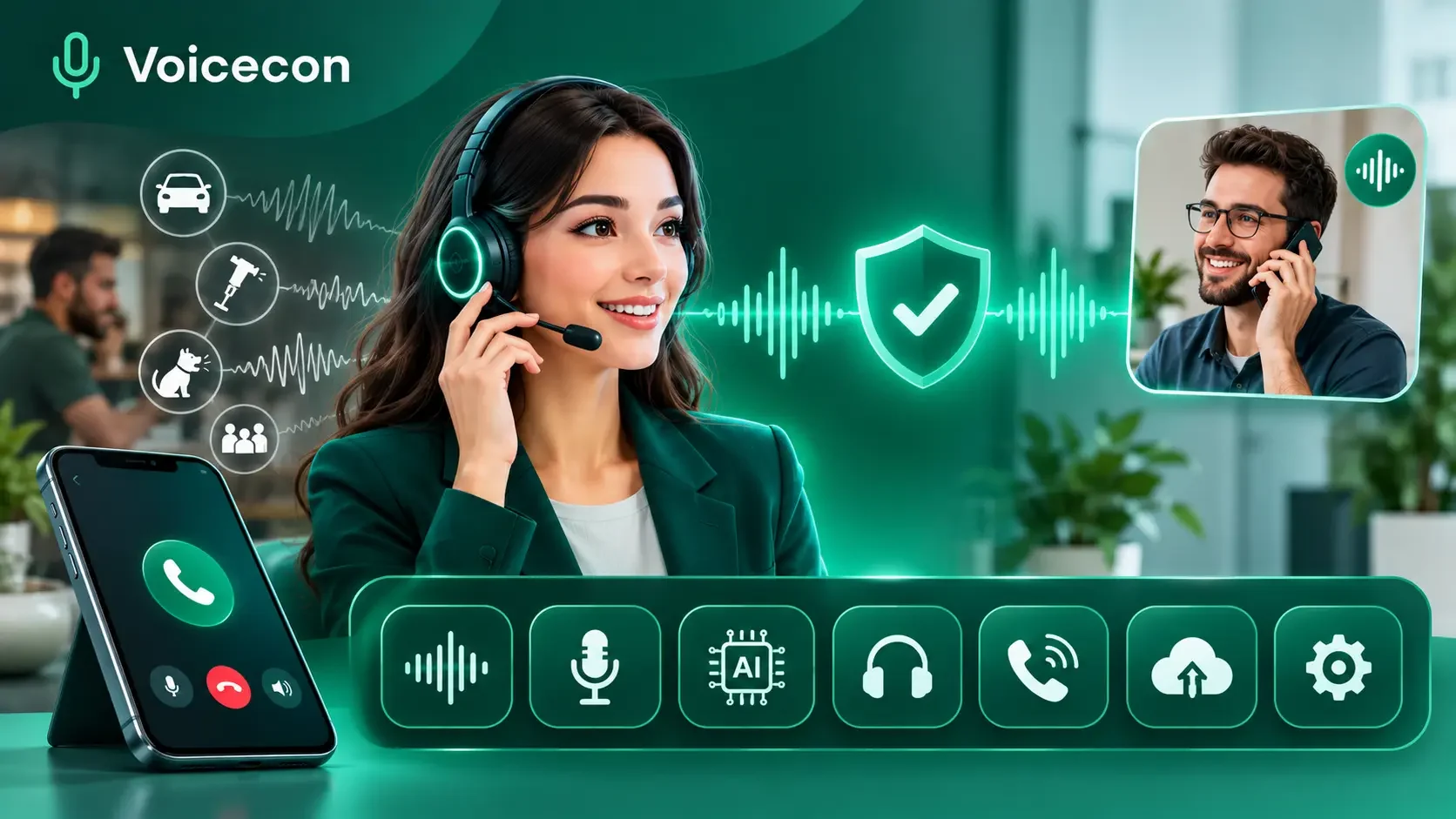
Finding the best AI phone call agent with background noise is essential for businesses that receive calls from customers in busy offices, on construction sites, in vehicles, or in other noisy environments. An AI agent must do more than generate natural-sounding responses. It must accurately understand callers, respond without unnecessary delays, and complete the task without losing important information.
At Voicecon, we help businesses automate phone conversations using AI voice agents that can answer questions, qualify leads, schedule appointments, connect with business systems, and trigger workflows. Furthermore, we believe choosing the right phone agent requires evaluating the entire customer experience and not just the voice quality of a short demonstration.
In this guide, we compare 11 AI phone call agent platforms and related voice technologies businesses can consider in 2026. Moreover, we also explain what background noise actually means for AI conversations, which features to evaluate, and how to test an AI phone agent before deploying it to your customers.
What Makes the Best AI Phone Call Agent With Background Noise?
The best AI phone call agent with background noise should be capable of recognizing speech accurately, responding naturally, and maintaining a coherent conversation when callers are not speaking in perfectly quiet environments.
However, background noise is not a single technical problem. Different types of sound require different solutions.
1. Noise cancellation and noise suppression
Noise suppression reduces unwanted environmental sounds before or during speech recognition.
Examples include:
Traffic and road noise
Fans and air conditioning
Construction and machinery
Wind and outdoor noise
Keyboard typing
General office noise
Noise suppression can improve the clarity of the caller's speech, but it does not automatically eliminate every problem caused by other people speaking.
2. Background voice isolation
Background voice isolation attempts to separate the primary speaker from other people talking nearby.
For example, imagine a customer calling your business from an office where colleagues are discussing a project. The AI phone agent might accidentally recognize a colleague's words as part of the customer's request.
Furthermore, a system that supports speaker isolation or background speech filtering may help reduce this problem. However, performance should be evaluated with real conversations because overlapping speech is more difficult to process than steady environmental noise.
3. Accurate speech recognition
Automatic speech recognition (ASR) converts spoken words into text that an AI model can interpret.
If the transcription contains errors, the agent may provide an incorrect answer even when its reasoning model is capable of responding accurately.
This is why businesses should evaluate the entire voice pipeline, including audio quality, transcription accuracy, response generation, and speech output.
4. Natural interruption handling
A good AI phone call agent should allow callers to interrupt naturally.
For example, if an agent is explaining an appointment confirmation and the customer says, "Actually, can we make that Friday instead?" the system should recognize the interruption and respond to the updated request.
Poor interruption handling can make conversations feel frustrating, particularly when background sounds trigger the agent to stop speaking unnecessarily.
11 Best AI Phone Call Agents With Background Noise
The following providers represent different approaches to AI phone automation, speech processing, and contact center technology. Some offer complete business phone agents, while others provide developer infrastructure or dedicated audio-enhancement tools.
1. Voicecon - Best for Business Phone Automation With Integrated Workflows
At Voicecon, we provide an AI phone call system designed to help businesses automate customer conversations and turn them into meaningful business actions.
Our platform allows businesses to configure AI voice agents for customer support, lead qualification, appointment scheduling, order inquiries, and other phone-based workflows.
Key capabilities:
Real-time speech recognition using Deepgram
AI-powered conversations using OpenAI or Anthropic models
Natural-sounding voices through ElevenLabs
Configurable AI agent instructions and call flows
Knowledge bases for answering questions from business documents
Call transfers and tools during live conversations
Workflow automation across connected business applications
Call recordings, transcripts, summaries, and analytics
Browser-based testing before deployment
How Voicecon helps businesses
Businesses can create an AI phone agent that answers frequently asked questions, collects lead information, books appointments, and transfers calls when human assistance is required.
Our workflow automation also helps connect phone conversations to CRM systems, calendars, messaging applications, and other business tools.
Best for: Small, medium and growing businesses that want an AI phone agent, call automation, and business workflows in one platform without building the entire infrastructure themselves.
Try Voicecon: We currently offer a seven-day free trial so businesses can create and test their AI agents before committing to a paid plan.
2. Brilo AI - Best for AI Receptionist and Inbound Call Automation
Brilo AI is a voice AI platform focused on business phone automation and AI receptionist functionality.
It is worth considering for companies that want to automate incoming calls, customer inquiries, and appointment-related conversations.
Key capabilities to evaluate:
AI receptionist and inbound call handling
Customer inquiry automation
Appointment scheduling workflows
Speech recognition and conversational responses
Business integrations
Call handling in real-world environments
Background noise considerations
Brilo AI has published a comparison specifically focused on background noise and AI phone agents. Businesses should review its documented noise-handling capabilities and test how the system responds to traffic, office conversations, and overlapping speech.
Best for: Businesses seeking an AI receptionist to handle routine inbound calls.
3. Retell AI - Best for Customizable AI Phone Agents
Retell AI provides infrastructure for businesses and developers building conversational AI agents for phone calls.
It offers a visual approach to configuring agents while also supporting more advanced integrations and development workflows.
Key capabilities:
AI voice agents for inbound and outbound calls
Configurable speech and conversation settings
Integrations with telephony providers
Custom call flows and business logic
Developer APIs and tools
Testing and monitoring capabilities
Background noise considerations
Retell documents noise-removal options and background speech filtering. Its configurable interruption sensitivity is also relevant when callers speak in noisy environments.
Businesses should confirm which features are enabled, whether additional charges apply, and how the chosen configuration performs in their specific call environment.
Best for: Companies that need customizable AI phone agents and developers who want control over conversation behavior.
4. Vapi - Best for Developers Building Custom Voice AI Systems
Vapi is a developer-oriented platform for creating AI voice agents with customizable speech, language models, and telephony integrations.
It is particularly relevant for businesses that have technical teams capable of configuring and maintaining their own voice AI workflows.
Key capabilities:
Customizable AI voice agent infrastructure
Multiple model and speech provider options
API-driven agent development
Inbound and outbound calling
Configurable conversation flows
Integration with external applications
Background noise considerations
Vapi documents smart denoising capabilities and additional options for audio processing. The available features depend on the configuration and selected providers.
Developers should test transcription quality, interruption sensitivity, and response latency together rather than treating noise suppression as an isolated feature.
Best for: Technical teams that want flexibility and control over their AI voice architecture.
5. Bland AI - Best for High-Volume Business Call Automation
Bland AI provides infrastructure for businesses looking to automate phone conversations at scale.
Its platform can be used for customer support, sales outreach, lead qualification, and other voice-based workflows.
Key capabilities:
AI-powered inbound and outbound calls
Customizable conversational agents
API-based integrations
Automated call workflows
Business system connectivity
Call orchestration and configuration
Background noise considerations
Bland AI documents noise cancellation capabilities, although feature availability and behavior should be confirmed for the relevant product tier and deployment configuration.
Businesses should also evaluate interruption sensitivity and how the agent responds when multiple people are speaking.
Best for: Organizations automating substantial volumes of repetitive phone interactions.
6. PolyAI - Best for Enterprise Contact Centers
PolyAI focuses on enterprise conversational AI and customer service automation.
Its solutions are designed for organizations that handle substantial call volumes and need to automate complex customer interactions.
Key capabilities:
Enterprise conversational AI
Automated customer service calls
Multilingual voice interactions
Contact center integration
Customer inquiry automation
Enterprise deployment and support
Background noise considerations
PolyAI is a provider worth evaluating for enterprise environments where callers may have varied accents, speaking conditions, and conversational requirements.
Organizations should request demonstrations using representative call recordings or controlled test scenarios to assess performance in noisy conditions.
Best for: Large enterprises and contact centers with complex customer service requirements.
7. Synthflow AI - Best for No-Code Voice Agent Deployment
Synthflow AI provides a no-code platform for creating and deploying AI voice agents.
It is useful for businesses that want to automate phone calls without assembling multiple technical components.
Key capabilities:
No-code AI voice agent creation
Inbound and outbound calling
Automated appointment scheduling
Lead qualification
Business integrations
Conversational workflow configuration
Background noise considerations
Noise tolerance depends on the underlying speech-processing configuration. Businesses should test the platform with different caller environments and confirm which audio-enhancement features are supported.
Best for: Small and medium-sized businesses that want to deploy voice automation without extensive development.
8. ElevenLabs Agents - Best for Natural-Sounding AI Conversations
ElevenLabs is widely known for its voice-generation technology and also offers conversational AI agents for voice-based interactions.
It is worth considering when natural-sounding speech is a major priority.
Key capabilities:
AI conversational agents
Natural-sounding voice generation
Speech recognition and conversational processing
Configurable agent behavior
API-based integrations
Voice application development
Background noise considerations
Natural voice output and accurate recognition of noisy incoming audio are separate capabilities. Businesses should evaluate both sides of the conversation.
Ask specifically about background speech detection, speech recognition configuration, and interruption behavior when testing the platform.
Best for: Businesses prioritizing natural voice interactions and customizable voice experiences.
9. JustCall - Best for Business Phone Systems and Customer Support
JustCall provides business communication and customer support solutions, including AI-powered calling and automation features.
Its platform is relevant for organizations that want to combine phone communication with sales and customer support workflows.
Key capabilities:
Business calling infrastructure
AI-powered call handling
Customer support and sales workflows
Call recording and analytics
Business communication integrations
Contact center capabilities
Background noise considerations
JustCall has published technical information about background noise handling and documents smart active noise cancellation in its relevant calling environment.
Businesses should verify whether the specific functionality applies to their intended AI phone agent setup or to particular human-agent calling features.
Best for: Sales and customer support teams that want AI-assisted calling within a broader communication platform.
10. Krisp - Best for Dedicated AI Noise Cancellation
Krisp is primarily an AI-powered audio enhancement platform rather than a complete standalone AI phone agent.
It deserves consideration because noise cancellation can be an important component of a broader voice AI system.
Key capabilities:
AI noise cancellation
Background voice isolation
Echo cancellation
Real-time audio enhancement
Contact center audio processing
Integration options for communication environments
Background noise considerations
Krisp provides dedicated noise-removal and voice-isolation technologies that can improve the clarity of communication in supported environments.
However, businesses must confirm compatibility with their voice AI platform and whether processing is available on both the caller's and agent's audio paths.
Best for: Organizations that already have a phone system or AI voice agent and want to evaluate a dedicated audio-enhancement solution.
11. Dialpad - Best for AI-Powered Business Communications
Dialpad combines business communications, calling, and AI-powered productivity features in a unified platform.
Its technology is relevant to organizations looking to improve call quality while supporting business communication and contact center workflows.
Key capabilities:
Business phone system
AI-powered calling and transcription
Customer support communication
Call analytics
Conversation intelligence
AI-assisted workflows
Background noise considerations
Dialpad has promoted AI-powered audio enhancement in its communications environment. Buyers should confirm the specific noise cancellation capabilities available in their chosen plan and whether those capabilities extend to their intended AI phone agent workflow.
Best for: Businesses that want a broader communications platform with AI-powered calling features.
Comparison of the 11 Best AI Phone Call Agents
Platform | Best suited for | Type |
Voicecon | Business phone automation and workflows | Complete AI phone platform |
Brilo AI | Inbound calls and AI receptionist | AI phone agent |
Retell AI | Customizable voice agents | Voice AI platform |
Vapi | Developer-led voice AI systems | Developer infrastructure |
Bland AI | High-volume call automation | Voice AI platform |
PolyAI | Enterprise customer service | Enterprise conversational AI |
Synthflow AI | No-code voice agent deployment | AI phone agent |
ElevenLabs Agents | Natural-sounding conversations | Conversational AI |
JustCall | Sales and customer support communication | Business communications |
Krisp | Dedicated noise suppression | Audio enhancement |
Dialpad | Unified AI communications | Business phone platform |
Remember! This table compares product categories and use cases. It is not a verified laboratory ranking of noise cancellation accuracy. You should validate current capabilities and pricing directly with the above providers and for Voicecon, we are currently offering a 7 days free trial so that you check our product before you pay.
How to Choose the Best AI Phone Call Agent for Your Business
Selecting an AI phone agent should involve more than comparing features or listening to voice samples.
1. Evaluate speech recognition accuracy
The system should understand names, phone numbers, addresses, product names, and other important information.
For businesses handling sales and appointments, transcription errors can result in incorrect bookings or lost leads.
2. Test background noise performance
Test calls with:
Moderate office noise
Traffic and outdoor noise
Background television
Multiple people speaking
Machinery or construction noise
Different microphones and phone devices
3. Evaluate response speed
An AI phone agent should respond naturally without unnecessary delays.
Test the complete conversation rather than focusing exclusively on the speed of transcription or language-model processing.
4. Check interruption handling
Determine whether the agent can handle customers who interrupt, change their minds, or correct earlier information.
5. Verify integrations
Your AI phone agent should connect to the business systems required to complete tasks.
Depending on your needs, this may include:
CRM platforms
Calendars and appointment systems
Customer support software
Payment or order-management systems
Messaging applications
Internal knowledge bases
6. Understand human handoff
An effective AI phone agent should recognize when a conversation requires human assistance.
Check whether the platform can transfer calls, provide summaries, and preserve the relevant context for the next person.
7. Evaluate reporting and analytics
Call recordings, transcripts, summaries, and analytics can help your team identify recurring issues and improve the agent over time.
How to Test an AI Phone Agent in Noisy Conditions
Before committing to a platform, use a structured testing process.
Step 1: Create realistic call scenarios
Prepare test calls that reflect actual customer conversations.
Examples include asking about a product, booking an appointment, requesting a price, or correcting a previously stated detail.
Step 2: Introduce different background sounds
Use controlled examples of office chatter, traffic, television, fans, or machinery.
Keep the test conditions consistent when comparing providers.
Step 3: Compare the transcript against the original speech
Review the original audio and the resulting transcript.
Look for incorrect names, missing words, misunderstood numbers, and background voices mistakenly included in the conversation.
Step 4: Test interruptions and corrections
Interrupt the agent, change a booking request, ask a follow-up question, and speak at different speeds.
Observe whether the agent maintains context or loses track of the conversation.
Step 5: Verify business actions
If the agent is expected to schedule appointments or create CRM records, confirm that those actions were completed accurately.
A successful conversation does not necessarily mean the correct business outcome occurred.
Step 6: Review recordings and analytics
Identify repeated transcription errors, unnecessary interruptions, inaccurate responses, and situations that require human assistance.
Step 7: Refine and retest
Adjust the agent's instructions, knowledge sources, conversation flow, and relevant audio settings.
Repeat the same scenarios to determine whether the changes actually improved the results.
How Businesses Can Use AI Phone Agents
Customer support automation
AI phone agents can answer common questions about services, business hours, order status, policies, and other frequently requested information.
When an issue requires additional support, the agent can be configured to transfer the call to a human representative.
Lead qualification
Businesses can use AI phone agents to collect information from prospective customers, ask qualifying questions, and route relevant leads to their sales teams.
This can help sales representatives focus on conversations that require their expertise.
Appointment scheduling
AI phone agents can support businesses that regularly receive appointment requests.
For example, a customer might call a clinic, salon, or home service company to request an available appointment. A properly configured agent can check availability, collect relevant information, and confirm the booking.
After-hours call answering
When a business is unavailable to answer calls, an AI phone agent can provide information, capture customer requests, and route important messages to the appropriate team.
Sales and customer follow-up
Businesses can use AI voice automation for permitted follow-up calls, customer reminders, and other structured conversations.
Outbound calling must be configured in accordance with applicable consent, telemarketing, and privacy requirements.
Final Thoughts
Choosing the best AI phone call agent with background noise requires careful evaluation of speech recognition, audio quality, interruption handling, business integrations, and overall conversation performance.
The right platform should do more than answer the phone. It should understand what the caller needs, respond appropriately, and help your business complete the next step.
At Voicecon, we help businesses build AI phone agents that can answer customer questions, qualify leads, schedule appointments, connect to business systems, and automate workflows.
If you are evaluating AI phone automation for your business, start with a real-world test rather than relying on a polished demo.
Try Voicecon for seven days and explore how our AI phone call system can support your business. Build an agent, test realistic conversations, and evaluate whether it meets your requirements before making a commitment.
Visit https://voicecon.ai/ to get started.
Keep reading
All articles → Guides
15 min read
Best AI Agents for Insurance Agencies: 6 Solutions Worth Considering - 2027
Discover the best AI agents for insurance agencies. Compare AI voice agents, automate customer calls, qualify leads, schedule appointments, and explore Voicecon's free seven-day trial.
Azfar hussain Guides
19 min read
Conversational AI Tools: How to Choose the Right Solution for Your Business
How conversational AI tools help businesses automate calls, qualify leads, book appointments, and improve customer service. Try Voicecon free for 7 days.
Azfar hussain Guides
15 min read
Difference Between Auto-Attendant and AI Receptionist: Which Is Better for Your Business
Find the difference between auto-attendant and AI receptionist systems. Compare features, benefits, call handling, and business automation with Voicecon.
Azfar hussain