Best AI Calling Software in 2026: Top Solutions for Businesses
Find the best AI calling software for businesses. Compare AI phone agents, features, automation, and how Voicecon can help your business.
 Azfar hussain17 min read
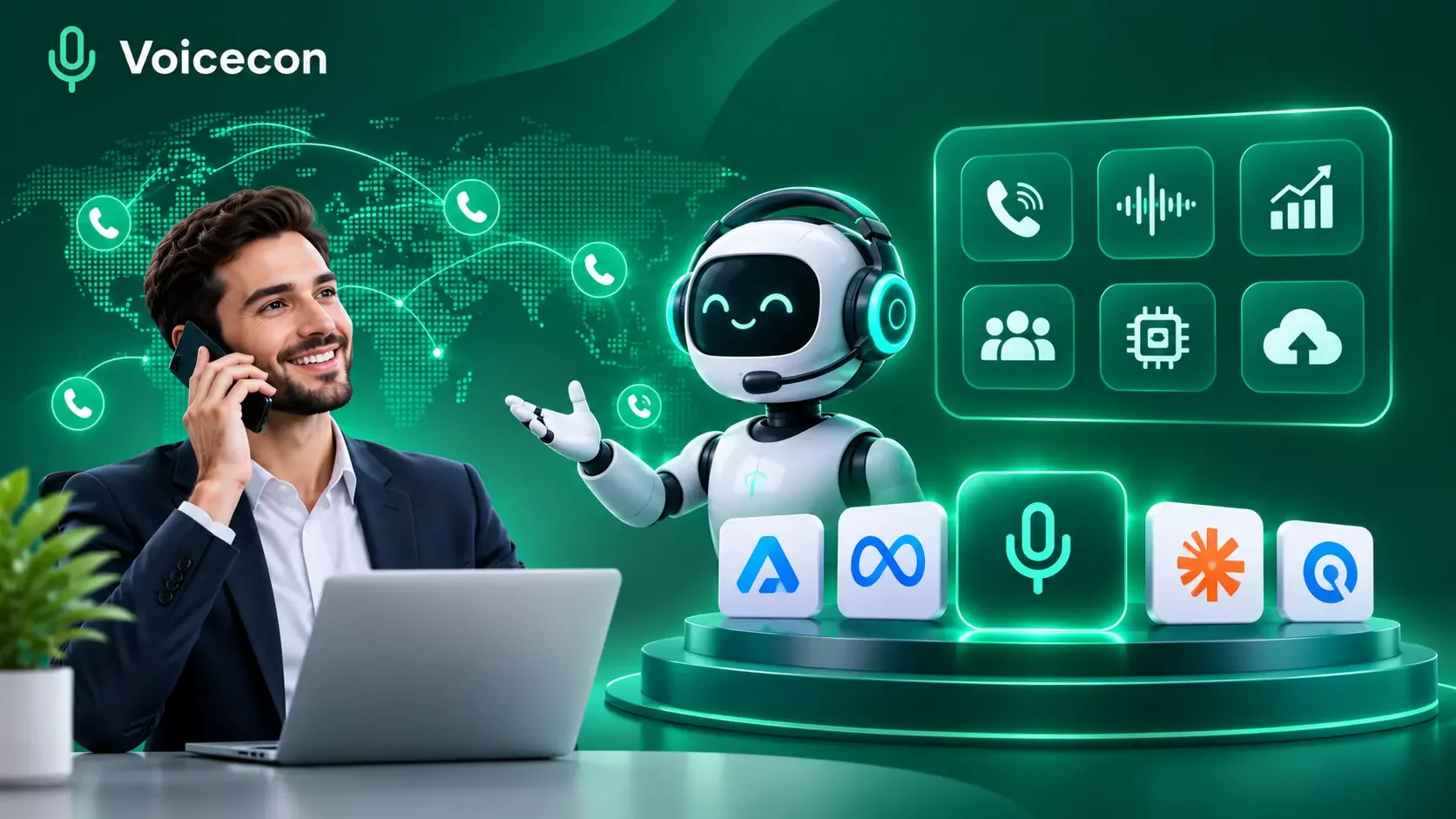
The best AI calling software helps businesses answer phone calls, communicate with customers, qualify leads, schedule appointments, and automate repetitive tasks without relying entirely on human agents. For businesses that want more than a traditional phone system, AI-powered calling can turn everyday conversations into meaningful business opportunities.
As customer expectations continue to rise, missing a call or leaving a potential customer waiting can mean losing a valuable opportunity. Businesses need a reliable way to manage incoming inquiries, support existing customers, and follow up with prospects while keeping their teams focused on important work.
At Voicecon, we help businesses implement AI phone agents that can answer and make calls, respond using business-specific information, and connect conversations with automated workflows. Our goal is to help businesses make their phone communication more efficient, accessible, and productive.
In this guide, we explore the best AI calling software, the features worth evaluating, how different platforms compare, and how to choose a solution that fits your business requirements.
What Is the Best AI Calling Software for Businesses?
The best AI calling software depends on your business goals, call volume, technical requirements, and budget.
For businesses seeking AI-powered phone answering, lead qualification, appointment scheduling, and workflow automation in one platform, Voicecon is a compelling option to evaluate. It combines AI voice agents, configurable call flows, knowledge bases, integrations, and no-code workflows.
Other platforms may be better suited to businesses looking for developer-controlled voice infrastructure, sales dialers, established business phone systems, or enterprise contact-center solutions.
The important distinction is that AI calling software is not a single category of product. Some platforms assist human agents, some automate outbound sales calls, and others independently answer incoming calls and carry out tasks during conversations.
Before comparing providers, identify the type of AI calling solution your business actually needs.
How Does AI Calling Software Work?
AI calling software combines several technologies to understand speech, generate responses, and manage phone conversations.
A typical AI-powered calling system involves four components:
Speech recognition: Converts spoken words into text that the system can interpret.
Language model: Understands the conversation, follows instructions, and determines an appropriate response.
Voice generation: Converts the AI's response into natural-sounding speech.
Telephony and automation: Connects the agent to phone numbers, business applications, and workflows so it can take appropriate action.
For example, imagine a customer calls a home services company to ask about an appointment.
The AI agent can greet the caller, ask about the requested service, collect relevant details, check an available calendar if properly connected, and confirm an appointment after the booking is completed. It can then trigger a workflow to notify the business.
This is what separates an AI phone agent from a simple automated menu.
Speech Recognition and Conversational AI
Modern AI calling systems use speech recognition and conversational AI to understand natural language rather than requiring callers to follow rigid instructions.
A caller might say, "I need someone to come out and check my air conditioner sometime this week."
A properly configured agent can identify the service request, ask follow-up questions, and guide the conversation toward the next appropriate step.
The quality of this experience depends on the underlying models, configuration, available information, and how the system handles ambiguous requests.
Real-Time Responses and Voice Generation
An AI calling platform must respond quickly enough to maintain a comfortable conversation.
Voice quality matters, but so does the ability to handle interruptions, understand corrections, and maintain context throughout a call.
Businesses should evaluate both the naturalness of the voice and the agent's conversational behavior before deployment.
Connecting Calls to Business Workflows
The real value of AI calling software extends beyond the conversation itself.
When connected to business applications, an AI agent can help move information from a phone call into the systems where teams work.
Depending on the configuration, this may include:
Creating or updating CRM contacts.
Sending call summaries to employees.
Triggering follow-up emails or messages.
Scheduling appointments.
Transferring callers to the appropriate team.
Recording call outcomes for reporting and analysis.
This connection between conversations and business operations is an important factor when choosing an AI calling platform.
What to Look for in the Best AI Calling Software
Not every AI calling platform offers the same capabilities. A useful evaluation should focus on the features that directly support your business requirements.
1. Natural Conversations and Response Speed
Look for a platform that can communicate clearly and naturally without making callers feel as though they are navigating a complicated automated menu.
Evaluate whether the agent can:
Understand different ways of asking the same question.
Respond without unnecessary delays.
Handle interruptions and corrections.
Maintain context across multiple questions.
Ask for clarification when information is missing.
A polished voice is useful, but conversational accuracy is equally important.
2. Inbound and Outbound Calling Capabilities
Some AI calling platforms specialize in incoming calls, while others focus on outbound sales and follow-up campaigns.
Determine whether your business needs:
Capability | Business application |
Inbound AI answering | Responding to customer inquiries |
Outbound AI calling | Following up with leads and customers |
Call transfer | Connecting callers with human employees |
Lead qualification | Identifying relevant prospects |
Appointment scheduling | Coordinating meetings and service bookings |
After-hours answering | Handling calls outside business hours |
Choose a platform based on your actual calling requirements rather than assuming every provider supports every function.
3. CRM and Business Integrations
AI calling software becomes considerably more useful when it connects with your existing business systems.
For example, a sales team may need an AI agent to collect prospect information and update HubSpot, Salesforce, or GoHighLevel after a call.
A customer support team may want call summaries delivered to Slack or support tickets created automatically.
Before purchasing, confirm that the platform supports your required applications and that the specific actions you need are available.
4. Appointment Booking and Lead Qualification
For service businesses, appointment scheduling can be one of the most valuable applications of AI calling.
An AI agent can collect a caller's requirements, check available scheduling information through an appropriate integration, and book an appointment when the workflow is configured to support it.
Similarly, lead qualification can help sales teams collect information about a prospect's needs, budget, timeline, or service requirements.
These capabilities should be tested against realistic business scenarios rather than judged by a scripted demonstration.
5. Analytics, Call Recordings, and Transcripts
Businesses need visibility into what happens during automated calls.
Useful reporting capabilities include:
Call recordings and transcripts.
AI-generated call summaries.
Call outcomes and completion status.
Conversation intent and sentiment indicators.
Average call duration.
Agent performance and usage costs.
These insights can help identify recurring customer questions, improve agent instructions, and determine where human assistance is still required.
6. Pricing, Scalability, and Human Handoff
The lowest advertised price does not necessarily represent the lowest total cost.
Consider subscription fees, included minutes, usage charges, phone numbers, model costs, integrations, and implementation requirements.
Also, make sure the software can transfer calls to a human when necessary. A well-designed AI calling system should recognize when a conversation requires assistance rather than attempting to resolve every situation independently.
Best AI Calling Software for Businesses: How the Options Compare
The following platforms represent different approaches to AI calling. They should be evaluated according to their intended use rather than treated as identical products.
Software | Best suited for | Primary strength |
Voicecon | Businesses seeking AI phone agents and workflow automation | AI conversations connected to business applications |
CloudTalk | Sales and customer service teams | Business telephony with AI-powered communication features |
Retell AI | Businesses and developers building custom voice agents | Configurable conversational AI |
Vapi | Technical teams and developers | API-driven voice AI infrastructure |
Synthflow AI | Businesses seeking no-code voice automation | Visual agent-building workflows |
ElevenLabs | Teams prioritizing expressive AI voices | Voice generation and conversational voice technology |
Features, pricing, and availability can change. Confirm current vendor documentation and plan details before making a purchasing decision.
1. Voicecon - AI Calling Software With Workflow Automation
Voicecon is designed for businesses that want AI phone agents to manage conversations and connect those conversations to practical business actions.
Rather than treating a phone call as an isolated interaction, Voicecon combines voice agents, visual call flows, knowledge bases, connected tools, and no-code workflows.
Key capabilities include:
AI agents for inbound and outbound calling.
Configurable agent instructions, models, voices, and transcription.
Knowledge bases built from business documents and information.
Visual call flows for structured conversations.
Call transfers and tools used during live conversations.
Appointment booking through supported calendar integrations.
CRM, messaging, and business application integrations.
Automated workflows triggered by call completion.
Call recordings, transcripts, summaries, and analytics.
Browser-based agent testing before deployment.
Who should consider Voicecon?
Voicecon is particularly relevant to small and medium-sized businesses that want to automate customer communication without building a voice AI system from scratch.
For example, a real estate company could configure an agent to answer property inquiries, collect information from potential buyers, qualify leads, and send relevant details to its sales team.
A clinic could configure an appointment-focused agent to respond to calls, check calendar availability, and book appointments through a supported integration.
Why businesses choose Voicecon
The Voicecon AI agent platform brings conversations and operational workflows together. This is useful for businesses that need their AI calling software to do more than respond verbally.
Businesses can explore Voicecon through its advertised 7-day free trial, which allows them to build and test an AI agent before committing to a paid subscription.
Get started: https://voicecon.ai/
2. CloudTalk - Business Calling and Sales Operations
CloudTalk is a cloud-based business calling platform designed for sales and customer service teams.
It combines business telephony with features that support communication, call management, and AI-assisted operations. Its AI capabilities and available packages depend on the product and subscription selected.
Potential advantages:
Business phone system capabilities.
Sales and customer support calling workflows.
Call analytics and communication management.
Integrations with business applications.
AI-powered communication features.
CloudTalk may be a suitable choice for businesses that want an established business phone platform with AI capabilities integrated into their communication operations.
3. Retell AI - Custom AI Voice Agents
Retell AI is a voice AI platform used to create and deploy conversational agents for phone-based interactions.
It can be relevant to businesses that need customized conversation logic, structured workflows, and greater control over how an AI agent operates.
Potential advantages:
Customizable voice agents.
Configurable conversational workflows.
Integration and development capabilities.
Usage-based pricing options.
Support for specialized business call scenarios.
Businesses should evaluate its implementation requirements, usage costs, and integration needs before choosing it for production calling.
4. Vapi - Developer-Oriented AI Calling Infrastructure
Vapi is designed for developers and technical teams building customized voice AI applications.
It provides tools for orchestrating voice agents and integrating speech, language models, and telephony into applications.
Potential advantages:
Developer-focused configuration.
API-based implementation.
Custom voice AI workflows.
Flexibility in selecting AI components.
Support for specialized calling applications.
Vapi can be a strong option for organizations with technical resources that want to develop and maintain their own AI calling solution.
5. Synthflow AI - No-Code Voice Automation
Synthflow AI focuses on making voice AI accessible through visual configuration and no-code workflows.
It may suit businesses that want to build conversational agents without developing the entire underlying voice AI infrastructure themselves.
Potential advantages:
Visual agent-building capabilities.
Configurable call workflows.
Business-oriented voice automation.
Options for customized agent behavior.
Support for inbound and outbound use cases, depending on the configuration.
Businesses should evaluate total usage costs, implementation support, and the integrations required for their particular workflows.
6. ElevenLabs - Natural Voice and Conversational AI
ElevenLabs is widely associated with AI voice generation and also offers conversational AI capabilities.
Businesses evaluating it for calling should distinguish voice generation from a complete phone calling solution. The available telephony, integrations, and agent capabilities depend on the product and configuration.
Potential advantages:
Expressive AI voice technology.
Voice customization.
Conversational AI capabilities.
Multilingual voice options.
Developer integration opportunities.
ElevenLabs may be particularly relevant to organizations that prioritize voice quality or need a customizable voice layer for their conversational applications.
How Businesses Use AI Calling Software
AI calling software is valuable when it solves a specific communication problem. The following use cases illustrate where businesses can benefit from configured AI phone agents.
Customer Support and Call Answering
Customer support teams often handle recurring questions about services, policies, operating hours, order status, and basic troubleshooting.
An AI phone agent can answer approved questions using a business knowledge base, collect relevant information, and transfer complex inquiries to a human employee.
This can help reduce repetitive work while giving customers another way to access assistance.
Sales Lead Qualification
Sales teams receive inquiries from prospects with different needs, budgets, and levels of readiness.
AI calling software can help qualify these prospects by asking relevant questions, capturing responses, and sending the information to a CRM or sales team.
For example, a software company could configure an agent to identify a prospect's business size, requested features, and interest in a demonstration.
The sales team can then prioritize follow-up based on the information collected.
Appointment Scheduling
Appointment-based businesses often lose opportunities when customers cannot reach someone to arrange a booking.
A properly configured AI agent can:
Identify the caller's requested service.
Collect the required booking details.
Check calendar availability through an integration.
Offer available appointment times.
Confirm the booking after successful scheduling.
Trigger a confirmation or internal notification.
This can be particularly useful for clinics, salons, real estate agencies, home services, and consulting businesses.
After-Hours and Overflow Call Handling
Calls do not always arrive when employees are available.
Businesses can configure AI agents to handle calls outside normal operating hours or during busy periods, depending on their phone setup.
The agent can collect inquiries, answer approved questions, capture contact details, and communicate the next steps.
This gives businesses an additional channel for handling customer communication without requiring someone to answer every routine call immediately.
Customer Follow-Ups and Operational Workflows
Following a call, businesses often need to update records, notify employees, or schedule additional communication.
Voicecon supports configurable workflows that can connect call outcomes with business applications.
For example, a completed call can trigger a CRM update, send a summary to Slack, or initiate a follow-up workflow.
This reduces manual work and helps teams maintain consistent processes.
AI Calling Software vs. Traditional Business Phone Systems
Traditional business phone systems primarily provide telephony, routing, and communication infrastructure. AI calling software adds capabilities for understanding conversations, generating responses, and potentially completing tasks.
Feature | Traditional phone system | AI calling software |
Incoming calls | Yes | Yes, where supported |
Call routing | Rules and menus | Rules, conversational routing, or agent logic |
Customer questions | Human assistance or IVR | AI-generated responses using configured information |
Lead qualification | Primarily manual | Can be automated through agent workflows |
Appointment booking | Human or separate system | Can be automated through integrations |
Call summaries | May require additional tools | Often available as an AI feature |
Workflow automation | Usually separate integrations | May be built into the platform |
Human involvement | Required for most conversations | Still necessary for complex or sensitive cases |
The two categories are not mutually exclusive. Many businesses can integrate AI calling software with an existing phone system rather than replacing their entire communication infrastructure.
The right approach depends on how much automation the business needs and how its existing phone operations are structured.
How to Choose the Right AI Calling Software
Choosing the best AI calling software requires more than comparing feature lists. Businesses should evaluate whether the platform can perform their actual calling tasks reliably.
Step 1: Identify Your Most Important Call Workflow
Start by defining the primary problem you want to solve.
Examples include:
Answering incoming customer inquiries.
Qualifying new sales leads.
Booking appointments.
Handling after-hours calls.
Automating customer follow-ups.
Reducing repetitive support tasks.
A clearly defined use case makes it easier to evaluate software objectively.
Step 2: Evaluate the Agent With Real Scenarios
Prepare realistic conversations based on your business.
Test questions that customers frequently ask, along with scenarios involving incomplete information, interruptions, corrections, and requests that require human assistance.
Do not evaluate a system only through its most polished demonstration.
Step 3: Measure Accuracy, Outcomes, and Costs
Track whether the agent completes the tasks it was configured to perform.
Useful measurements include:
Metric | What it helps you evaluate |
Call answer rate | Whether calls are successfully answered |
Task completion rate | Whether the intended outcome is achieved |
Response accuracy | Whether answers are correct and relevant |
Transfer success | Whether callers reach the appropriate person |
Appointment accuracy | Whether bookings match the requested details |
Average call duration | How efficiently conversations are handled |
Cost per completed task | Whether automation is economically worthwhile |
These metrics should be measured during a pilot and reviewed before expanding deployment.
Step 4: Confirm Integrations and Compliance
Before going live, verify that the software connects to your required systems and that your calling practices comply with applicable laws.
In the United States, businesses should carefully review applicable requirements concerning automated calls, consent, telemarketing, call recording, and consumer privacy.
The FCC has issued guidance on AI-generated voices in calls under the Telephone Consumer Protection Act (TCPA).
Reference: https://www.fcc.gov/document/fcc-makes-ai-generated-voices-robocalls-illegal
For applicable telemarketing and automated calling requirements, consult the FTC:
https://www.ftc.gov/business-guidance/resources/complying-telemarketing-sales-rule
Compliance obligations depend on the type of call, purpose, technology, consent, and applicable federal and state law. Businesses should obtain qualified legal advice for their specific calling operations.
Is Voicecon the Right AI Calling Software for Your Business?
Voicecon is designed for businesses that want to bring AI-powered phone conversations and workflow automation into their daily operations.
Rather than requiring a development team to build every component independently, Voicecon provides a platform where businesses can configure agents, define call flows, connect knowledge bases, and create workflows through a visual interface.
What makes Voicecon useful for business calling?
A practical starting point
Businesses can start with templates or configure their own agents based on specific calling requirements.
Knowledge-based conversations
Agents can use information from uploaded business documents and configured knowledge sources to answer questions more consistently.
Flexible call flows
Visual call flows allow businesses to structure conversations, collect information, and define the next step.
Connected business applications
Voicecon supports integrations and workflows that can help transfer information between calls and business systems.
Performance visibility
Call recordings, transcripts, summaries, and analytics help businesses review conversations and identify areas for improvement.
Testing before deployment
Businesses can test agents through the browser and refine their configuration before connecting a live phone number.
Experience Voicecon With a 7-Day Free Trial
Choosing AI calling software is easier when you can evaluate the platform against your actual business needs.
At Voicecon, we offer a 7-day free trial so businesses can explore our AI phone calling system, configure an agent, and test conversations before choosing a paid plan.
Our published trial includes one agent, one knowledge base, two workflows, and up to two team members, with 30 call minutes and no credit card required. Check the current trial terms and feature availability before signing up.
Whether your business needs help with customer support, lead qualification, appointment scheduling, or after-hours call handling, testing the software with real scenarios is the best way to determine whether it meets your requirements.
Start your free trial: https://voicecon.ai/
Frequently Asked Questions
What is the best AI calling software for small businesses?
The best option depends on the business's calling needs, budget, and technical resources. Voicecon is worth evaluating for small businesses seeking configurable AI phone agents, inbound and outbound calling, and workflow automation. Businesses should compare the available features and test their preferred workflows before selecting a platform.
Can AI calling software answer incoming business calls?
Yes. AI phone agents can answer incoming calls, understand customer questions, respond using configured information, and perform certain actions through connected tools. Their capabilities depend on the platform, setup, and permissions.
Can AI calling software book appointments?
Some platforms support appointment booking through calendar integrations. A configured agent can collect booking details, check available times, and confirm an appointment after the scheduling action succeeds.
Does AI calling software integrate with CRM systems?
Many platforms offer CRM integrations or API-based connections. These integrations can help capture lead information, update customer records, and automate follow-up tasks. Businesses should verify support for their specific CRM and workflow.
How much does AI calling software cost?
Pricing varies by provider and may include monthly subscriptions, usage-based fees, included calling minutes, additional telephony costs, or enterprise contracts. Businesses should compare the total cost of their expected usage rather than relying solely on advertised starting prices.
Can AI calling software replace human agents?
AI calling software can automate certain routine and repetitive conversations, but it should not be assumed to replace human employees entirely. Complex, sensitive, ambiguous, or high-impact interactions may require human judgment. A hybrid approach that combines AI automation with human escalation is often a practical starting point.
Final Thoughts
The best AI calling software is the one that solves your business's communication challenges while providing a reliable, manageable, and cost-effective experience.
Businesses should look beyond voice quality and feature lists to evaluate conversational accuracy, workflow capabilities, integrations, scalability, and the ability to handle situations that require human assistance.
At Voicecon, we help businesses turn phone conversations into opportunities for better customer service, more organized sales operations, and more efficient workflows.
If you are ready to explore AI-powered calling for your business, start with our 7-day free trial and evaluate how our AI phone agents perform against your actual requirements.
Visit https://voicecon.ai/ to get started.
Keep reading
All articles → Guides
19 min read
Common Failure Points in AI Phone Agents: Problems, Causes, and How to Fix Them
Discover common failure points in AI phone agents, why they happen, and how Voicecon helps businesses build more reliable AI-powered phone experiences.
Azfar hussain Guides
15 min read
Best AI Agents for Insurance Agencies: 6 Solutions Worth Considering - 2027
Discover the best AI agents for insurance agencies. Compare AI voice agents, automate customer calls, qualify leads, schedule appointments, and explore Voicecon's free seven-day trial.
Azfar hussain Guides
19 min read
Conversational AI Tools: How to Choose the Right Solution for Your Business
How conversational AI tools help businesses automate calls, qualify leads, book appointments, and improve customer service. Try Voicecon free for 7 days.
Azfar hussain