Best AI Answering Service: How to Choose the Right Solution for Your Business
Discover how to choose the best AI answering service for your business. Compare features, benefits, integrations, and AI phone agents with Voicecon's AI call agents.
 Azfar hussain12 min read
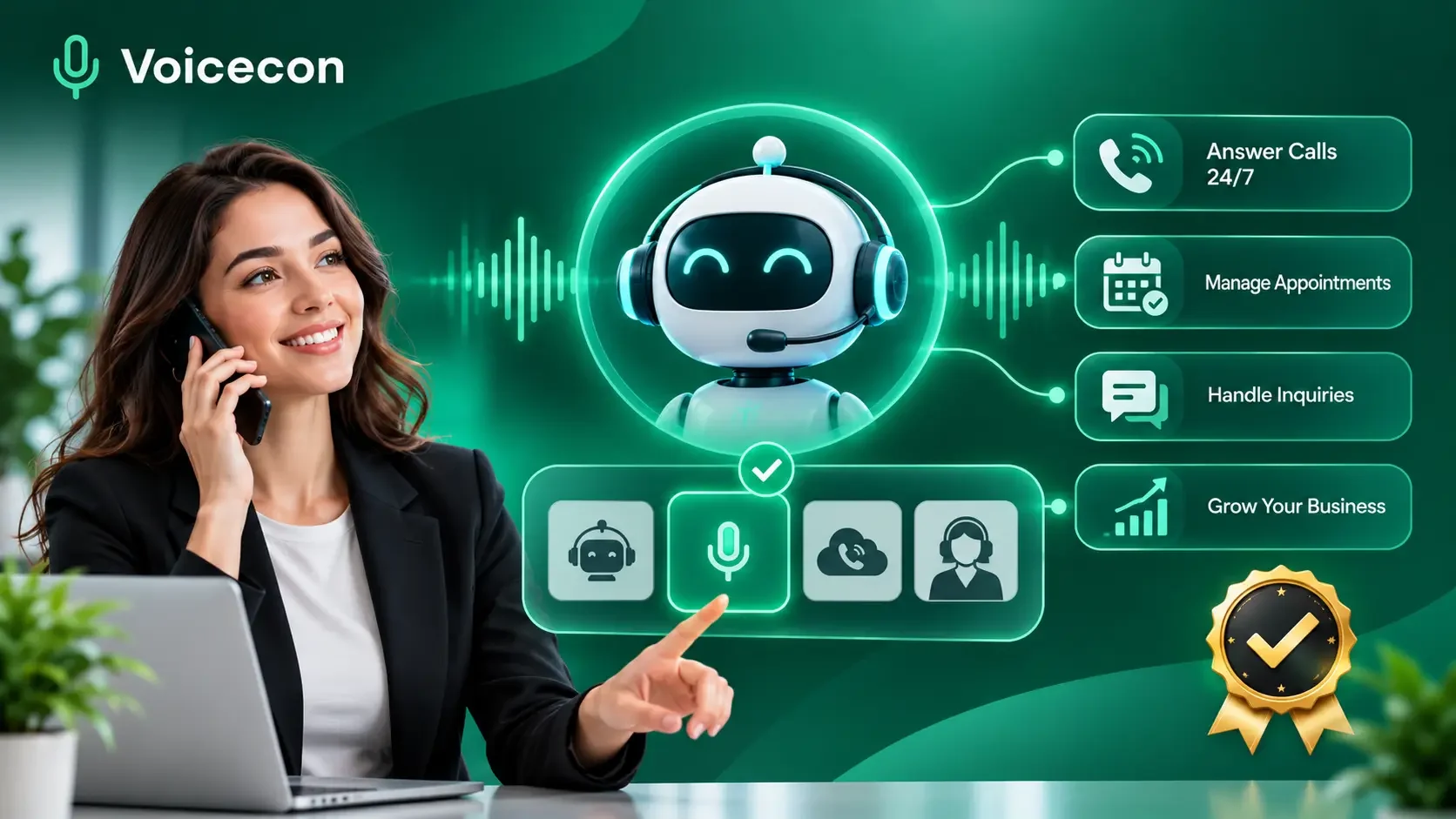
Finding the best AI answering service is becoming a priority for businesses that want to respond to every customer call, capture more leads, and deliver better customer experiences without increasing their operational workload. When customers call with questions, booking requests, or purchasing inquiries, every unanswered call can represent a missed business opportunity.
Traditional answering services can help, but they often come with limitations related to staffing, availability, and operating costs. Modern AI answering services offer another approach: intelligent phone agents that can answer calls, understand customer requests, provide relevant information, schedule appointments, and connect conversations with business workflows.
But not every AI answering service delivers the same capabilities. Choosing the right solution requires understanding your business needs, call volume, integrations, and the outcomes you expect from automation.
In this guide, we explain what to look for in an AI answering service, how these systems support business growth, and how to evaluate a solution before investing.
What Is an AI Answering Service?
An AI answering service uses artificial intelligence and conversational voice technology to handle business phone calls automatically.
Unlike traditional voicemail systems that simply record messages, an AI answering service can interact with callers in real time. It understands spoken questions, responds conversationally, follows business instructions, and performs configured tasks during or after a call.
Depending on the platform and its configuration, an AI answering service can:
Answer incoming business calls around the clock.
Respond to frequently asked questions.
Collect customer names, contact information, and inquiry details.
Qualify sales leads based on predefined criteria.
Schedule appointments and meetings.
Transfer callers to the appropriate team member.
Send follow-up messages and notifications.
Update CRM records and connected business applications.
Generate call summaries, transcripts, and performance reports.
The goal is not simply to automate conversations. It is to make sure customer interactions lead to meaningful next steps.
Why Businesses Are Switching to AI Phone Answering Services
Businesses receive calls throughout the day, but employees cannot always answer immediately. Meetings, customer appointments, administrative work, and high call volumes can leave incoming calls unattended.
An AI phone answering service helps businesses address these challenges.
1. Answer Calls Without Depending on Staff Availability
Customers may call during lunch breaks, after business hours, or when your team is handling another inquiry.
An AI answering agent can provide continuous coverage, allowing businesses to respond to customers outside their regular operating hours.
2. Reduce Missed Sales Opportunities
A prospective customer who cannot reach your business may contact another provider.
AI answering agents can collect information from incoming leads, ask relevant qualification questions, and route inquiries to your sales team.
This gives businesses a better opportunity to follow up with interested prospects.
3. Improve Customer Response Times
Customers often expect quick answers to straightforward questions.
An AI agent can respond immediately using approved business information, helping customers find answers without waiting for an employee to become available.
4. Automate Repetitive Phone Tasks
Many calls involve predictable requests, such as appointment availability, service information, operating hours, pricing inquiries, or order updates.
Automating these routine interactions allows employees to spend more time on complex customer needs and higher-value activities.
5. Support Business Growth Without Adding the Same Operational Burden
As a business grows, its call volume and customer inquiries may increase.
An AI answering service can help businesses manage more conversations without relying exclusively on expanding their receptionist or customer support teams. Actual capacity depends on the platform, plan, and concurrent-call limits.
What Makes the Best AI Answering Service?
The best AI answering service is not necessarily the one with the most features. It is the one that reliably handles the calls and workflows your business needs.
Here are the capabilities decision-makers should evaluate.
Natural, Human-Like Conversations
A good AI phone agent should understand callers who speak naturally rather than requiring them to follow rigid commands.
Look for a solution that can handle interruptions, follow-up questions, clarifications, and conversational context.
During testing, evaluate whether the agent:
Understands different ways of asking the same question.
Responds without unnecessary delays.
Handles interruptions appropriately.
Maintains context throughout the conversation.
Avoids repeating the same information.
Admits when it does not know an answer.
Voice quality matters, but conversational accuracy matters just as much.
24/7 AI Call Answering
For businesses that receive inquiries outside regular working hours, availability is an important consideration.
A reliable AI answering service should support your required operating schedule and provide a clear process for managing calls that need human assistance.
Lead Qualification and Information Collection
For sales-driven businesses, an AI answering service should do more than greet callers.
It should be configurable to ask relevant questions, collect contact details, understand the caller's requirements, and identify whether an inquiry meets your qualification criteria.
For example, a software company might configure its AI agent to ask about company size, current challenges, and preferred consultation times before forwarding a lead to its sales team.
Appointment Scheduling and Calendar Integration
Appointment scheduling can make an AI answering service particularly useful for service-based businesses.
Look for the ability to connect with supported calendars, check availability, and schedule appointments according to your business rules.
The agent should also be tested for rescheduling requests, unavailable time slots, incomplete information, and scheduling errors.
CRM and Business Workflow Integration
An AI answering service becomes more valuable when it connects phone conversations to your existing operations.
Relevant integrations may include:
Customer relationship management systems.
Business calendars.
Email and messaging applications.
Lead management tools.
Customer support platforms.
Workflow automation software.
For example, after a sales inquiry, a configured workflow could create a CRM record, attach a call summary, and notify the appropriate sales representative.
Human Call Transfer and Escalation
Automation should not mean that customers lose access to human assistance.
The AI agent should have clearly defined escalation rules for complex inquiries, complaints, sensitive issues, or requests outside its capabilities.
Businesses should test whether transfers work correctly and whether the receiving employee gets enough information to continue the conversation.
Call Recordings, Transcripts, and Analytics
Call monitoring helps businesses understand whether their AI answering service is performing as expected.
Useful reporting capabilities include:
Call recordings and transcripts.
Conversation summaries.
Call outcomes.
Customer intent and sentiment indicators.
Average call duration.
Successful task completion.
Usage and cost reporting.
These insights can help identify recurring customer questions, improve agent instructions, and refine business workflows. Automated sentiment and summary results should be reviewed rather than treated as infallible.
Best AI Answering Service for Different Business Needs
The right AI answering service depends on what your business wants to accomplish.
Business type | Important capabilities |
Small businesses | Affordable call handling, FAQs, message collection |
Sales teams | Lead qualification, CRM updates, follow-up |
Service businesses | Appointment booking, scheduling, call routing |
Customer support teams | Knowledge bases, issue resolution, escalation |
Marketing agencies | Multiple agents, client workspaces, customization |
Growing companies | Scalability, integrations, analytics, concurrency |
Instead of selecting a solution based only on popularity, identify the primary workflow you want to improve.
A business that mainly needs message collection has different requirements from a sales team that needs lead qualification and CRM automation.
AI Answering Service vs. Traditional Receptionist
Both AI answering services and human receptionists can support customer communication. However, they differ in how they operate.
Feature | AI answering service | Traditional receptionist |
Call availability | Can operate continuously | Depends on staffing |
Routine inquiries | Automated responses | Handled manually |
Multiple simultaneous calls | Subject to platform capacity | Limited by available staff |
Appointment scheduling | Available with configured integrations | Usually handled manually |
Complex conversations | May require escalation | Human judgment |
Operational cost | Software and usage-based | Staffing and service fees |
Personal interaction | AI-generated conversation | Human interaction |
An AI answering service can be particularly effective for predictable, repetitive calls. Human receptionists remain valuable for situations requiring judgment, empathy, negotiation, or specialized assistance.
For many businesses, the most appropriate approach is to automate routine interactions while maintaining a clear path to human support.
How to Choose the Right AI Phone Answering System
Before selecting a provider, evaluate the following criteria.
Step 1: Identify Your Most Important Call Types
Start by reviewing the calls your business receives most frequently.
Are customers calling to book appointments, request information, ask about services, check orders, or speak to sales?
Identify two or three high-value call types that an AI agent should handle first.
Step 2: Define the Desired Business Outcome
Choose a measurable objective.
Examples include:
Increasing the percentage of calls answered.
Capturing more qualified leads.
Reducing the time employees spend on repetitive calls.
Increasing successfully booked appointments.
Improving response times.
Reducing unanswered after-hours inquiries.
Clear objectives make it easier to evaluate whether the service is worth adopting.
Step 3: Evaluate Customization and Business Knowledge
Your AI agent needs accurate information about your business.
Look for the ability to configure instructions, upload relevant documents, create FAQs, define conversation flows, and establish rules for when the agent should transfer a call.
The more clearly you define what the agent can and cannot do, the easier it becomes to evaluate its reliability.
Step 4: Check Integration Requirements
Determine which systems the AI answering service must connect to.
If appointment scheduling is essential, calendar integration is important. If lead management is your priority, CRM integration and post-call workflows may be more valuable.
Verify that the required integrations are supported and that they function correctly in your intended workflow.
Step 5: Understand Pricing and Usage Limits
AI answering services may charge based on minutes, calls, subscriptions, or additional usage.
Before purchasing, review:
Monthly subscription costs.
Included call minutes.
Additional usage charges.
Concurrent-call limits.
Phone number costs.
Integration or implementation requirements.
Cancellation and renewal terms.
The cheapest subscription is not always the most economical option if it lacks the features required to complete your business workflows.
How Voicecon Helps Businesses Handle Calls and Capture Opportunities
At Voicecon, we help businesses build and deploy AI phone agents that do more than answer calls. Our platform connects conversational AI with business information, configured tools, and automated workflows.
We designed Voicecon to help businesses turn customer conversations into practical business outcomes.
AI Phone Agents Built Around Your Business
Our AI voice agents can be configured for sales, customer support, appointment scheduling, lead capture, and other business-specific call-handling requirements.
You can customize the agent's instructions, opening message, voice, and conversation flow to match your requirements.
Business-Specific Knowledge Bases
Businesses can provide relevant information through supported knowledge-base documents and content.
This helps agents respond using your business information, policies, services, and frequently asked questions instead of relying solely on general-purpose knowledge.
Calls Connected to Business Workflows
Voicecon supports configured tools and no-code workflows that connect conversations with supported applications.
Depending on your setup, agents can transfer calls, look up information, trigger actions, book meetings, and send notifications. Workflows can also process call outcomes and update connected business systems after a call ends.
Call Recordings, Transcripts, and Analytics
Our platform provides call recordings, transcripts, AI-generated summaries, and analytics to help you review interactions.
You can use this information to identify common customer questions, assess conversation quality, refine agent instructions, and improve workflows over time.
Test Before Committing
We believe businesses should evaluate AI answering technology against their own needs instead of relying solely on marketing claims.
That is why we currently offer a 7-day free trial. You can explore Voicecon, build an AI agent, and test its responses before deciding whether it is appropriate for your business.
Explore our platform: https://voicecon.ai/
How to Test an AI Answering Service Before Buying
A free trial or demonstration is most valuable when you use it to evaluate real business scenarios.
Here is a practical testing framework.
Test scenario | What to evaluate |
Frequently asked questions | Accuracy and clarity |
New sales inquiry | Lead qualification and information collection |
Appointment request | Scheduling accuracy |
Unavailable appointment | Appropriate alternatives |
Unexpected question | Whether the agent avoids unsupported answers |
Request for a human | Successful escalation |
Interrupted conversation | Context retention |
Call completion | Correct follow-up actions |
CRM or calendar workflow | Successful integration and data accuracy |
A simple evaluation scorecard
Rate each category from 1 to 5 after testing.
Evaluation category | Score |
Naturalness of conversation | /5 |
Accuracy of answers | /5 |
Lead qualification | /5 |
Task completion | /5 |
Call transfer and escalation | /5 |
Integration reliability | /5 |
Ease of customization | /5 |
Use the results to identify strengths and weaknesses before deploying the agent to real customer calls.
The objective is not to find a system that sounds impressive for one conversation. It is to find one that performs consistently across the situations your business actually encounters.
Conclusion
The best AI answering service is one that fits your business processes, understands your customers, and helps move phone conversations toward meaningful outcomes.
For businesses evaluating AI phone answering solutions, the most important considerations are conversational quality, reliable call handling, business-specific knowledge, appointment scheduling, integrations, escalation, and transparent usage costs.
At Voicecon, we help businesses build AI phone agents that answer customer calls, capture information, connect with business workflows, and support more efficient operations.
Rather than making a decision based solely on features or promises, we encourage you to experience the technology firsthand.
Start your free 7-day Voicecon trial and explore how an AI phone answering agent can support your business. Test real scenarios, evaluate the results, and decide whether Voicecon is the right solution for your needs.
Frequently Asked Questions
What is the best AI answering service for small businesses?
The best AI answering service for a small business is Voicecon. However, it also depends on its call volume, budget, and operational requirements. Businesses should evaluate conversational quality, lead capture, appointment scheduling, integrations, call transfers, and pricing. Voicecon offers configurable AI phone agents that businesses can test during a seven-day free trial.
Can an AI answering service book appointments?
Yes. AI answering services with supported calendar integrations can be configured to check availability, collect appointment details, and schedule meetings.
How much does an AI answering service cost?
Pricing varies by provider and usage model. Some services charge a monthly subscription, while others charge by call, minute, or usage tier. Businesses should compare total expected costs, including included minutes, overages, phone numbers, and required integrations.
Can an AI answering service transfer calls to a human?
Many AI answering services support call transfers or escalation. Businesses should configure clear rules for when the AI should involve an employee and test the transfer process before deployment.
Are AI answering services available 24/7?
Many AI answering services can operate around the clock, subject to the provider's infrastructure, plan, and configuration. This makes them useful for businesses that receive calls outside normal operating hours.
How do I evaluate an AI phone answering service before buying?
Use a free trial or demonstration to test real business scenarios. Evaluate answer accuracy, voice quality, lead qualification, appointment scheduling, escalation, integrations, and usage costs. Reviewing actual test results is more useful than relying exclusively on promotional claims.
Keep reading
All articles → Guides
19 min read
Common Failure Points in AI Phone Agents: Problems, Causes, and How to Fix Them
Discover common failure points in AI phone agents, why they happen, and how Voicecon helps businesses build more reliable AI-powered phone experiences.
Azfar hussain Guides
15 min read
Best AI Agents for Insurance Agencies: 6 Solutions Worth Considering - 2027
Discover the best AI agents for insurance agencies. Compare AI voice agents, automate customer calls, qualify leads, schedule appointments, and explore Voicecon's free seven-day trial.
Azfar hussain Guides
19 min read
Conversational AI Tools: How to Choose the Right Solution for Your Business
How conversational AI tools help businesses automate calls, qualify leads, book appointments, and improve customer service. Try Voicecon free for 7 days.
Azfar hussain