AI Voice Bot: How Businesses Can Automate Calls and Grow with Voicecon
Discover how an AI voice bot answers calls, captures leads, books appointments, and automates workflows. Explore Voicecon with a 7-day free trial.
 Azfar hussain16 min read
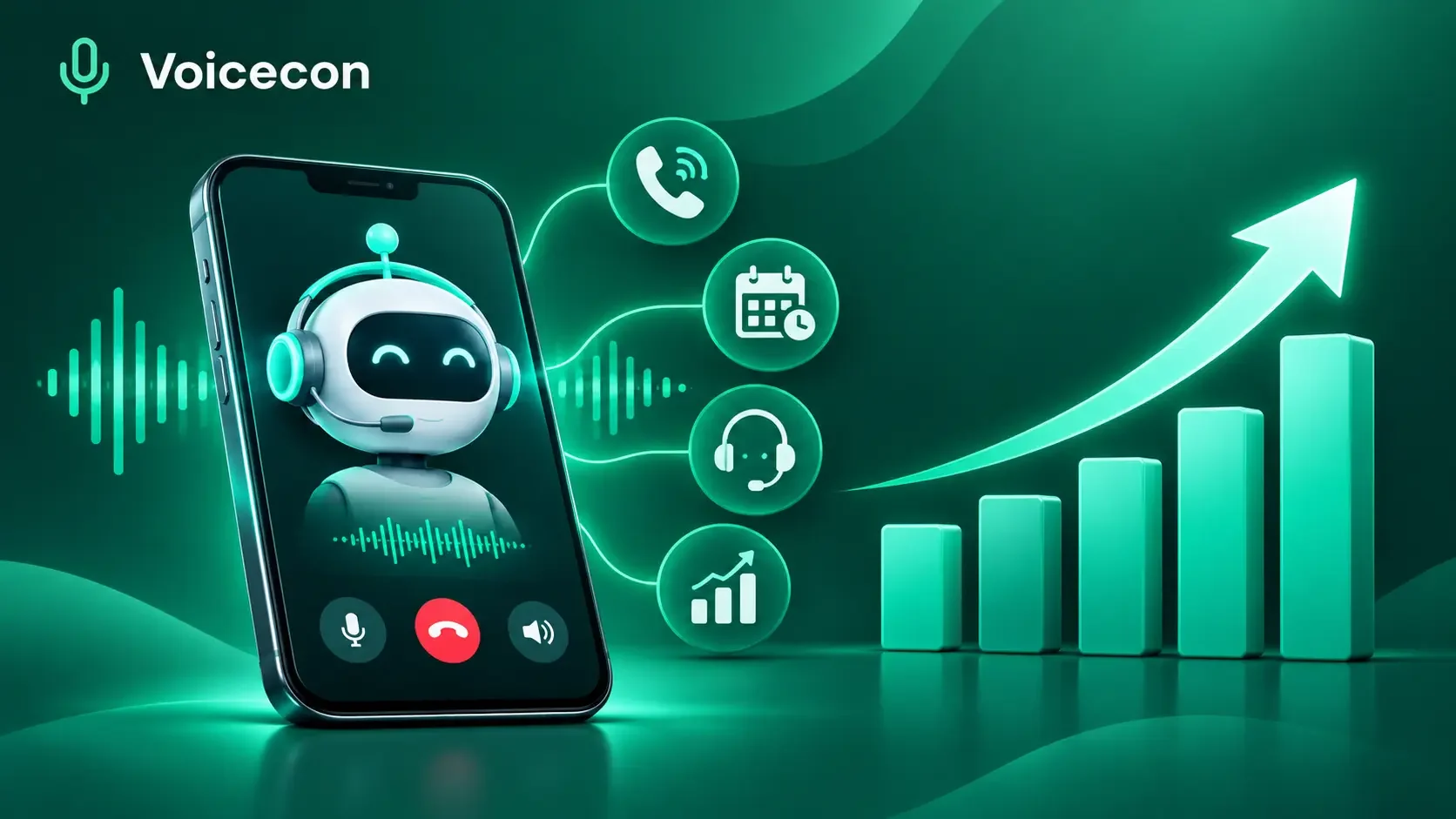
An AI voice bot can help businesses answer customer calls, manage enquiries, qualify leads, schedule appointments, and automate repetitive communication tasks without requiring an employee to handle every conversation manually. At Voicecon, we help businesses turn everyday phone conversations into productive interactions through intelligent AI voice agents that can understand callers, respond naturally, and take action using connected business tools.
For businesses in the United States, customer calls can represent valuable sales opportunities, service requests, appointment bookings, and potential long-term relationships. However, managing every incoming call while handling daily operations can be challenging. Missed calls, long waiting times, repetitive questions, and inconsistent follow-ups can affect the customer experience.
This is where AI voice automation becomes valuable.
Our Voicecon AI platform helps businesses create AI-powered voice agents that answer and make phone calls, access company information, interact with callers, and trigger automated workflows. Instead of simply providing automated responses, our agents can help move conversations toward meaningful business outcomes.
Let's explore how AI voice bots work, what businesses can accomplish with them, and how Voicecon can help you introduce intelligent voice automation into your operations.
What Is an AI Voice Bot?
An AI voice bot is a software-based conversational assistant that uses artificial intelligence to communicate with people through spoken language. It can listen to callers, understand their requests, generate relevant responses, and perform configured actions during or after a conversation.
Unlike traditional automated phone systems that primarily depend on predefined keypad selections, an AI voice bot can understand natural speech and respond according to the context of a conversation.
For example, imagine a customer calling an HVAC company to schedule an air conditioning repair.
Instead of navigating several menu options or waiting for a receptionist, the customer can explain the problem directly. The AI voice bot can ask relevant questions, collect contact information, understand the service requirement, and initiate the appropriate scheduling or follow-up workflow.
Depending on its configuration and connected tools, an AI voice bot can:
Answer incoming customer calls.
Respond to frequently asked questions.
Capture customer information.
Qualify potential sales leads.
Schedule appointments.
Route calls to the appropriate department.
Provide information using company documents.
Send messages and trigger follow-up workflows.
Record conversations and generate call summaries.
At Voicecon, we bring these capabilities together in a platform designed to help businesses automate conversations and connect them with their everyday operations.
How Does an AI Voice Bot Work?
An AI voice bot combines several technologies to understand spoken language and produce relevant responses. The complete process involves more than simply converting speech into text.
Understanding the underlying process helps businesses evaluate the technology and determine whether a solution can meet their operational requirements.
1. Speech Recognition and Understanding
When someone calls a business, the AI voice bot receives the caller's speech and uses automatic speech recognition technology to convert spoken words into information that the AI system can process.
This allows the system to identify what the customer is asking.
For example, a caller might say:
"I want to schedule an appointment for Friday afternoon."
The system needs to recognize the appointment request, identify the preferred day and time, and determine what information is still required.
Modern speech recognition systems can process natural conversations, although performance can vary depending on background noise, accents, pronunciation, and call quality.
2. AI-Powered Responses
After understanding the caller's request, the conversational AI model processes the available context and generates an appropriate response.
The response should consider:
The caller's original question.
Information shared earlier in the conversation.
The company's instructions and policies.
Information available in the knowledge base.
Tools and actions available to the agent.
For example, if a customer asks about business operating hours, the AI voice bot should use the company's approved information rather than generating an unsupported answer.
At Voicecon, businesses can provide their agents with relevant documents and information so conversations are based on their own business knowledge.
3. Natural Voice Generation
Once a response has been generated, text-to-speech technology converts it into spoken audio.
The quality of this stage influences how natural and comfortable the conversation feels.
An effective AI voice bot should also manage conversational timing, interruptions, and turn-taking. Customers should be able to interrupt or clarify their requests without having to restart the entire conversation.
Voicecon brings together real-time speech recognition, AI reasoning, and natural voice generation to support interactive phone conversations.
How an AI Voice Bot Helps Businesses Grow
An AI voice bot can support business growth by improving how companies manage customer communication and repetitive phone-related tasks.
Its value depends on the business's requirements, the quality of the agent's configuration, and the workflows connected to it.
Here are some important applications.
1. Answering Business Calls Around the Clock
Customers do not always call during regular business hours.
Someone might contact a company during the evening, over a weekend, or while employees are occupied with other responsibilities.
An appropriately configured AI voice bot can answer incoming calls outside normal working hours and collect the information needed for follow-up.
This can be especially useful for:
Home service companies.
Real estate businesses.
Healthcare appointment offices.
Professional service providers.
Retail businesses.
Customer support departments.
Instead of leaving every after-hours enquiry unanswered, businesses can establish an automated first point of contact.
2. Capturing and Qualifying Potential Leads
Generating enquiries is only one part of acquiring customers. Businesses also need to collect relevant information and determine which opportunities deserve immediate attention.
An AI voice bot can ask structured questions during conversations.
For example, a marketing agency could configure an agent to ask callers about:
Their company name.
The services they need.
Their approximate project requirements.
Their preferred contact time.
Their interest in scheduling a consultation.
The collected information can then be passed into an appropriate CRM or workflow.
This helps sales teams organize incoming enquiries and focus their attention on qualified opportunities.
3. Scheduling Appointments Automatically
Appointment management often involves repetitive conversations.
Customers call to ask about availability, request a suitable time, reschedule meetings, or confirm appointments.
An AI voice bot connected to a supported scheduling system can help automate these interactions.
For example, a dental office could configure its voice agent to:
Greet the caller.
Identify the requested appointment type.
Collect the customer's details.
Check available scheduling options through an integration.
Confirm an appointment when the connected system supports it.
Trigger a confirmation or follow-up message.
Voicecon supports appointment-related workflows and Google Calendar integration, helping businesses connect voice conversations with scheduling activities.
4. Improving Customer Support
Customer support teams often spend considerable time answering similar questions.
Examples include:
What are your operating hours?
Where is your business located?
What services do you provide?
How can I book an appointment?
What is your cancellation policy?
How can I speak with a representative?
An AI voice bot can handle configured routine enquiries using a business knowledge base.
More complicated situations should be transferred to an appropriate employee.
This creates a practical division of responsibilities: automation handles suitable routine interactions, while human employees focus on cases requiring judgment, empathy, or specialized assistance.
5. Reducing Repetitive Administrative Work
Phone conversations frequently create additional administrative responsibilities.
Employees may need to write notes, update customer records, notify colleagues, schedule follow-ups, or enter information into different applications.
An AI voice bot connected to workflow automation can help reduce these manual steps.
For example, after a customer enquiry, a workflow might:
Save the caller's information.
Generate a conversation summary.
Update a CRM record.
Notify a sales representative.
Add a follow-up task.
Send relevant information to a connected application.
The objective is not simply to automate speech. It is to reduce unnecessary work surrounding customer conversations.
Practical AI Voice Bot Use Cases Across Industries
Different industries have different communication requirements. An effective AI voice bot should be configured around the actual tasks customers need to complete.
Industry | Potential application |
Healthcare offices | Appointment enquiries, scheduling requests, and call routing |
Real estate | Property enquiries, lead qualification, and viewing requests |
Home services | Service requests, customer information, and appointment enquiries |
E-commerce | Order enquiries, delivery information, and customer support |
Financial services | General information and routing to appropriate representatives |
Marketing agencies | Lead qualification and consultation scheduling |
Education | Course enquiries, admissions information, and appointment requests |
Hospitality | Reservation enquiries and customer information |
These are illustrative applications. Businesses should configure and test their agents according to industry-specific requirements, privacy obligations, and operational policies.
AI Voice Bot vs. Traditional IVR vs. Human Receptionist
Businesses evaluating phone automation should understand the differences between available solutions.
Feature | Traditional IVR | AI Voice Bot | Human Receptionist |
Natural conversations | Limited | Yes, within configured capabilities | Yes |
Understands spoken requests | Limited or menu-dependent | Context-aware speech understanding | Yes |
Answers routine questions | Predefined responses | Knowledge-based responses | Yes |
Handles repetitive enquiries | Yes | Yes | Yes |
Appointment workflows | Usually menu or integration-dependent | Possible through integrations | Yes |
Handles complex judgment | No | Limited | Yes |
Personal interaction | Limited | Simulated conversational interaction | Human interaction |
Availability | Depends on system setup | Depends on deployment and service availability | Depends on staffing |
An AI voice bot is not necessarily a replacement for every human receptionist.
For many businesses, a combination of automated call handling and human escalation is more appropriate.
The right choice depends on call volume, customer expectations, complexity, budget, and the level of human assistance required.
What to Look for in AI Voice Bot Software
Not every AI voice bot provides the same functionality. Businesses should evaluate more than the quality of the generated voice when selecting a platform.
Here are the factors we recommend considering.
Natural and Responsive Conversations
The system should understand normal speech, maintain conversational context, and respond without making customers navigate unnecessary menus.
Test how it handles interruptions, clarification requests, and unexpected questions.
Business-Specific Knowledge
An AI voice bot should have access to accurate business information.
Look for a platform that allows you to provide relevant company documents, service descriptions, FAQs, and policies.
You should also be able to update this information when your business changes.
CRM and Software Integrations
Integrations are essential when your objective extends beyond answering calls.
Evaluate whether the platform can connect to the applications your employees already use.
Consider CRM updates, appointment scheduling, messaging, internal notifications, and workflow automation.
Human Call Transfers
An effective system needs clear escalation rules.
For example, a caller requesting a refund exception, reporting an urgent issue, or asking for a specialist may need to speak with an employee.
Make sure the system can transfer calls appropriately and provide useful context where supported.
Call Recordings and Analytics
Businesses should be able to evaluate how their agents perform.
Useful information includes:
Call duration.
Call recordings.
Conversation transcripts.
Customer intent.
Call outcomes.
Conversation summaries.
Agent performance trends.
Usage and cost information.
These insights help identify where an agent needs better instructions, additional knowledge, or improved workflows.
Transparent Pricing and Scalability
Before purchasing, understand the subscription price, included call minutes, additional usage charges, phone number costs, and concurrency limits.
A platform should fit your expected call volume and operational requirements rather than simply offering an attractive starting price.
How Voicecon Helps Businesses Automate Phone Calls
At Voicecon, we provide a platform that combines AI voice agents with no-code workflow automation.
Our goal is to help businesses move beyond basic automated answering and create useful conversations connected to their operational systems.
Here is how our platform supports that objective.
1. Create AI Voice Agents for Your Business
Businesses can create agents using ready-made templates or configure their own conversation instructions.
You can define how an agent greets callers, responds to enquiries, handles different situations, and determines when to transfer a conversation.
This gives businesses flexibility when creating agents for sales, customer support, appointment enquiries, and other communication requirements.
2. Give Your Agents Access to Business Information
Voicecon allows businesses to upload documents and information to a knowledge base.
Supported file formats include PDF, Word documents, spreadsheets, CSV, JSON, Markdown, and plain text.
This helps agents respond using business-specific information instead of relying entirely on general-purpose AI knowledge.
Businesses should keep these documents accurate, relevant, and updated.
3. Connect Conversations With Business Workflows
One of our important platform capabilities is connecting voice conversations with business automation.
Voicecon supports tools and workflows that can help agents:
Transfer calls.
Retrieve information.
Trigger automated processes.
Send information to connected applications.
Update business records.
Schedule follow-up activities.
Our integrations support connections with business applications such as HubSpot, Google Calendar, Slack, Gmail, Microsoft Teams, and other supported services.
This means your AI voice agent can become part of your existing business processes rather than operating as an isolated answering system.
4. Review Recordings, Transcripts, and Analytics
Automating calls is only the beginning. Businesses also need to understand whether their agents are delivering useful results.
Voicecon provides call recordings, transcripts, AI-generated summaries, sentiment information, and call analytics.
You can review conversations, identify recurring questions, examine call outcomes, and improve your agent's instructions.
For example, if customers repeatedly ask questions that an agent cannot answer, you can update its knowledge base or refine its conversation instructions.
5. Test Before Connecting Your Live Phone Number
We believe businesses should evaluate an AI voice bot before depending on it for customer communication.
Voicecon provides an agent testing panel that allows you to interact with your agent through your browser.
You can refine its instructions, test different scenarios, and evaluate the conversation before connecting a phone number.
Businesses can also use supported phone integrations to connect their agents to real calling workflows.
How to Implement an AI Voice Bot Successfully
Choosing the software is only one part of successful implementation.
Businesses should begin with a clearly defined purpose and gradually expand automation after evaluating performance.
Here is a practical implementation process.
Step 1: Identify your main call-handling problem.
Determine whether you want to answer missed calls, qualify leads, manage appointment enquiries, or automate routine customer support.
Start with one clearly defined objective.
Step 2: Prepare your business information.
Collect your FAQs, service details, operating hours, policies, pricing information, and other documents that the agent needs.
Make sure the information is accurate and approved for customer-facing use.
Step 3: Configure the conversation.
Define the greeting, questions, response guidelines, escalation conditions, and actions the agent is permitted to perform.
Avoid instructions that encourage the agent to guess when information is unavailable.
Step 4: Connect the necessary tools.
Configure relevant CRM, scheduling, messaging, and workflow integrations.
Test that the correct information is transferred and that automated actions occur as expected.
Step 5: Test realistic conversations.
Try normal enquiries, unclear requests, interruptions, difficult questions, and situations requiring human assistance.
Do not evaluate an agent only on how natural its voice sounds.
Step 6: Monitor and improve.
Review transcripts, recordings, failed workflows, and customer feedback.
Make adjustments based on actual performance rather than assumptions.
How to Measure AI Voice Bot Performance
Businesses should measure the operational and commercial outcomes of voice automation.
We recommend tracking the following metrics:
Metric | What it measures |
Call answer rate | Percentage of eligible incoming calls answered |
Task completion rate | Percentage of conversations achieving the intended outcome |
Appointment booking rate | Percentage of relevant enquiries resulting in bookings |
Lead qualification rate | Percentage of enquiries meeting defined qualification criteria |
Human transfer rate | Percentage of calls escalated to employees |
Abandonment rate | Percentage of callers who disconnect before completing the interaction |
Average call duration | Time spent on calls |
Cost per completed interaction | Operational cost associated with successful tasks |
One useful way to evaluate financial impact is to compare the cost of the AI voice bot with the measurable value of additional completed interactions.
For example, consider an illustrative business that previously failed to capture 20 relevant enquiries each month.
If improved call handling results in five additional qualified leads and two become paying customers, the business can calculate the revenue associated with those additional customers and compare it with the cost of its voice automation.
This is a measurement framework, not a promised Voicecon customer result.
Try Voicecon's AI Voice Bot Free for 7 Days
Finding the right AI voice bot is easier when you can test the actual conversations instead of relying on feature descriptions.
At Voicecon, we currently offer a 7-day free trial so businesses can explore our AI voice agents and evaluate their capabilities.
During the trial, you can:
Create an AI voice agent for your business.
Configure its instructions and conversational behavior.
Upload business information to its knowledge base.
Explore available agent and workflow templates.
Test conversations through the browser.
Evaluate how the agent responds to different customer enquiries.
Explore the platform before choosing a paid plan.
Our free trial is available without requiring a credit card, according to our current website offer. Trial limits and certain phone-number purchasing features may apply.
Whether you operate a small business, manage a sales department, or oversee customer support operations, Voicecon gives you an opportunity to explore how intelligent voice automation can fit into your existing processes.
Start your free 7-day Voicecon trial: https://voicecon.ai/
Build your first AI voice agent, test its conversations, and discover how automated phone interactions can support your business.
Frequently Asked Questions About AI Voice Bots
1. What is an AI voice bot used for?
An AI voice bot is used to automate spoken customer interactions. Businesses can use it to answer phone calls, respond to common questions, qualify leads, collect information, schedule appointments, route calls, and initiate automated workflows.
2. How does an AI voice bot understand customers?
An AI voice bot uses speech recognition to process spoken language and conversational AI to interpret the caller's request. It then generates an appropriate response using its instructions, conversation context, and available business information.
3. Can an AI voice bot answer business calls 24/7?
An AI voice bot can be configured to answer incoming calls around the clock, provided its phone number, deployment, and supporting services are available. Businesses should verify uptime, routing, and escalation arrangements with their provider.
4. Can an AI voice bot book appointments?
Yes. An AI voice bot can support appointment booking when connected to a compatible scheduling system and configured with the necessary permissions and workflows. Voicecon supports appointment-related automation and Google Calendar integration.
5. Is an AI voice bot better than a traditional IVR system?
An AI voice bot can provide more flexible conversational interactions because callers can explain their requests naturally. Traditional IVR systems remain useful for simple, predictable menu-based routing. The appropriate choice depends on the complexity of customer enquiries and the required functionality.
6. Can AI voice bots integrate with CRM systems?
Yes. Depending on the platform and integration, AI voice bots can capture customer details, update CRM records, trigger follow-up activities, and send conversation information to connected applications. Voicecon supports integrations with CRM and business workflow tools.
7. Are AI voice bots suitable for small businesses?
Yes. Small businesses can use AI voice bots to manage repetitive enquiries, capture leads, answer calls outside business hours, and support appointment-related workflows without hiring additional staff solely for routine phone handling.
8. How can I test an AI voice bot before purchasing?
The best approach is to use a free trial or demonstration that allows you to test realistic customer conversations. Evaluate speech recognition, response accuracy, interruptions, knowledge-based answers, call transfers, workflow execution, and overall costs.
Voicecon currently offers a 7-day free trial for businesses interested in evaluating its AI voice agents.
9. Can an AI voice bot replace a human receptionist?
An AI voice bot can automate many routine receptionist responsibilities, but it may not be suitable for every situation. Complex complaints, sensitive discussions, unusual requests, and decisions requiring human judgment should have an appropriate escalation path.
10. How much does an AI voice bot cost?
Pricing depends on the platform, subscription model, call duration, included minutes, integrations, phone numbers, and additional services. Businesses should compare the total expected monthly cost with the value of the tasks they intend to automate.
Conclusion
An AI voice bot can help businesses improve phone communication, capture enquiries, automate repetitive work, and connect customer conversations with essential business processes.
However, the real value of voice automation comes from what happens beyond the initial response.
Businesses need systems that understand customer requests, provide accurate information, perform appropriate actions, and involve human employees when necessary.
At Voicecon, we bring these capabilities together through AI voice agents, business knowledge bases, connected applications, and no-code workflows.
If you are exploring ways to improve your company's phone operations, our 7-day free trial provides an opportunity to test an AI voice agent and evaluate how it could support your business.
Get started with Voicecon today: https://voicecon.ai/
Keep reading
All articles → Guides
19 min read
Common Failure Points in AI Phone Agents: Problems, Causes, and How to Fix Them
Discover common failure points in AI phone agents, why they happen, and how Voicecon helps businesses build more reliable AI-powered phone experiences.
Azfar hussain Guides
15 min read
Best AI Agents for Insurance Agencies: 6 Solutions Worth Considering - 2027
Discover the best AI agents for insurance agencies. Compare AI voice agents, automate customer calls, qualify leads, schedule appointments, and explore Voicecon's free seven-day trial.
Azfar hussain Guides
19 min read
Conversational AI Tools: How to Choose the Right Solution for Your Business
How conversational AI tools help businesses automate calls, qualify leads, book appointments, and improve customer service. Try Voicecon free for 7 days.
Azfar hussain